Minga
/MEEN-gah/
Meaning
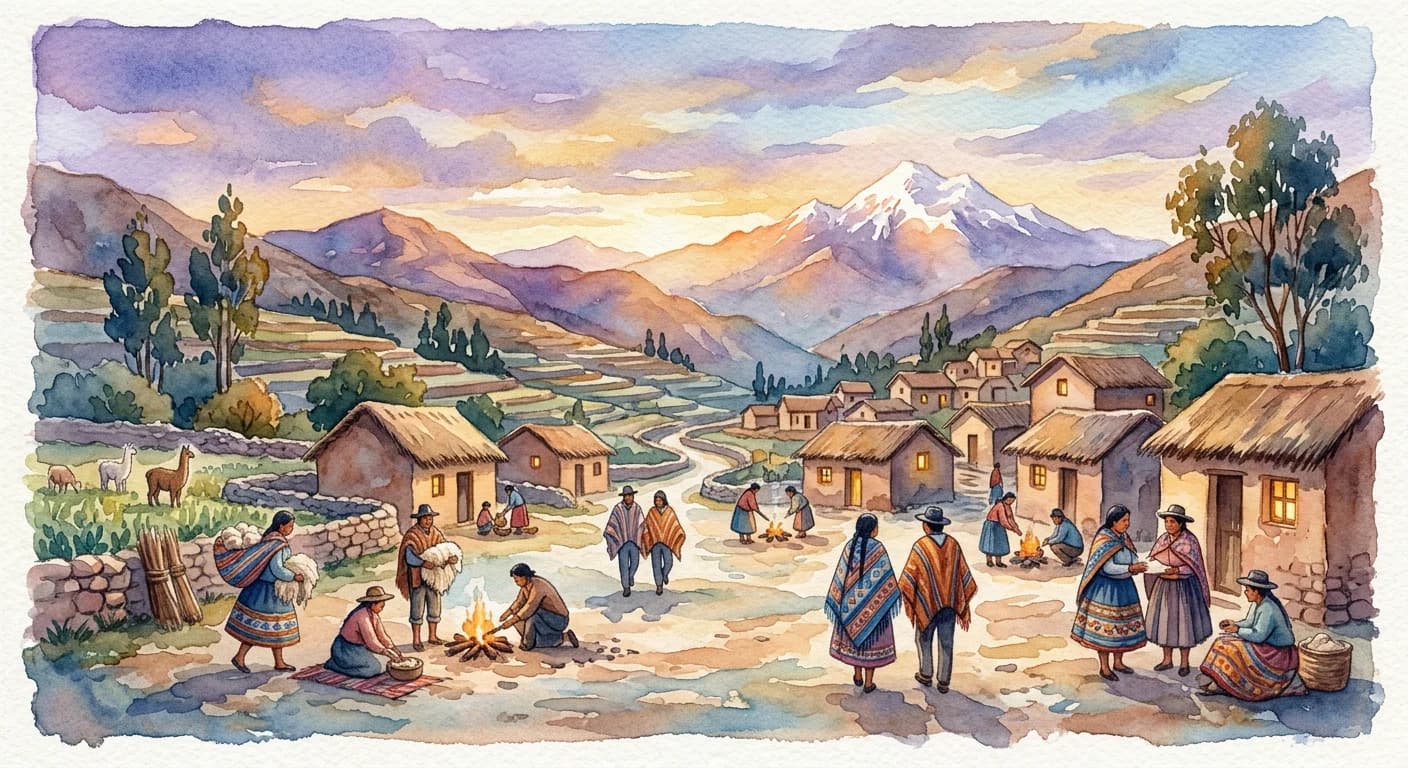
Minga is a vibrant, deeply ingrained communal practice, particularly in the Andean regions, where neighbors and community members spontaneously gather to assist one of their own with a significant, often arduous task. This could range from raising a new house, harvesting an entire field of potatoes, or repairing vital infrastructure. It's far more than just shared labor; it embodies profound solidarity, reciprocal support, and a collective responsibility that strengthens social bonds and ensures the well-being and resilience of the entire community.
Literal Translation
The Quechua word 'minga' doesn't have a direct single-word literal translation in English, but it relates to concepts of collective work or contribution.
The Story Behind the Word
The concept of Minga is rooted in the pre-Columbian agricultural societies of the Andes, particularly within the Inca Empire, where collective labor was fundamental to survival and prosperity. It reflects an Andean worldview of 'Ayni' (reciprocity) and 'Ayullu' (community/kinship), where the individual's well-being is intrinsically linked to the collective. This practice highlights a profound understanding that daunting tasks become manageable through unity, and that mutual aid is not just an act of charity, but a foundational pillar of social cohesion and continued existence. It reveals a culture that prioritizes the collective over the individual, understanding that sustained community effort is the key to overcoming challenges in a demanding environment.
Experience It
Harvesting the Fields
The sun beat down on Maria's potato field, a vast expanse she couldn't possibly harvest alone before the rains. Suddenly, a wave of familiar faces appeared over the ridge – neighbors, friends, and family, hoes and baskets in hand, ready for the 'minga'. Laughter and chatter filled the air as dozens of hands worked swiftly, transforming the impossible into a joyful collective effort.
Building a New Home
When old Don Pedro's adobe house collapsed after a storm, he despaired. But within days, the community organized a 'minga'. Men mixed mud, women carried stones, and children fetched water, all working in unison. By week's end, the walls of a new, sturdier home began to rise, built not just with bricks, but with shared effort and unwavering support.
The Deeper Meaning
Minga embodies a profound philosophy of 'Buen Vivir' or 'Sumak Kawsay' (Living Well), an indigenous Andean concept that emphasizes harmony with nature and community over individual accumulation. It suggests that true well-being is found not in isolation or competition, but in reciprocal relationships, collective effort, and a deep sense of belonging and shared responsibility for one another and the land.
Did You Know?
The spirit of Minga is so strong it has been adapted in modern contexts, with 'mingas' being organized for environmental clean-ups or community infrastructure projects in urban areas, demonstrating its enduring relevance.
How It's Used
The term 'minga' is used to describe the act of communal work or a gathering where people come together to help each other with a task.