Apthapi
/ahp-TAH-pee/
Meaning
Apthapi is far more than a simple potluck; it's a sacred communal meal where each participant contributes whatever sustenance they have, fostering an unbreakable bond of reciprocity and collective well-being. This tradition deeply embodies the Aymara spirit of 'ayni' (reciprocity) and 'minka' (communal work), ensuring that no one in the community goes hungry and reinforcing social ties with every shared bite. It's a vibrant expression of interdependence, a living testament to the Andean philosophy of shared responsibility and harmonious existence within the 'ayllu' (community).
Literal Translation
Sharing food (literally 'food to eat', but implying shared contribution)
The Story Behind the Word
The Apthapi is deeply rooted in the Andean cosmovision, reflecting the Aymara people's profound connection to Pachamama (Mother Earth) and the principle of 'suma qamaña' (living well or good living). It's not merely about eating, but about celebrating life, community, and the bounty of the land. Historically, it served as a vital social safety net, ensuring survival in harsh highland environments where individual resources could be scarce. This practice reinforces 'ayni,' a fundamental concept of reciprocal exchange, where helping one another is not just a duty but a natural flow of energy that maintains balance within the community and with the spiritual world. The act of sharing food openly reveals a worldview where collective prosperity is prioritized over individual accumulation, and where the strength of the community lies in its unity and mutual support.
Experience It
Harvest Festival Apthapi
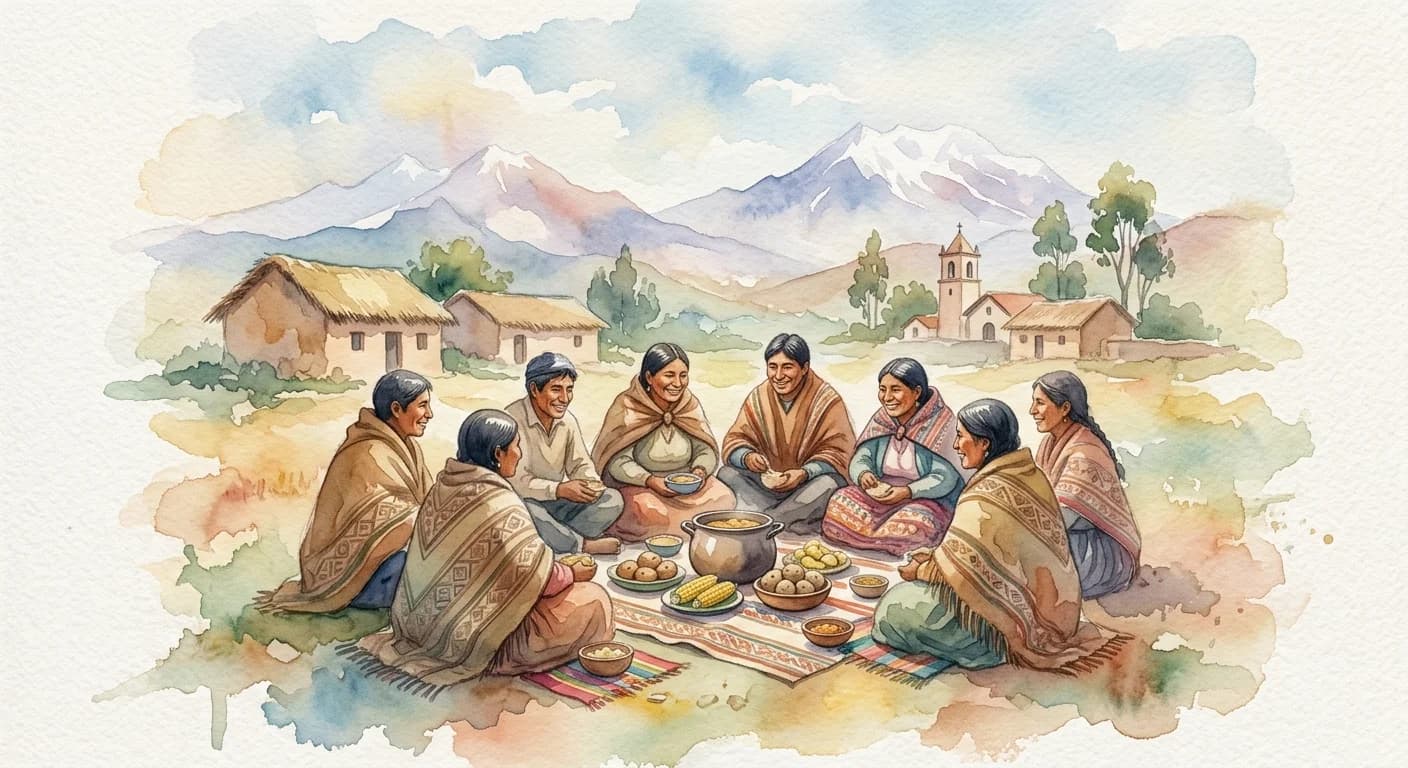
After a long day of communal harvest in the high fields, families gather. One brings potatoes, another quinoa, a third some charque (dried meat). They lay their contributions on a large aguayo (woven cloth), creating a vibrant mosaic of food, everyone eating from the shared bounty, their laughter echoing through the valley as the sun sets.
Community Meeting Apthapi
Following a lengthy discussion about village improvements, the community leader declares it's time for Apthapi. Women unwrap bundles of cheese, bread, and fruits, while men bring thermoses of hot api (purple corn drink). The formal meeting dissolves into a bustling, joyful feast, solidifying decisions and strengthening bonds over shared nourishment.
The Deeper Meaning
Apthapi encapsulates the Andean philosophy of 'suma qamaña' (good living), which emphasizes harmony with nature, community, and oneself, rather than material wealth. It illustrates 'ayni,' the principle of reciprocal exchange and collective responsibility, where well-being is achieved through mutual support and shared resources, reflecting a deep spiritual connection to the land and its people.
Did You Know?
Apthapi often involves eating directly from a large communal cloth spread on the ground, symbolizing direct connection to Pachamama and the shared source of sustenance.
How It's Used
This term is used to describe a specific type of communal meal or gathering where food is shared among participants, often in rural or indigenous Aymara communities.