Halqa
/HAL-kah/
Meaning
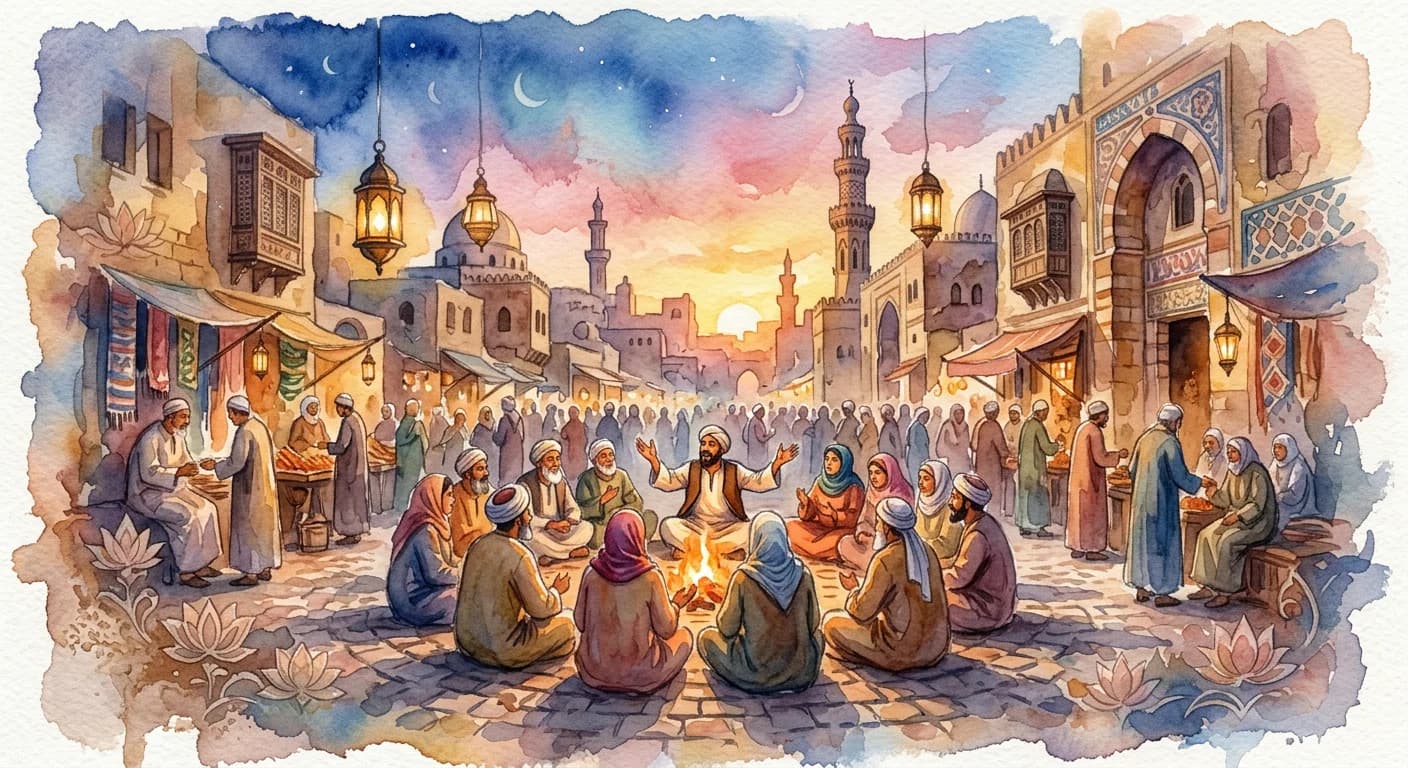
A 'Halqa' is far more than just a circle; it is a vibrant, spontaneous public arena where oral traditions come alive. It describes a traditional gathering, often in a bustling town square or marketplace, where storytellers, musicians, poets, or performers captivate an audience arranged in a circular formation. This immersive, communal art form fosters deep connection and collective participation, embodying the enduring spirit of shared cultural heritage and spontaneous community engagement that transcends mere entertainment.
Literal Translation
Circle / Ring
The Story Behind the Word
The 'Halqa' tradition is deeply rooted in the oral cultures of the Middle East and North Africa, serving as a primary conduit for entertainment, education, and the transmission of history and folklore long before mass media. Its existence reflects a societal value placed on communal experience, direct human interaction, and the power of the spoken word. It reveals a world where knowledge, wisdom, and entertainment were not consumed in isolation but shared in a collective embrace. The circular formation itself is symbolic, emphasizing equality among participants and fostering a sense of unity between performer and audience, blurring the lines between them. It's a testament to the enduring power of human connection and narrative in shaping cultural identity.
Experience It
Marketplace Storyteller
In the bustling Khan el-Khalili market, a crowd naturally gathers around an old man with a mesmerizing voice. As he weaves tales of ancient pharaohs and cunning tricksters, people lean in, forming a tight 'Halqa', their faces illuminated by the flickering gas lamps, lost in his narrative.
Musicians' Spontaneous Jam
A group of street musicians begins playing soulful melodies in a public square. Passersby stop, drawn by the rhythm, and soon a respectful 'Halqa' forms around them, some tapping their feet, others swaying, all sharing in the spontaneous joy of the music.
The Deeper Meaning
The 'Halqa' embodies a philosophy of shared human experience and the inherent value of collective memory. It suggests that knowledge and joy are best amplified through communal engagement, challenging the individualistic consumption of art. It underscores the belief that a community's identity is continuously forged and reinforced through the shared act of listening, learning, and participating in its living traditions.
Did You Know?
The famous Jemaa el-Fna square in Marrakech, Morocco, is globally renowned as a living museum of 'Halqa' traditions, featuring storytellers, snake charmers, and musicians daily.
How It's Used
Used to describe a traditional public gathering or performance, especially storytelling or musical performances, that takes place in a circular formation. It's common in public spaces like squares or marketplaces.