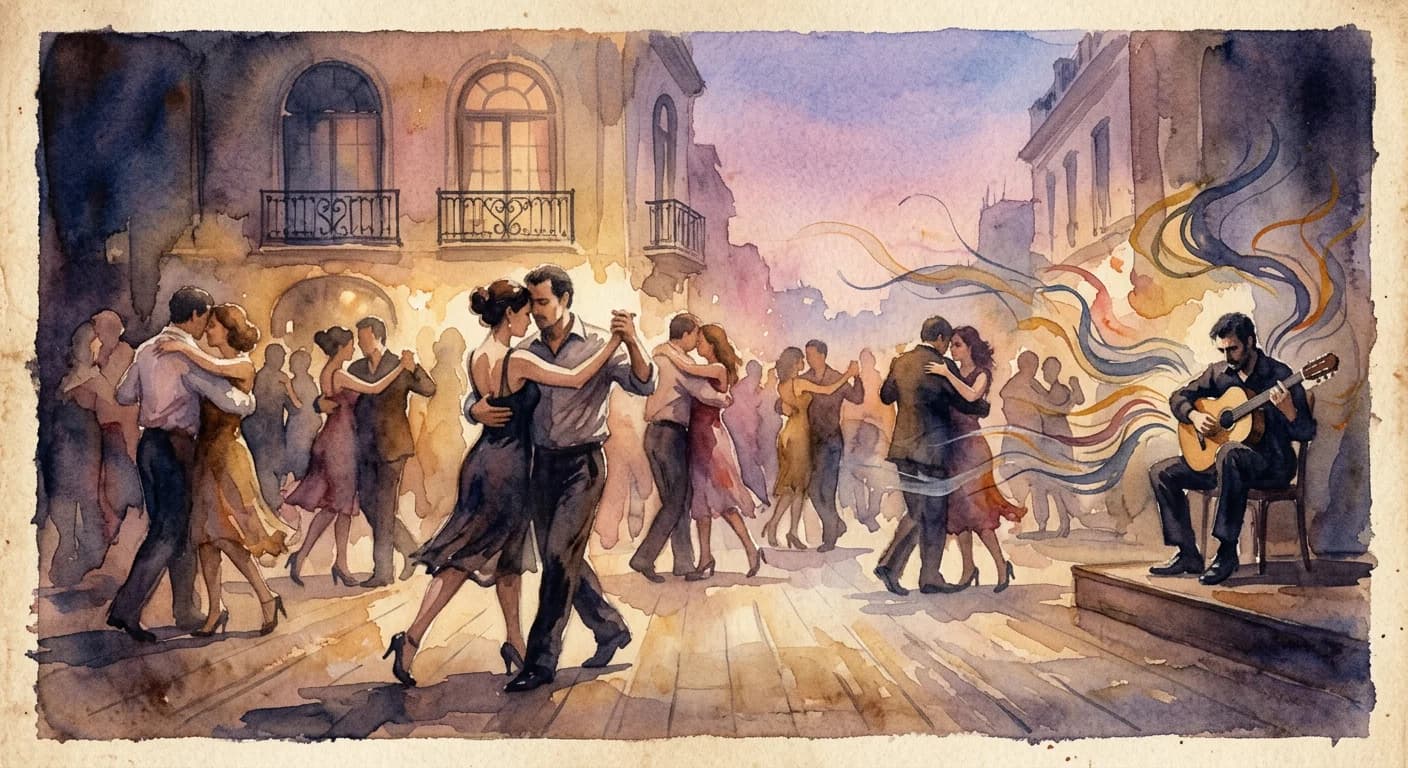
Milonga
/mee-LONG-gah/
Meaning
Milonga is far more than just a dance hall; it's the vibrant, pulsating heart of tango culture, a hallowed social ritual where music, movement, and emotion converge. It encompasses the entire experience: the live orchestra's melancholic strains, the intricate dance floor etiquette, and the palpable sense of community. Within its embrace, dancers connect through the passionate language of tango, weaving together a tapestry of shared nostalgia, present-day camaraderie, and an unspoken understanding deeply rooted in the River Plate identity.
Literal Translation
The word 'milonga' itself doesn't have a direct literal meaning in Spanish that fully captures its cultural significance; it's more of a cultural term that evolved.
The Story Behind the Word
The term 'milonga' itself has roots in the Kimbundu word 'mulonga,' meaning 'word,' 'dispute,' or 'problem,' which evolved through Afro-Uruguayan and Afro-Argentine communities to describe informal musical gatherings and a specific musical genre that predates tango. As tango emerged in the late 19th century from the melting pot of Buenos Aires and Montevideo, the 'milonga' became the natural social space for its development and expression. It reflects a cultural emphasis on community, shared experience, and an almost ritualistic dedication to an art form that encapsulates the region's complex history – a blend of European immigration, African rhythms, and indigenous influences. The milonga reveals a society that values deep, non-verbal communication, social codes, and the enduring power of music and dance to forge identity and belonging, often in the face of melancholy or hardship.
Experience It
First Milonga Experience
A young traveler, curious about Buenos Aires nightlife, steps into a dimly lit salon. The air is thick with the scent of perfume and the soulful strains of a bandoneón. Observing the intricate dance of invitations and the fluid grace of the couples, she feels an immediate pull, sensing a community where stories are told without words.
Regular's Evening Ritual
For an elderly couple, Tuesday night at the local milonga is sacred. They greet familiar faces with warm embraces, find their usual table, and wait for their favorite tanda. As they glide across the floor, their bodies move with decades of shared history, each step a testament to their enduring connection and the dance's timeless allure.
The Deeper Meaning
Milonga embodies a philosophy of connection and presence. It's a space where the past (through traditional music and steps) meets the present (in the improvised embrace), fostering a profound sense of 'here and now.' This ritualistic gathering underscores the human need for shared rhythm, emotional expression, and belonging, suggesting that true connection often transcends verbal communication and finds its deepest expression in shared experience and embodied art.
Did You Know?
Before it referred to a dance event, 'milonga' was a distinct musical genre, a faster, more rustic precursor to tango, often improvised and sung by gauchos and working-class people.
How It's Used
Used to refer to a place where tango is danced, or a tango music genre.