Murga
/MUR-gah/
Meaning
Murga is a pulsating, satirical musical folk art form that erupts during Carnival in Argentina and Uruguay, particularly in Buenos Aires and Montevideo. Far more than mere entertainment, it's a collective, boisterous expression of social critique, humor, and communal identity, performed by groups of musicians and dancers. Its distinctive sound, characterized by brass, percussion, and powerful vocalizations, embodies the democratic spirit of Carnival, serving as a vibrant voice for the people to address everyday life and political issues with sharp wit and infectious energy.
Literal Translation
The etymology is debated, but it's believed to derive from the Arabic 'murju', meaning a type of musical performance, or possibly from the Spanish 'murguía', meaning a boisterous, informal gathering.
The Story Behind the Word
Murga's roots are complex, drawing from European Carnival traditions, African rhythms brought by enslaved people, and local creole adaptations. It emerged in the late 19th and early 20th centuries as a voice for working-class neighborhoods, allowing for public critique and catharsis in societies often marked by political repression and social inequality. The very existence of murga speaks to a cultural need for collective expression, a space where humor and music can dismantle power structures, even temporarily. It reflects a belief in the power of popular art to foster community, preserve collective memory, and challenge the status quo, embodying a spirit of resilient joy and defiant creativity in the face of adversity. Murga is a living testament to the idea that celebration and protest are not mutually exclusive but deeply intertwined.
Experience It
Carnival Night Parade
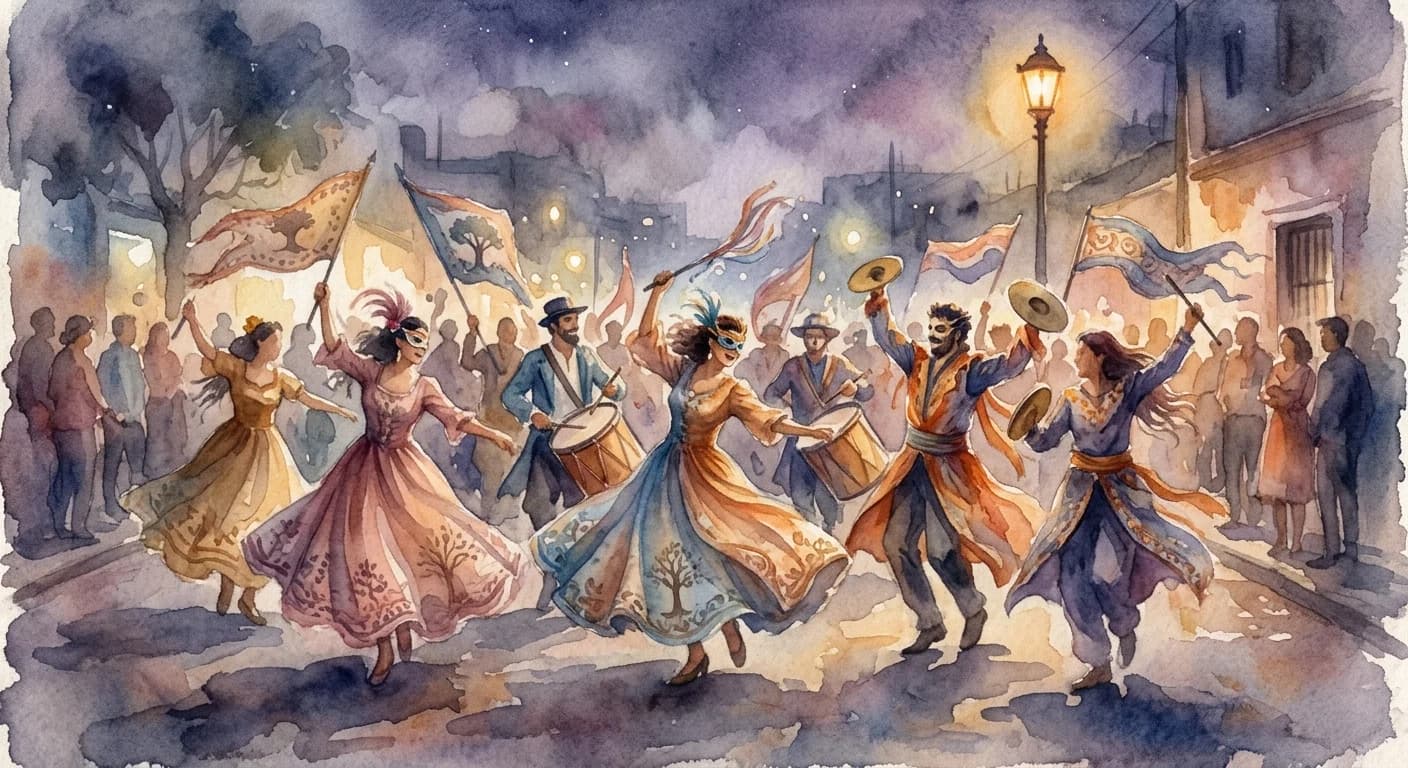
The air crackled with anticipation as the murga, 'Los Elegantes del Ritmo,' marched down the street. Their vibrant costumes shimmered under the streetlights, and the booming bass drum, insistent cymbals, and piercing trumpets created a wall of sound that vibrated through the onlookers' chests. Their satirical lyrics, sung with passionate gusto, lampooned the latest political scandal, drawing cheers and knowing laughter from the crowd, who felt their own frustrations mirrored and amplified.
Neighborhood Celebration
At a local community festival, a murga performance brought everyone to their feet. Children mimicked the dancers' elaborate steps, while elders tapped their feet to the infectious rhythm. The group's performance wasn't just entertainment; it was a unifying force, reminding everyone of their shared cultural heritage and the enduring power of collective joy and social commentary woven into the fabric of their neighborhood life.
The Deeper Meaning
Murga encapsulates a philosophy where art is inherently democratic and communal, not just for aesthetic pleasure but as a vital tool for social discourse and collective identity. It asserts that humor and celebration can be powerful forms of resistance and critique, fostering a sense of shared purpose and resilience among ordinary people. It embodies the idea that true freedom includes the freedom to mock power and to celebrate life, loudly and together.
Did You Know?
Some murga groups famously practice year-round, not just for Carnival, refining their music, choreography, and especially their satirical lyrics to ensure their social commentary is as sharp and current as possible.
How It's Used
Used to refer to the musical/theatrical groups that perform during Carnival, as well as the musical style itself. Murga performances are a central part of public celebrations, especially in Buenos Aires and Montevideo.