Zócalo
/THO-kah-lo/
Meaning
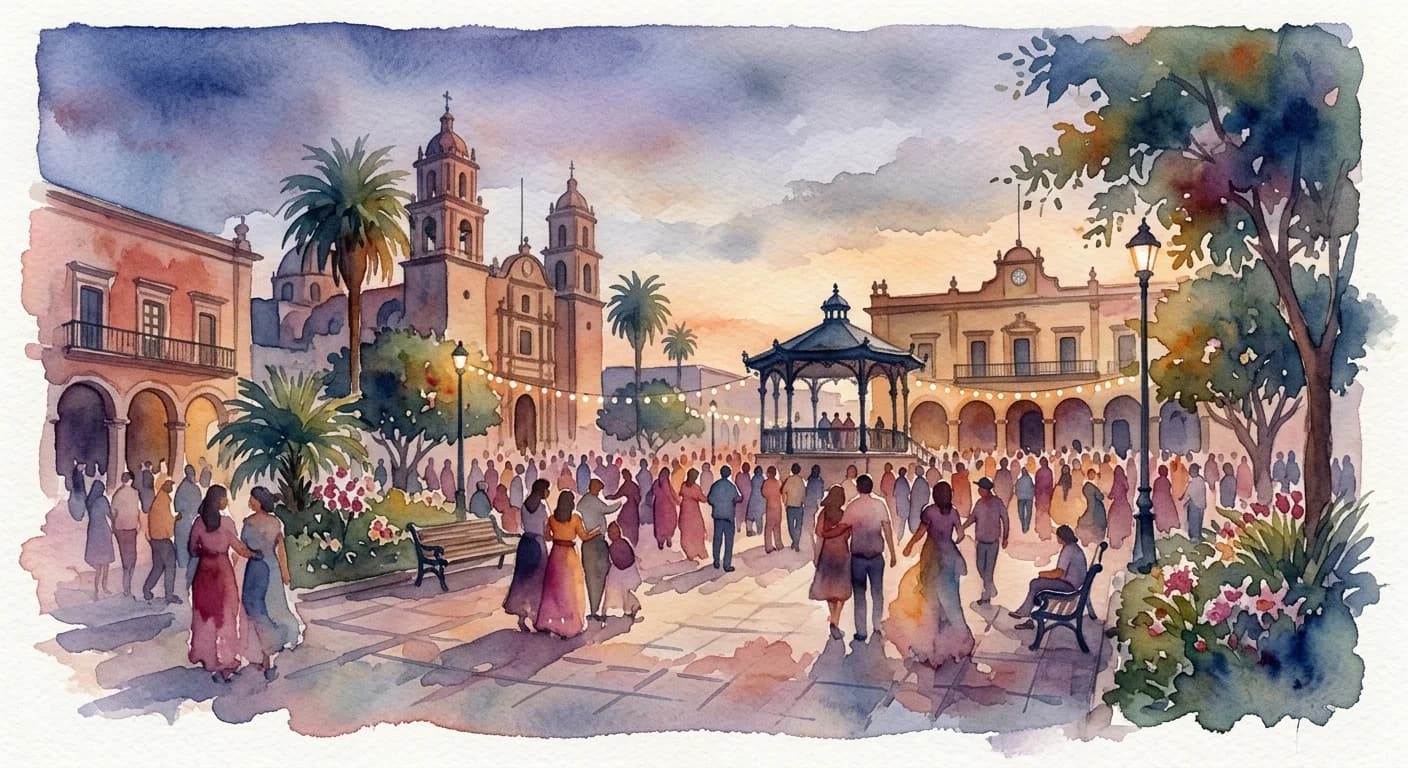
The Zócalo, especially in Mexico City, transcends its literal meaning of 'pedestal' to denote the vibrant, beating heart of urban Mexican life. It is the quintessential main public square, a crucible where daily life, historical memory, and national identity coalesce. From bustling markets and impromptu performances to impassioned political rallies and solemn civic ceremonies, it is a dynamic stage where the city's collective spirit is not just observed, but actively lived and constantly renewed, often framed by magnificent colonial architecture.
Literal Translation
base, pedestal, plinth
The Story Behind the Word
The Zócalo's significance in Mexico is deeply rooted in both pre-Hispanic and colonial urban planning. Indigenous civilizations, like the Aztecs, centered their cities around a main ceremonial precinct (such as Tenochtitlan's Templo Mayor area), a practice the Spanish conquistadors mirrored and adapted. They strategically built their main plazas atop these indigenous centers, symbolizing a new order while retaining the concept of a central communal space. This continuous tradition has cemented the Zócalo as the enduring nucleus of public life, a place where the past and present constantly interact. It is where national narratives are performed, from Independence Day celebrations to protests, revealing a culture that values public assembly, collective memory, and the physical manifestation of civic identity. The very name 'Zócalo' for the main plaza of Mexico City originated from an uncompleted monument's base, which became the de facto meeting point, and the name stuck, spreading to other Mexican cities.
Experience It
Fiesta in the Square
During the Día de la Independencia celebrations, families flocked to the Zócalo. Children chased pigeons while street vendors hawked balloons and antojitos, all awaiting the President's 'Grito' from the Palacio Nacional balcony overlooking the square, uniting thousands in a chorus of '¡Viva México!'.
Daily Commute
Marta hurried across the Zócalo on her way to work, navigating through a morning market setting up, past a group of indigenous dancers performing for tourists, and around students staging a small protest. The square was, as always, a microcosm of Mexico City's relentless energy and diverse daily rhythms.
What Gets Lost in Translation
English speakers might simply translate 'Zócalo' as 'main square' or 'town square,' missing its profound cultural and historical weight in Mexico. It's not just any square; it's *the* Zócalo, a specific, highly symbolic locus of national identity, historical events, and ongoing civic life. The term is also primarily used in Mexico; in Spain, a 'zócalo' still typically refers to a pedestal.
Across Cultures
While 'plaza mayor' is a more general Spanish term, 'Zócalo' carries a uniquely Mexican resonance for the main square. Similar central gathering spaces exist globally: the 'agora' in ancient Greece, the 'forum' in ancient Rome, or the 'piazza' in Italy. In many European cities, the 'Marktplatz' (Germany) or 'Grand-Place' (Belgium) serve comparable functions as historical, commercial, and social hubs, reflecting a universal human need for communal urban centers.
The Deeper Meaning
The Zócalo embodies the Mexican philosophy of collective life and public space. It represents the idea that a city's heart is not just its administrative center, but a dynamic, democratic arena where history is remembered, dissent is voiced, and community is forged. It reflects a worldview where individual existence is deeply intertwined with the shared public sphere, making the city itself a living organism with a pulsing core.
Did You Know?
The term 'Zócalo' for a city's main square actually comes from an uncompleted monument's pedestal that was meant for Mexico City's central plaza in the 19th century. The pedestal was all that was built, but it became such a popular meeting point that the name stuck and eventually became synonymous with the central plaza itself!
How It's Used
Used to refer to the main central plaza of a city in Mexico. It is also used in Spain for the base or pedestal of a statue, but its iconic usage is primarily Mexican.