Bajareque
/bah-hah-REH-keh/
Meaning
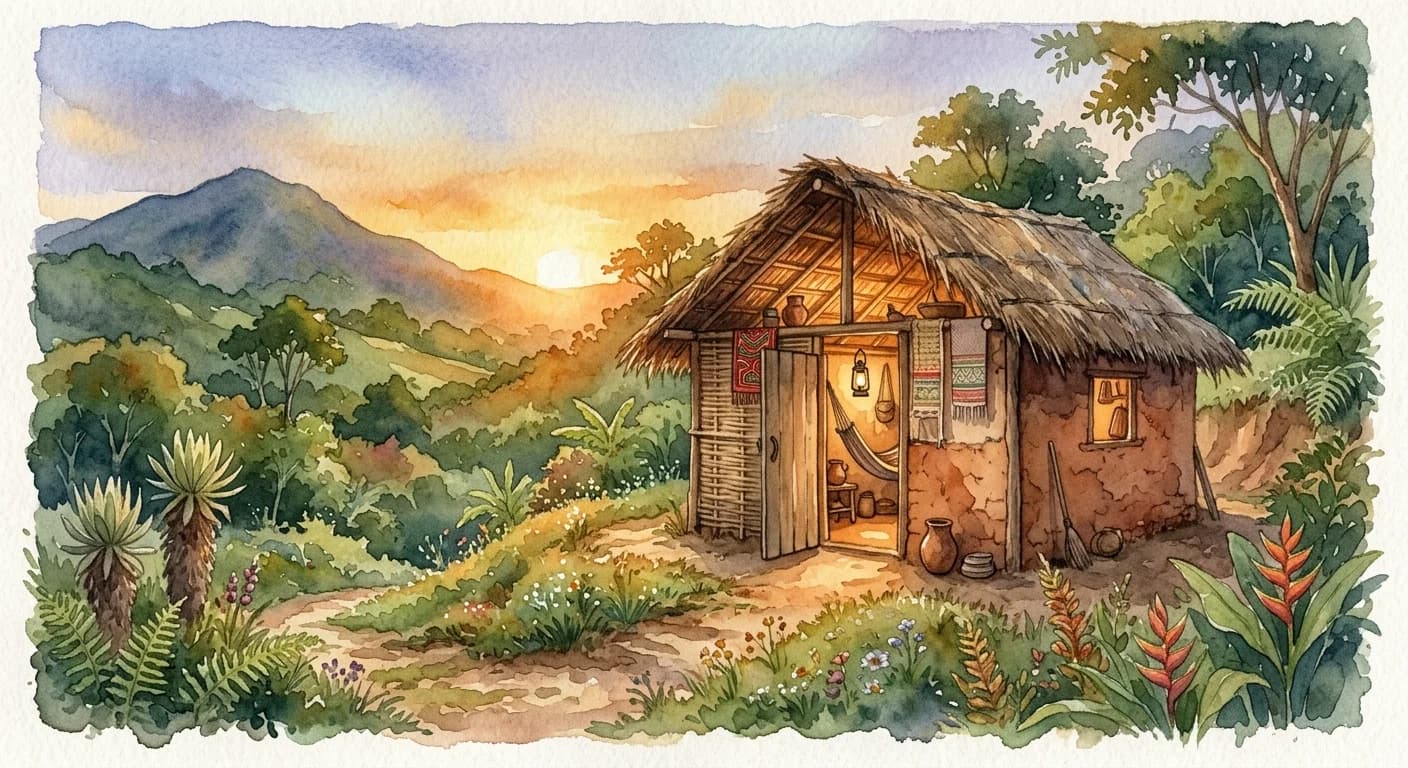
Bajareque refers to a venerable construction method, predominantly found in the rural heartlands of Latin America, where walls are meticulously crafted from a interwoven lattice of wood or cane, then plastered with a rich mixture of mud, clay, and other natural fibers. This ingenious technique yields structures that are not only remarkably sturdy and earthquake-resistant but also inherently breathable and well-adapted to diverse climates. It embodies a profound connection to the earth, showcasing a sustainable architectural philosophy that harmonizes human dwelling with the environment through resourceful utilization of readily available, local materials.
Literal Translation
The origin is debated, but it's theorized to come from the Nahuatl word 'pāxcalli' (a type of adobe or mud wall) or possibly from the Spanish 'baja' (low) and 'reque' (a type of reed), referring to materials used in its construction. However, its current usage is firmly rooted in Spanish.
The Story Behind the Word
The existence of 'bajareque' as a distinct term reveals a deep-seated cultural appreciation for resourcefulness, sustainability, and an intimate connection to the land in Latin American societies. It's more than just a building technique; it represents a way of life where communities traditionally coexisted with their environment, using what nature provided to create shelter. This method, passed down through generations, often signifies community effort in construction, reflecting a collective spirit of building and belonging. It speaks to a worldview that values durability, practicality, and harmony with natural cycles over imported, often less suitable, modern materials. The term itself carries the echoes of ancestral knowledge, embodying resilience and adaptability in the face of environmental challenges.
Experience It
Grandma's Bajareque Home
Returning to the family farm, Ana felt a wave of nostalgia as she saw her grandmother's house, its bajareque walls still standing strong after decades. The cool, earthy scent emanating from the mud-and-cane structure brought back memories of childhood summers spent in its comforting embrace, a testament to its enduring design.
Building a Community Center
In the remote village, the elders decided to construct the new community center using bajareque, rallying everyone to gather materials from the nearby forest and riverbed. The communal effort of weaving the cane and applying the mud plaster fostered a strong sense of unity, building not just a structure, but also strengthening their shared heritage.
The Deeper Meaning
Bajareque embodies a philosophy of 'living with the land,' where human ingenuity adapts to local resources rather than imposing external solutions. It reflects a worldview that values sustainability, community cooperation, and a deep respect for the environment, seeing natural materials not as primitive, but as perfect for creating resilient and harmonious dwellings.
Did You Know?
Despite its ancient origins, bajareque construction is surprisingly earthquake-resistant due to its flexible, lightweight structure, making it a viable and sustainable option in seismically active regions.
How It's Used
Used to describe a specific type of traditional construction material and method, or the resulting building itself. It is commonly found in rural or older architectural contexts.