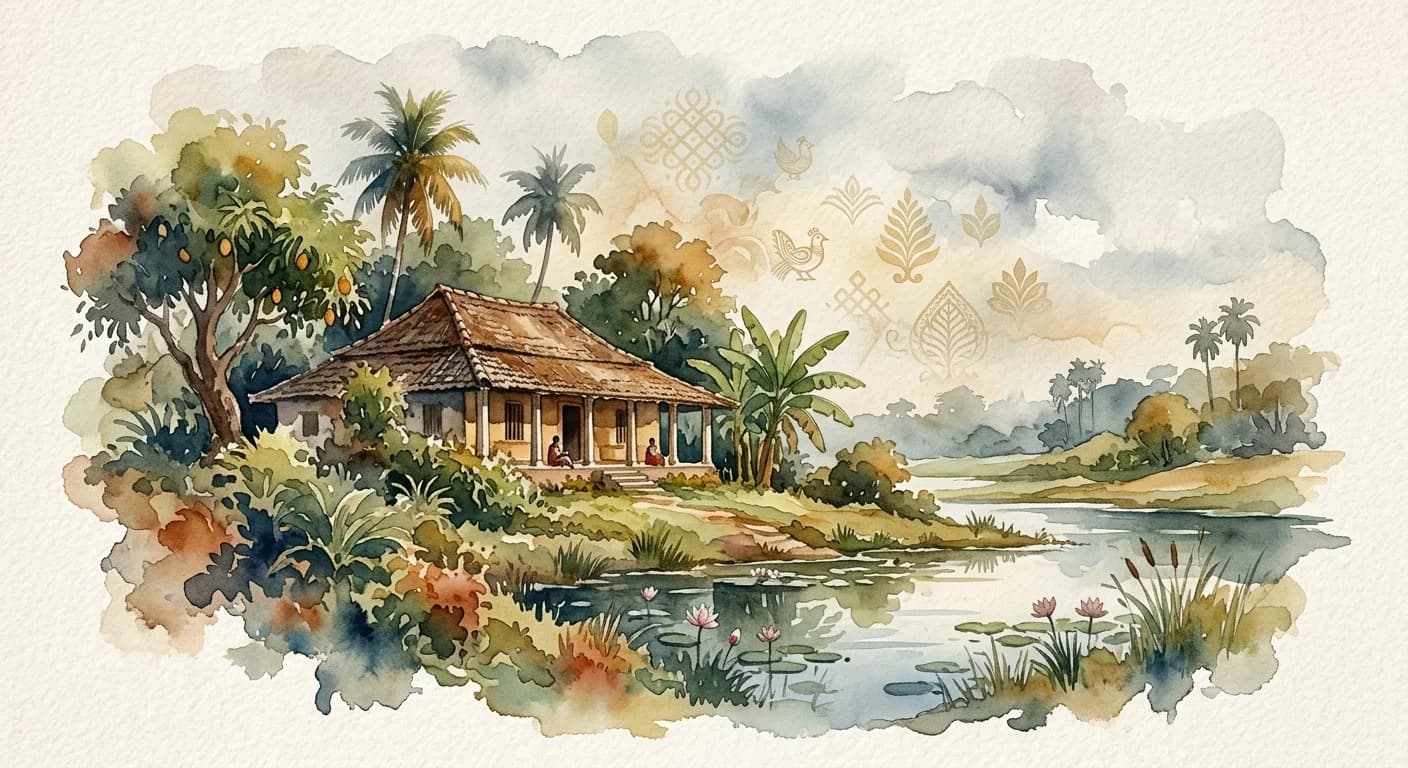
Maha Gedar
/MAH-hah GEH-dar/
Meaning
Maha Gedar transcends the simple notion of a house; it is the sacred hearth of a Sinhala lineage, the ancestral abode that has witnessed generations unfold. This 'Great House' is not merely a physical structure but the living repository of collective memory, traditions, and the enduring spirit of a family, embodying a profound sense of belonging and heritage. It serves as an unshakeable anchor, a place of refuge where family history is etched into its very foundations, and where the past continuously informs the present and future. More than a gathering point, it is the beating heart of familial identity and cultural continuity.
Literal Translation
Great House
The Story Behind the Word
The existence of 'Maha Gedar' in Sinhala culture is deeply rooted in an agrarian, collectivist society where lineage and intergenerational continuity are paramount. It reflects a worldview where individual identity is inextricably linked to family history and ancestral heritage. The Maha Gedar serves as a tangible link to one's roots, a physical manifestation of the family tree, and a place where cultural values, rituals, and stories are passed down. It embodies the reverence for elders and ancestors, acting as a spiritual and social anchor that prevents familial dispersion and upholds traditional structures, emphasizing stability and belonging over individualistic pursuits.
Experience It
Annual New Year Gathering
During the Sinhala and Tamil New Year, all the scattered relatives, from bustling cities and distant villages, converge upon the Maha Gedar. The air is thick with laughter, the aroma of kiribath and kokis, as cousins who haven't seen each other all year reunite, sharing stories and rekindling bonds under the watchful gaze of ancestral portraits.
A Difficult Decision
When a complex family dispute arose regarding a land inheritance, everyone naturally turned to the matriarch, living in the Maha Gedar. Her wisdom, rooted in generations of family history witnessed within those very walls, guided them, and her pronouncement from the Maha Gedar carried an undeniable authority, ensuring peace and continuity.
What Gets Lost in Translation
English speakers might mistake 'Maha Gedar' for simply 'the family home' or 'ancestral house,' missing the profound spiritual and social weight it carries. It's not just where one's parents live, but the foundational home from which all other family branches sprung, often implying a hierarchical respect for the eldest living family member and the traditions preserved there. The concept extends beyond mere ownership to a deep, almost mystical connection to the land and the ancestors who lived within its walls.
Across Cultures
Similar concepts exist across various cultures, though rarely with the same precise linguistic weight. Japan's 'honke' (本家) refers to the main family line or house, distinct from branch families ('bunke'). The 'family seat' in European aristocracy, or the 'homestead' in some American contexts, hint at this, but often lack the pervasive, deeply spiritual connection to ancestral presence. Many indigenous cultures have words for ancestral lands or sacred gathering places that resonate with Maha Gedar's spirit.
The Deeper Meaning
The concept of Maha Gedar reveals a profound Sinhala philosophical insight: that identity is not solely individual but deeply communal and historical. It underscores the belief in the enduring presence of ancestors, the importance of continuity, and the idea that one's life is part of a larger, intergenerational narrative. It embodies the wisdom that true stability and belonging are found not just in material possessions, but in the unbroken chain of heritage and the sacred space that nurtures it across time.
Did You Know?
Often, even if a family member builds their own new house, the 'Maha Gedar' retains its symbolic supremacy. Important family decisions, weddings, or funerals might still be initiated or centered there, regardless of where the current 'head' of the family physically resides.
How It's Used
Used to refer to the main family home, ancestral house, or the house of the eldest member of a family, particularly in rural or traditional contexts.