Chakana
/CHAH-kah-nah/
Meaning
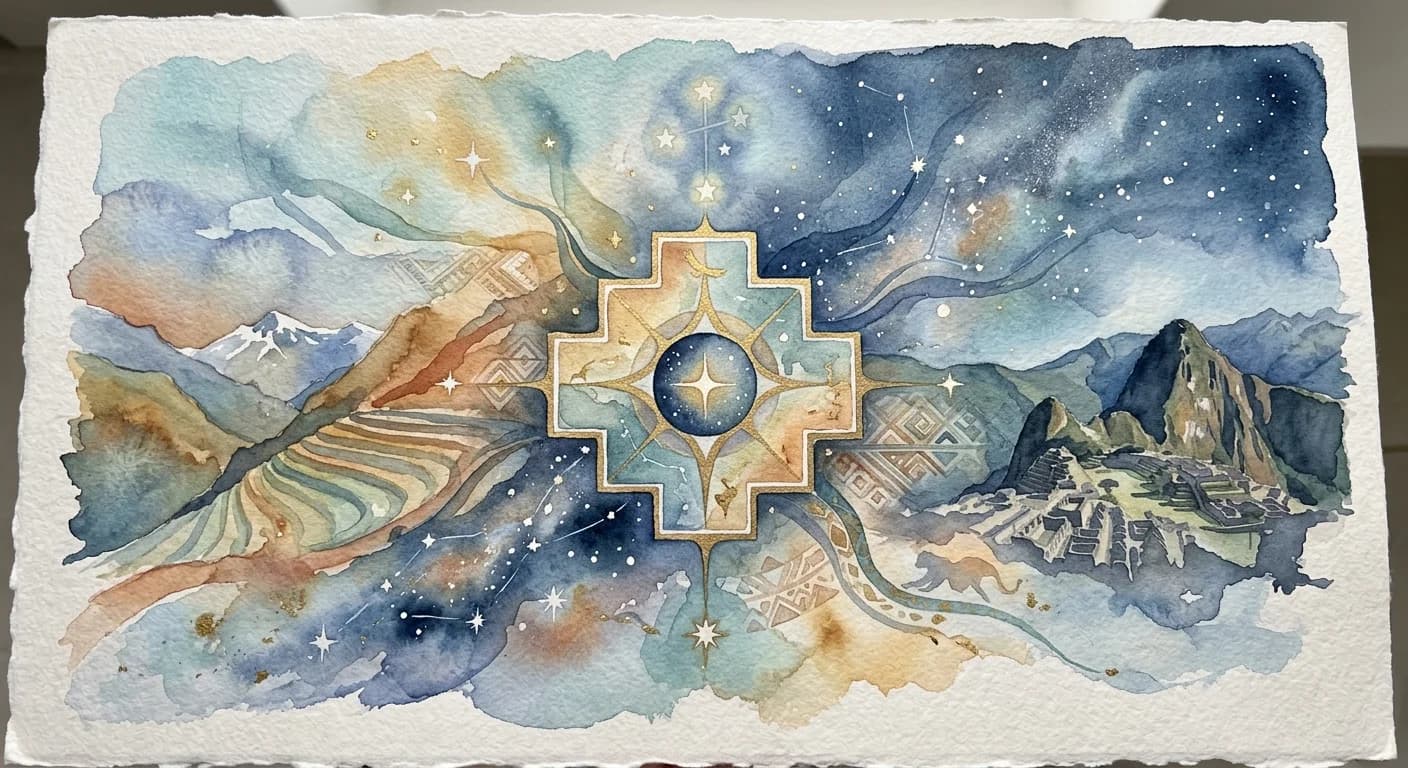
The Chakana, or 'Andean cross', is a profound Quechua symbol embodying the cosmic order and the harmonious interaction of the three worlds: Hanan Pacha (celestial), Kay Pacha (earthly), and Uku Pacha (subterranean). More than a mere geometric design, it represents a holistic worldview of balance (Ayni), reciprocity, and the continuous cycle of existence, death, and rebirth. Its stepped form mirrors mountain terraces and the Southern Cross constellation, serving as a spiritual blueprint for understanding the universe and humanity's place within it.
Literal Translation
Stair
The Story Behind the Word
The Chakana is central to Andean cosmology, predating the Inca Empire and appearing in ancient Tiwanaku and Wari cultures. It reflects the deep reverence for Pachamama (Mother Earth) and the Apus (mountain spirits), crucial elements in Andean spiritual life. Its existence reveals a worldview where everything is interconnected and interdependent, emphasizing the concept of Ayni – reciprocal exchange and balance – in all aspects of life, from farming to social relations. The Chakana serves as a mnemonic for remembering complex astronomical observations, agricultural cycles, and ethical principles, demonstrating a sophisticated understanding of the natural world and a philosophy of living in harmony with it. It represents a spiritual ladder, allowing passage between the different realms of existence, and a guide for moral conduct and spiritual growth.
Experience It
Ceremonial Offering
During an Inti Raymi ceremony, an elder places coca leaves and chicha on an altar adorned with a carved Chakana. He speaks of connecting the Hanan Pacha with Kay Pacha, asking the sun god Inti to bless the harvest, guided by the ancient symbol of cosmic balance.
Textile Weaving Wisdom
A young woman in a high Andean village meticulously weaves a vibrant textile, incorporating the Chakana pattern. Her grandmother watches, explaining that each step and corner of the symbol tells a story of their ancestors, the mountains, and the cyclical journey of life and death, teaching her about their heritage and connection to the cosmos.
Pilgrimage to Sacred Sites
A group of spiritual seekers embarks on a pilgrimage to Machu Picchu, guided by an Andean shaman. At a sacred overlook, the shaman points to the alignment of the mountains and constellations, explaining how the Chakana represents this celestial-terrestrial connection, a living map etched into the landscape that guides their spiritual journey and understanding of the universe.
Agricultural Planning
Farmers in a remote community gather to plan their planting schedule. They consult the position of the Southern Cross, represented by the Chakana, to determine the optimal time for sowing. This ancient wisdom, passed down through generations, ensures a bountiful harvest by aligning their efforts with the rhythms of the cosmos and Pachamama.
The Deeper Meaning
The Chakana embodies a profound Andean philosophy of interconnectedness and duality, where opposing forces are not in conflict but in dynamic, complementary relationship. It promotes the idea of 'Pachakuti,' a cyclical transformation or turning of time, suggesting that life is a continuous process of renewal and spiritual evolution. This symbol encourages a holistic perspective, urging individuals to seek balance within themselves and with the natural and spiritual worlds, recognizing their integral role in the cosmic dance.
Did You Know?
The Chakana's three steps on each side are often interpreted to represent the three worlds, the three basic laws of the Inca (Ama K'ella, Ama Llulla, Ama Súa – don't be lazy, don't lie, don't steal), and the three levels of Inca society.
How It's Used
The Chakana symbol is used in spiritual ceremonies, traditional art, textiles, and as a representation of Andean culture and philosophy. It is often seen as a bridge between the physical and spiritual worlds, used for meditation and to connect with Pachamama (Mother Earth).