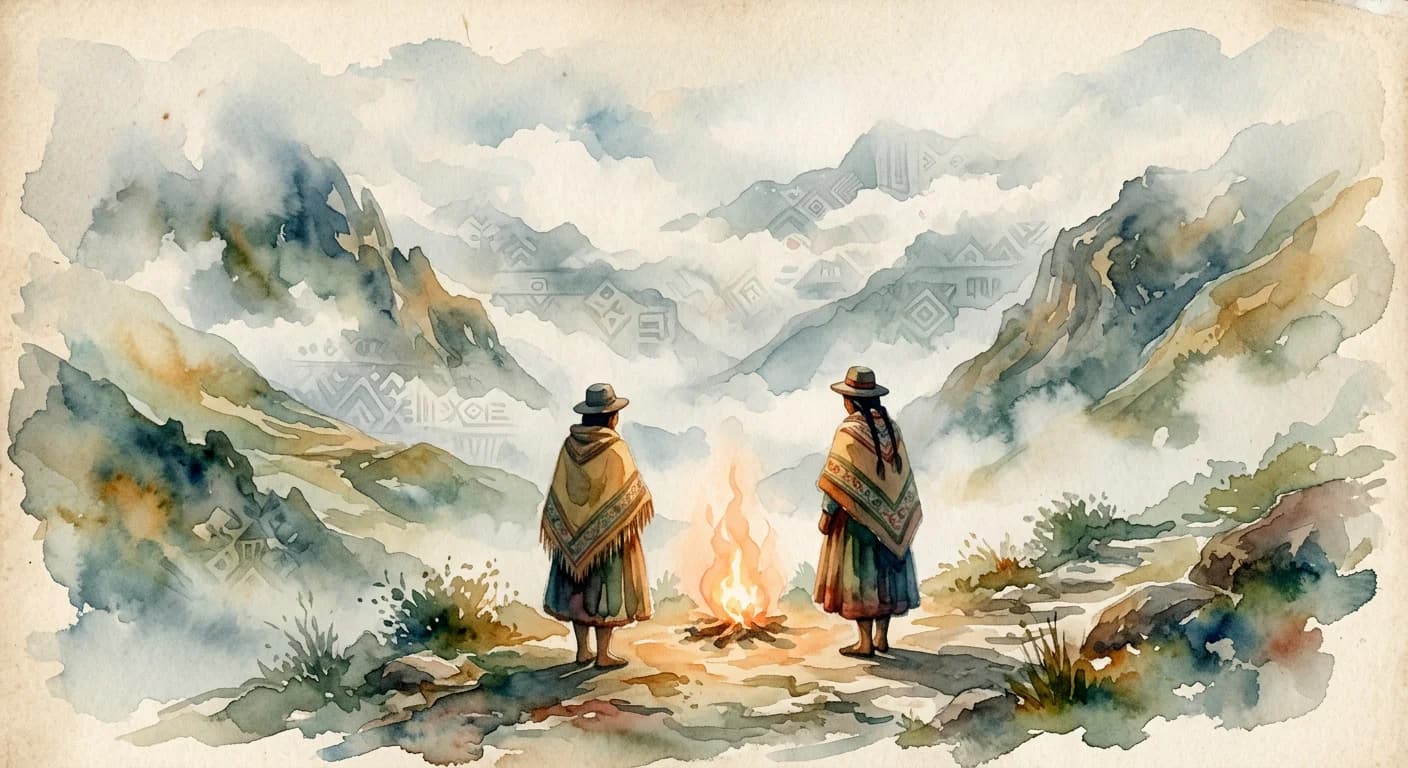
Nina
/NEE-nah/
Meaning
In Quechua, 'nina' transcends the simple definition of fire or flame. It embodies the very essence of life-giving warmth, the illuminating light that guides, and the transformative energy crucial for survival and community. It represents purification, the primal force that cooks food and forges tools, and a sacred link to ancestral spirits and the earth's powerful core. More than a physical phenomenon, 'nina' is a dynamic, spiritual presence woven into the fabric of Andean existence.
Literal Translation
fire, flame
The Story Behind the Word
The concept of 'nina' is deeply rooted in Andean cosmology, where fire is not merely an element but a living entity with spirit and agency. It reflects the Andean worldview that everything in nature possesses a 'kawsay' (life force). For the Quechua, 'nina' is a mediator between the human world and the 'Pachamama' (Mother Earth) and the 'Apus' (mountain spirits). Its presence at rituals, hearths, and communal gatherings signifies protection, purification, and an unbroken connection to their ancestors and the vital energy of the cosmos. The reverence for 'nina' reveals a culture that perceives the natural world as imbued with sacred power, where human well-being is intrinsically linked to the respectful interaction with these forces. It is the heart of the home, the center of storytelling, and the symbol of enduring tradition.
Experience It
Hearth's Warm Embrace
As the Andean night descends, Grandma Elena carefully tends the 'nina' in the adobe hearth. Its flickering glow illuminates the faces of her grandchildren, casting long shadows as she recounts ancient tales, the warmth a palpable comfort against the mountain chill.
Ritual Offering
During the 'Pachamama Raymi' ceremony, the community gathers, and a sacred 'nina' is lit. Offerings of coca leaves and chicha are gently placed into the flames, a communal prayer carried upwards by the smoke, connecting the people to the earth and sky.
The Deeper Meaning
The word 'nina' reveals a profound Andean philosophy of interconnectedness and vitalism. It underscores the belief that life itself is a continuous process of transformation and renewal, powered by inherent natural forces. The respect for 'nina' reflects a worldview where humanity is not separate from nature but an integral part of a living, spiritual cosmos, sustained by reciprocal relationships with all elements.
Did You Know?
Did you know that in many Andean communities, the 'nina' from the hearth is never completely extinguished, but is carefully banked overnight to be rekindled, symbolizing the continuous cycle of life and tradition?
How It's Used
Used to refer to fire, flame, or a source of heat and light in Quechua-speaking communities.