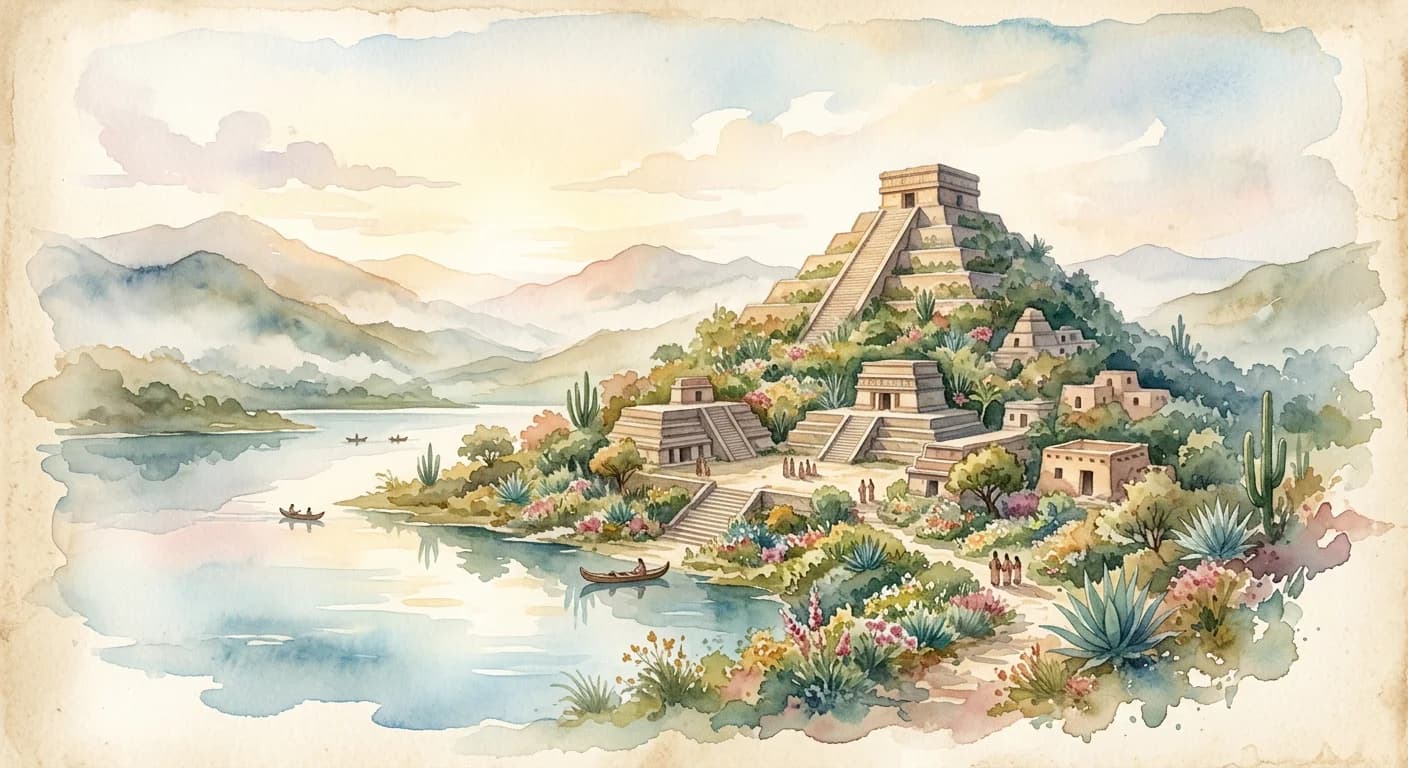
Altépetl
/ahl-teh-PET-l/
Meaning
The altépetl is a profound Nahua concept, representing far more than a mere city or town; it is the vibrant, living heart of a community, a sacred socio-political and territorial entity. It embodies the ancestral lands, the collective identity, and the spiritual connection between a people, their environment, and their governance. This foundational unit signifies a self-sustaining body, complete with its own revered mountain (tepetl) and life-giving water (atl), symbolizing its autonomy and the wellspring of its existence. It is where human society, divine will, and the natural world inextricably converge.
Literal Translation
mountain-water
The Story Behind the Word
The altépetl is central to understanding pre-Hispanic Nahua civilization. Its existence reveals a worldview where human settlements were not just pragmatic gatherings but cosmic reflections, sacred spaces where the community's destiny was intertwined with the land's spiritual power. The 'mountain' (tepetl) element often referred to the ceremonial center, sometimes an actual mountain, symbolizing stability, protection, and a connection to the gods, while 'water' (atl) represented sustenance, fertility, and the flow of life. This dual symbolism underscored the altépetl's self-sufficiency and its holistic integration of natural resources with social and political organization. It wasn't merely a place but a living, breathing entity with its own history, patron deities, and a communal identity forged over generations, making it the fundamental building block of the Nahua world.
Experience It
Founding an Altépetl
After a long migration, the elders consulted the omens and found a sacred place. They ceremonially marked the mountain and the spring, declaring the establishment of their new altépetl, a place where their people and gods would thrive together, forever bound to this land.
Defending the Altépetl
When rival forces threatened, every warrior rose to defend their altépetl. It wasn't just about protecting homes, but safeguarding their sacred mountain, their life-giving waters, and the very soul of their collective identity and ancestral heritage.
The Deeper Meaning
The altépetl reveals a Nahua philosophy where human existence is deeply rooted in a reciprocal relationship with the natural world and the divine. It emphasizes that a community's identity, sovereignty, and well-being are inseparable from its sacred territory. This worldview challenges modern separations of nature and culture, positing a holistic cosmology where the physical landscape is imbued with spiritual meaning and vital for social cohesion and political legitimacy.
Did You Know?
Many modern Mexican towns and cities, particularly in the central highlands, still occupy the exact geographic locations and sometimes even retain the original boundaries of ancient altépetl, demonstrating their enduring legacy.
How It's Used
Used in historical and anthropological contexts to describe the organizational and conceptual unit of Nahua societies, particularly before and during the Spanish conquest. It denotes a self-governing entity with its own territory, rulers, and people.