Mzungu
/MZOO-ngoo/
Meaning
Mzungu, a Swahili term, paints a vivid picture of a white person, particularly those of European or American heritage, but it's far more than a mere racial descriptor. It encapsulates the essence of an 'outsider' – someone who navigates the local landscape with a distinct unfamiliarity, perhaps displaying curious behaviors or a different rhythm of life. While often used neutrally, it can carry a playful curiosity, a gentle observation of difference, and occasionally, a subtle undertone of the 'other' who stands apart from the interwoven tapestry of local customs and understanding.
Literal Translation
White person / foreigner
The Story Behind the Word
The word 'Mzungu' is deeply rooted in the history of East Africa, emerging from the initial encounters between indigenous African communities and European explorers, missionaries, and colonialists. Its etymology is often linked to the verb 'kuzunguka,' meaning 'to wander around' or 'to go in circles,' reflecting the early perception of Europeans as transient, often lost, or simply different in their movements and intentions compared to established local patterns. This word therefore acts as a linguistic marker of historical interaction, signifying not just skin color, but a distinct cultural and behavioral paradigm. It reveals a worldview where identity is often tied to place and custom; a 'Mzungu' is someone whose origins and ways are 'outside' the familiar, prompting a natural human curiosity about their purpose and presence. The persistence of the term, even post-colonialism, underscores an enduring awareness of these historical power dynamics and cultural distinctions, even as interactions become more globalized.
Experience It
Roadside Curiosity
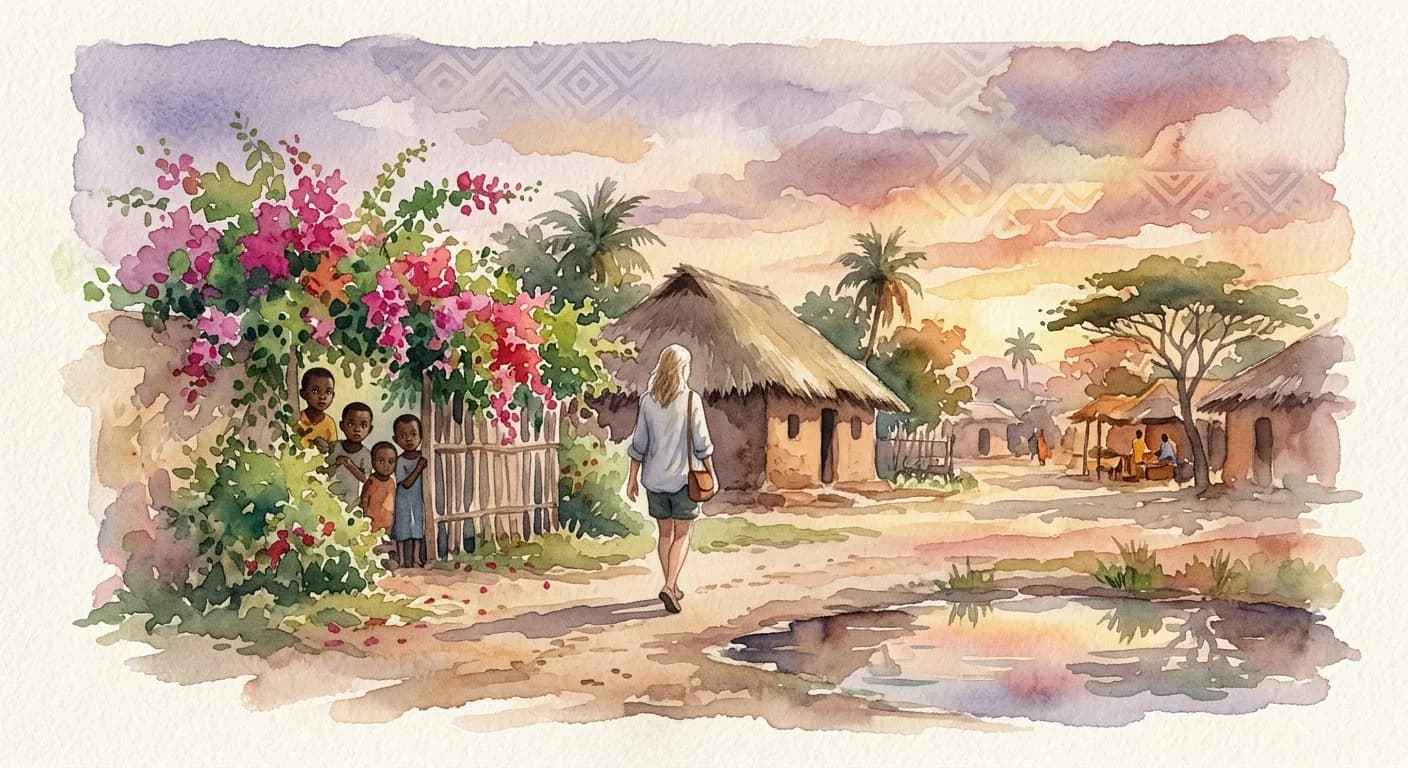
A group of children in a rural Tanzanian village spot a tourist bus. As it passes, several of them excitedly point and shout, 'Mzungu! Mzungu!' with broad smiles and waves, their voices filled with innocent curiosity rather than malice.
Market Bartering
At a bustling market, a vendor quotes a slightly higher price to a fair-skinned customer. After a friendly negotiation, he chuckles, 'Ah, Mzungu, you learn quickly!' acknowledging the customer's unfamiliarity with local bargaining customs but also their adaptability.
The Deeper Meaning
The term 'Mzungu' subtly highlights a fundamental human tendency to categorize and understand 'the other.' It reflects a worldview where identity is not just individual but deeply communal and geographically rooted. The 'Mzungu' is a mirror, reflecting back the local culture's self-definition by delineating what lies outside its immediate, understood boundaries, thereby reinforcing the sense of 'us' versus 'them' in a non-pejorative, purely observational way.
Did You Know?
The plural form of Mzungu is 'Wazungu,' and you might often hear 'Muzungu' as a common mispronunciation, particularly by those less familiar with Swahili grammar.
How It's Used
Used in East African countries where Swahili is spoken to refer to white foreigners. It is often the first word learned by tourists and can be used in a variety of contexts, from simple identification to expressing curiosity about someone's origin or behavior.