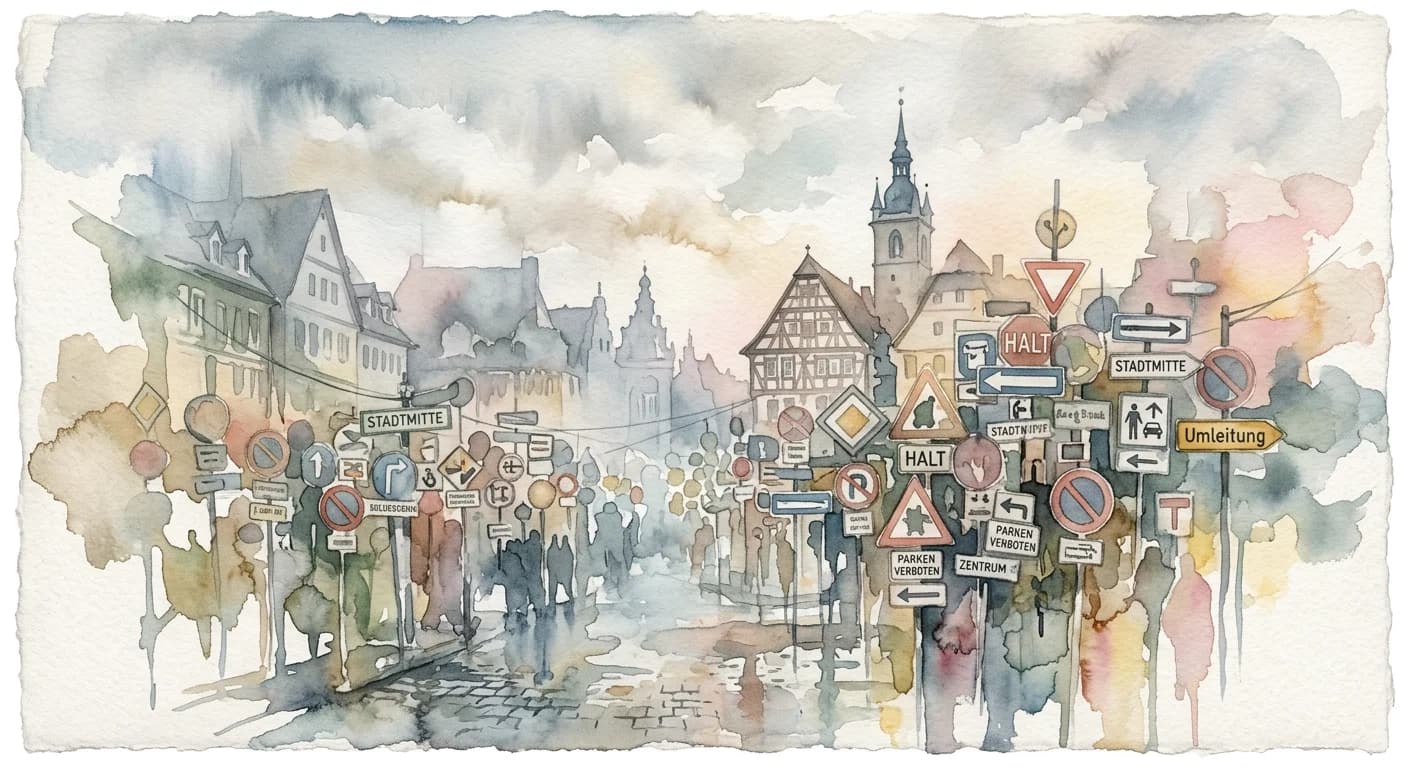
Schilderwald
/SHIL-der-valt/
Meaning
Schilderwald vividly captures the overwhelming visual chaos of an excessive concentration of road signs, particularly in urban landscapes or complex intersections. It describes a situation where the sheer volume and proximity of directives, warnings, and informational panels create a bewildering "forest" of metal and symbols. This sensory overload not only frustrates drivers and pedestrians but actively hinders clear decision-making, transforming navigation into a confusing and sometimes hazardous ordeal, much like being lost in a dense, tangled wood where every tree seems to point in a different direction.
Literal Translation
sign forest
The Story Behind the Word
The existence of "Schilderwald" in the German lexicon is deeply rooted in German culture's intricate relationship with order, regulation, and efficiency. Germany is renowned for its meticulous planning and comprehensive rule-sets, which extend to its road infrastructure. While this often ensures safety and clarity, the bureaucratic zeal can sometimes lead to an overabundance of signage, as every conceivable situation or regulation is deemed to require its own distinct sign. The term reflects a wry, self-aware critique of this very characteristic—a recognition that even the best intentions for order can inadvertently create chaos. It reveals a culture that values precision but also acknowledges the ironic pitfalls of excessive regulation, highlighting a tension between the desire for control and the practical reality of information overload. It’s a testament to a society that grapples with the consequences of its own thoroughness.
Experience It
Confusing City Intersection
Approaching the Hauptbahnhof, Sarah squinted at the tangle of blue, red, and yellow signs. Each pointed in a different direction, some for buses, others for cars, bikes, and pedestrians. "This is a proper Schilderwald," she muttered, nearly missing her turn amidst the visual clutter.
Construction Zone Maze
Driving through the construction zone, Mark found himself surrounded by temporary signs: speed limits, lane closures, detours, and warnings about loose chippings. The sheer volume created a dizzying Schilderwald, making it impossible to quickly grasp the correct path and slowing traffic to a crawl.
The Deeper Meaning
Schilderwald subtly critiques the human tendency to over-regulate and over-inform, revealing a German philosophical undercurrent that values clarity and efficiency but simultaneously recognizes the irony when these very pursuits lead to their opposite. It highlights how an excess of good intentions, when manifested as an overwhelming cascade of directives, can paradoxically obscure the desired path, forcing a re-evaluation of what constitutes truly effective guidance versus mere bureaucratic proliferation.
Did You Know?
The term "Schilderwald" is so universally understood in Germany that it's often used in public discourse and media to criticize bureaucratic excess, not just regarding road signs, but any overwhelming set of rules or directives.
How It's Used
Used to describe a situation with an excessive and confusing amount of road signs, often leading to disorientation or frustration.