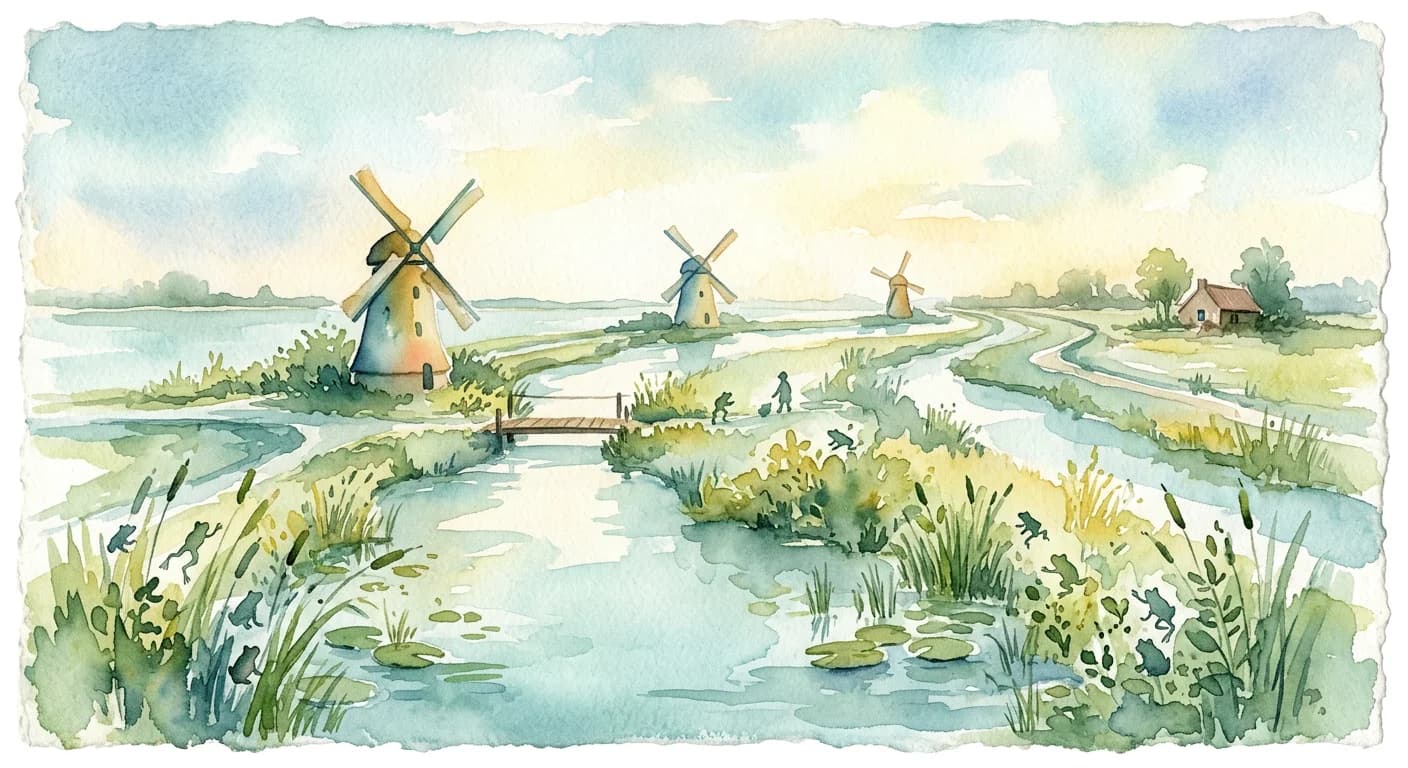
Kikkerlandje
/KIK-ker-luhn-juh/
Meaning
Kikkerlandje is an endearingly whimsical and deeply affectionate term for the Netherlands, literally translating to 'little frog land.' It conjures an image of a cozy, low-lying nation intricately shaped by water, where the ubiquitous presence of frogs symbolizes its unique, often below-sea-level geography. This nickname reflects a playful pride in the country's small scale, resilience against the elements, and the intimate, often quirky, charm that defines the Dutch national character.
Literal Translation
Little frog land
The Story Behind the Word
The existence of 'Kikkerlandje' is deeply rooted in Dutch history and geography. For centuries, the Dutch have literally fought against the water, reclaiming land from the sea and managing intricate canal systems. This constant struggle and ingenuity against nature have fostered a pragmatic yet resilient national character. The 'frog' imagery, therefore, isn't random; it subtly acknowledges the country's watery foundations and the constant, often unseen, effort required to keep it habitable. It reveals a people who view their smallness not as a weakness, but as a source of unique identity, efficiency, and a certain cozy charm. The term embodies a self-aware, almost humble pride in their unique existence, shaped by both human endeavor and the natural landscape.
Experience It
Homesick Abroad
A Dutch student studying in Australia sighs during a video call with her parents. 'Ik mis ons Kikkerlandje zo,' she laments, a wistful smile on her face, thinking of canals and stroopwafels. Her parents chuckle, understanding her longing for the familiar, small-scale comfort of home.
National Pride
During a World Cup match, a group of Dutch fans, clad in orange, cheer wildly. 'Hup Holland, hup! Laat zien waarom we het beste Kikkerlandje zijn!' one shouts, pumping his fist in the air. It's a playful yet proud declaration of their country's spirit, even on the global stage.
What Gets Lost in Translation
English speakers might mistakenly interpret 'little frog land' as derogatory or childish. However, 'Kikkerlandje' is far from an insult; it's a term of endearment, reflecting a self-deprecating humor and a deep affection for the homeland. The diminutive '-je' suffix is key, transforming a simple description into a warm, almost cuddly, appellation, signifying fondness rather than belittlement.
Across Cultures
While direct translations are rare, many cultures have affectionate, often geographically inspired, nicknames for their homelands. Japan has 'land of the rising sun,' and Ireland is often called 'the Emerald Isle.' Similarly, 'Aotearoa' (New Zealand) means 'land of the long white cloud.' These terms, like Kikkerlandje, encapsulate a nation's defining characteristics through a poetic lens, fostering a sense of shared identity and pride.
The Deeper Meaning
Kikkerlandje reveals a profound Dutch philosophy of self-acceptance and resourceful pragmatism. It symbolizes an embrace of their geographical realities – the low-lying, water-dominated landscape – transforming what might be seen as a vulnerability into a point of endearing national identity. It reflects a worldview that values ingenuity, community, and a wry, understated pride in overcoming challenges, acknowledging their unique place in the world with a charming modesty.
Did You Know?
Despite its 'little frog' moniker, the Netherlands is also one of the most densely populated countries in the world, showcasing a remarkable ability to thrive in its unique, water-rich environment.
How It's Used
Typically used informally and affectionately by Dutch people to refer to their own country, often in a lighthearted or patriotic context. It can also be used by foreigners with a fond appreciation for the Netherlands.