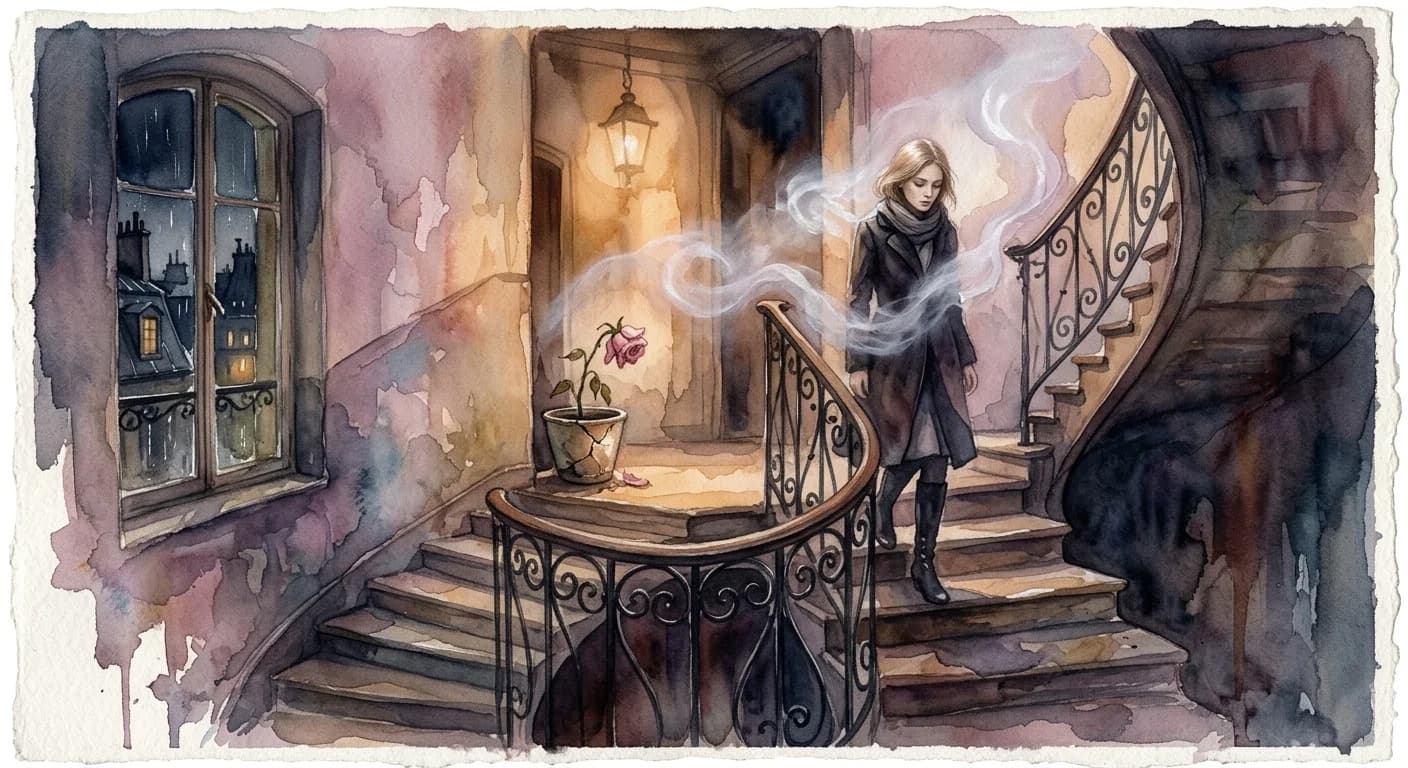
Esprit d'escalier
/es-PREE de-skal-YAY/
Meaning
Esprit d'escalier captures that exquisitely frustrating moment when the perfect, witty retort or incisive observation crystallizes in your mind only after the conversation has concluded and you're physically departing, often literally on the staircase. It's the sharp pang of regret for a missed opportunity to shine, a brilliant thought born too late to be delivered. This phrase encapsulates the universal human experience of delayed realization, highlighting the social pressure and value placed on quick intellectual sparring and eloquent repartee.
Literal Translation
Spirit of the staircase
The Story Behind the Word
The existence of 'esprit d'escalier' in French culture speaks volumes about the historical emphasis on rhetoric, wit, and salon culture. In 17th and 18th-century France, intellectual salons were crucial social spaces where sharp minds engaged in rapid-fire, eloquent conversation, and the ability to deliver a clever, well-phrased remark instantly was highly prized. To miss such an opportunity, to only formulate the perfect riposte after the fact, was not just a personal frustration but a social failing – a sign of lacking the 'esprit' (spirit/wit) required for such exchanges. The phrase is attributed to Denis Diderot, who lamented his own experience of this phenomenon, solidifying its place in the French lexicon and underscoring the enduring cultural value placed on intellectual agility and verbal artistry.
Experience It
Boardroom Battle
After a tense board meeting where a colleague unfairly criticized her proposal, Sarah left feeling defeated. As she descended the office stairs, the perfect, irrefutable argument suddenly formed in her mind, a devastating counterpoint she wished she'd delivered. The 'esprit d'escalier' hit hard.
Awkward Family Dinner
Uncle Jean made a rather insensitive comment about his nephew's career choice. Later, while helping clear the table, the nephew suddenly thought of a brilliantly sarcastic, yet polite, comeback that would have perfectly shut down the conversation. Too late, the moment had passed, leaving him with a classic case of 'esprit d'escalier'.
The Deeper Meaning
This phrase delves into the nature of human cognition and social interaction, revealing our constant striving for intellectual mastery and the elusive ideal of perfect presence of mind. It highlights the gap between our internal thought processes and our real-time performance, suggesting a universal human vulnerability to delayed insight and the regret that accompanies missed opportunities for verbal brilliance. It reflects a culture that values not just intelligence, but its immediate, articulate expression.
Did You Know?
The phrase is widely attributed to the French philosopher Denis Diderot, who described experiencing this very phenomenon after a dinner party with a particularly witty host.
How It's Used
Used to describe the experience of thinking of a clever retort or response too late, after the opportunity to use it has passed.