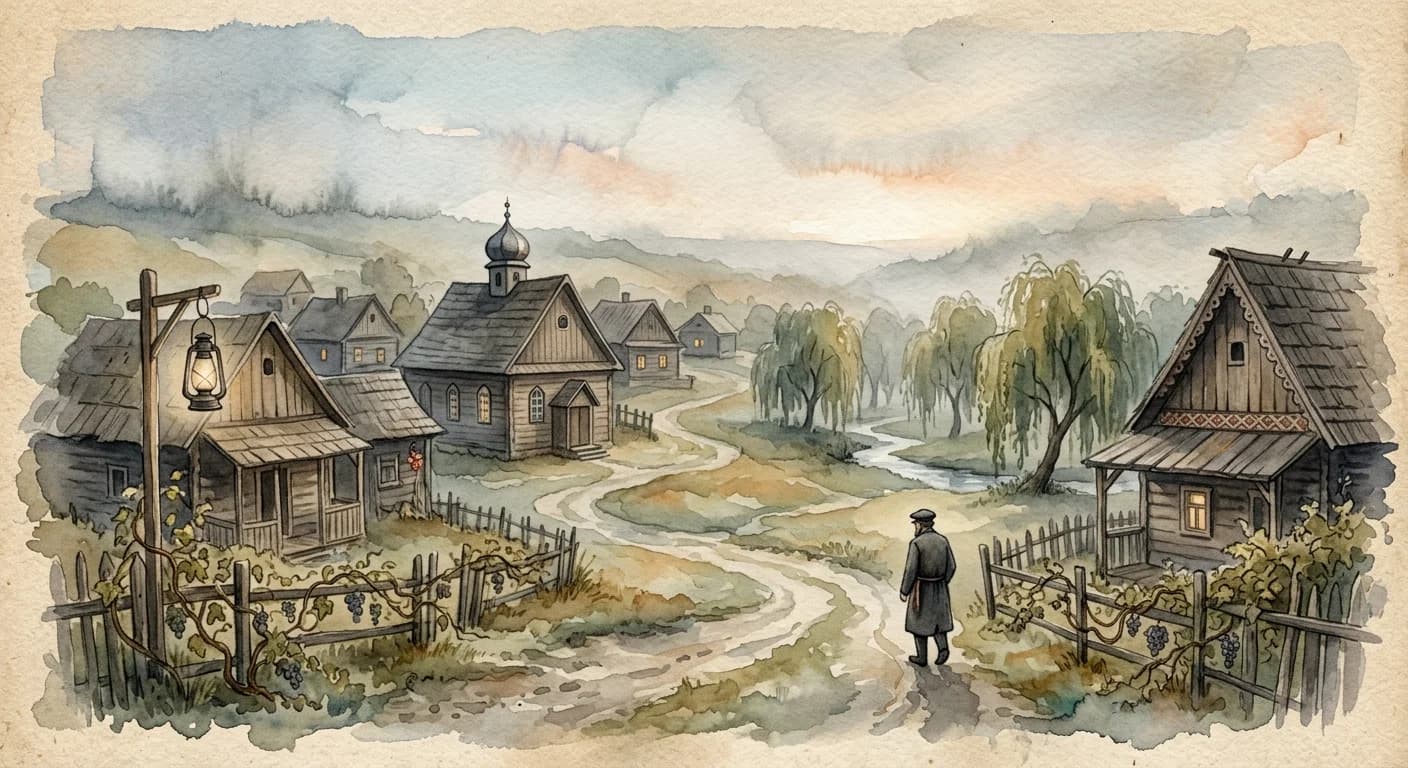
Shtetl
/SHTET-el/
Meaning
A 'shtetl' was far more than just a small Jewish village in Eastern Europe; it was a vibrant, self-contained universe where Jewish life unfolded in its most traditional and intense forms. These close-knit communities, often nestled away from larger urban centers, were crucibles of religious observance, Yiddish culture, and communal solidarity, where every aspect of life, from commerce to courtship, was steeped in ancient traditions. The term now conjures a poignant nostalgia for a lost epoch, representing a world tragically extinguished by the Holocaust and subsequent emigration, yet enduring vividly in memory and cultural legacy.
Literal Translation
Little town
The Story Behind the Word
The word 'shtetl' encapsulates centuries of Eastern European Jewish experience, emerging from a historical context where Jewish communities, due to various decrees and economic factors, often lived in semi-autonomous enclaves within larger gentile societies. It reflects a worldview prioritizing communal interdependence, religious scholarship, and the preservation of Jewish identity against a backdrop of often hostile surroundings. The shtetl was a place where Jewish law (Halakha) governed daily life, Yiddish was the lingua franca, and a rich tapestry of customs, folklore, and spiritual striving defined existence. Its existence highlights a profound resilience and an intricate social structure designed to sustain Jewish life and values, even in isolation. The term's enduring power lies in its representation of a complete way of life, now largely vanished, yet formative in the collective memory of Ashkenazi Jews.
Experience It
Remembering the Old World
Sarah, a third-generation immigrant, looked at the faded photograph of her great-grandparents. 'They came from a shtetl,' she explained to her daughter, 'a place where everyone knew each other, and the rhythm of life was set by the Shabbat and the holidays. It was a whole world unto itself.'
A Story from the Past
The old man's eyes twinkled as he recounted tales of his youth. 'In our shtetl,' he began, 'the rabbi was not just a scholar but the heart of our community, guiding us through good times and bad, a true spiritual shepherd for all of us little Jews.'
The Deeper Meaning
The concept of the shtetl reveals a profound emphasis on community (kehilla) and collective identity over individualistic pursuits. It underscores a worldview where tradition, religious observance, and mutual support were paramount, shaping a society deeply rooted in shared heritage and a sense of belonging. The shtetl suggests that true meaning was found not in material wealth or personal ambition, but in the intricate web of relationships and spiritual devotion that bound its inhabitants together.
Did You Know?
Many famous Jewish writers, artists, and thinkers, including Isaac Bashevis Singer and Marc Chagall, drew heavily on their memories and imaginations of shtetl life in their works.
How It's Used
Used to refer to a specific type of Eastern European Jewish settlement, often with a nostalgic or historical context.