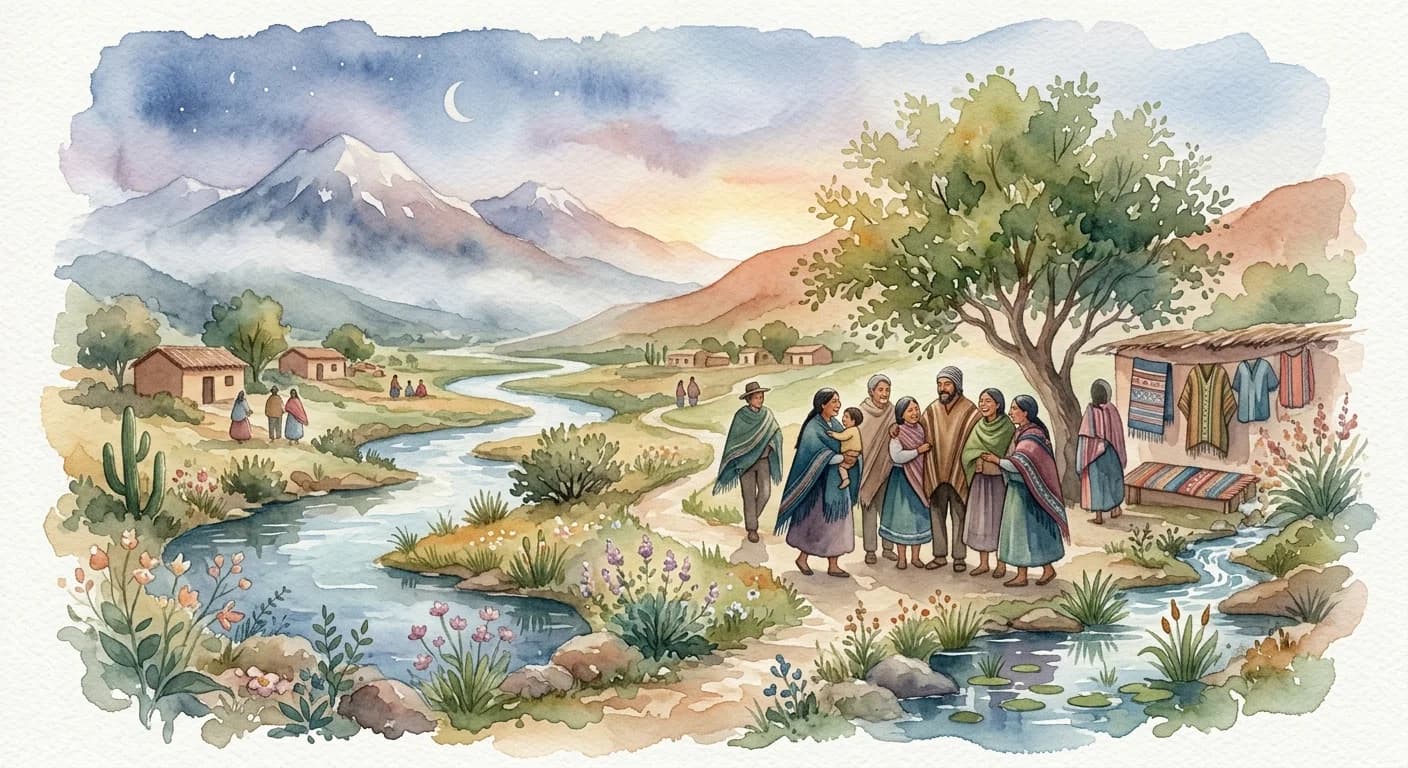
Buen vivir
/BWEN vee-VEER/
Meaning
"Buen vivir," or 'good living,' is a profound Andean philosophy that transcends mere material wealth, advocating for a holistic existence rooted in community harmony, ecological balance, and dignified living for all. It prioritizes collective well-being and a reciprocal relationship with Pachamama (Mother Earth) over individualistic consumption, fostering a life rich in social connection, spiritual fulfillment, and respect for all forms of life. This vision champions a just and sustainable society where human needs are met in profound balance with the planet's finite capacities, rejecting extractive models of development.
Literal Translation
Good to live
The Story Behind the Word
The concept of "Buen vivir" (Sumak Kawsay in Quechua, Suma Qamaña in Aymara) is deeply embedded in the cosmological and ethical frameworks of Indigenous Andean peoples, particularly in what is now Bolivia and Ecuador. It predates colonial influence, reflecting an ancient worldview where humans are an integral part of nature, not its dominators. Its resurgence in modern discourse, particularly in the early 21st century, represents a powerful Indigenous response to Western development paradigms that often prioritize economic growth at the expense of social cohesion and environmental health. It challenges linear progress, instead advocating for a cyclical understanding of time and interconnectedness, where the well-being of future generations and the Earth itself are paramount. This philosophy reveals a world where reciprocity (ayni), solidarity, and living in harmony with the cosmos are fundamental to a truly fulfilling existence.
Experience It
Community Harvest
In a small Andean village, families gather not just to harvest their own crops, but to collectively bring in the entire community's yield. The elderly share traditional songs, children play, and everyone contributes their labor, ensuring no one's harvest is left behind. This collective effort embodies "Buen vivir," where shared prosperity and communal bonds are more vital than individual accumulation.
River Protection
When a mining company proposed a project threatening a local river, Indigenous leaders rallied their community. They argued not just for their water rights, but for the river's inherent right to flow clean, explaining its spiritual significance and role in sustaining all life. Their resistance, prioritizing the health of Pachamama over economic gain, was a direct application of "Buen vivir" principles.
What Gets Lost in Translation
English speakers often mistake "Buen vivir" for mere 'sustainable development' or 'quality of life.' However, it's far more profound. It's not just about sustaining current lifestyles or improving individual comfort; it's a radical paradigm shift that questions the very foundations of capitalism and individualism, proposing a different ontological relationship with nature and society. It's not about living better *individually*, but about living well *collectively* and *in balance with all life*.
Across Cultures
Similar concepts resonate globally: the Maori concept of 'kaitiakitanga' (guardianship of the environment), the Japanese 'ikigai' (reason for being, often linked to community and purpose), and certain African philosophies like 'Ubuntu' (I am because we are) all share common ground with "Buen vivir" by emphasizing interconnectedness, community well-being, and a harmonious relationship with one's surroundings.
The Deeper Meaning
"Buen vivir" reveals a profound worldview that challenges anthropocentrism, positing that humans are not superior to nature but rather an integral, interdependent part of it. It implies a cyclical understanding of time and existence, where the past informs the present and future, and where balance, reciprocity, and the well-being of the collective—including the Earth itself—are the ultimate measures of a flourishing life. This philosophy offers a powerful critique of modern notions of progress and development.
Did You Know?
"Buen vivir" has been incorporated into the constitutions of Ecuador (2008) and Bolivia (2009), making them the first nations in the world to enshrine the rights of nature and the pursuit of a holistic "good living" as state objectives.
How It's Used
Often used in political and social discourse, particularly in Latin America, to advocate for alternative development models that prioritize community and environmental well-being over unchecked economic growth. It's invoked in discussions about Indigenous rights, social justice, and sustainable living.