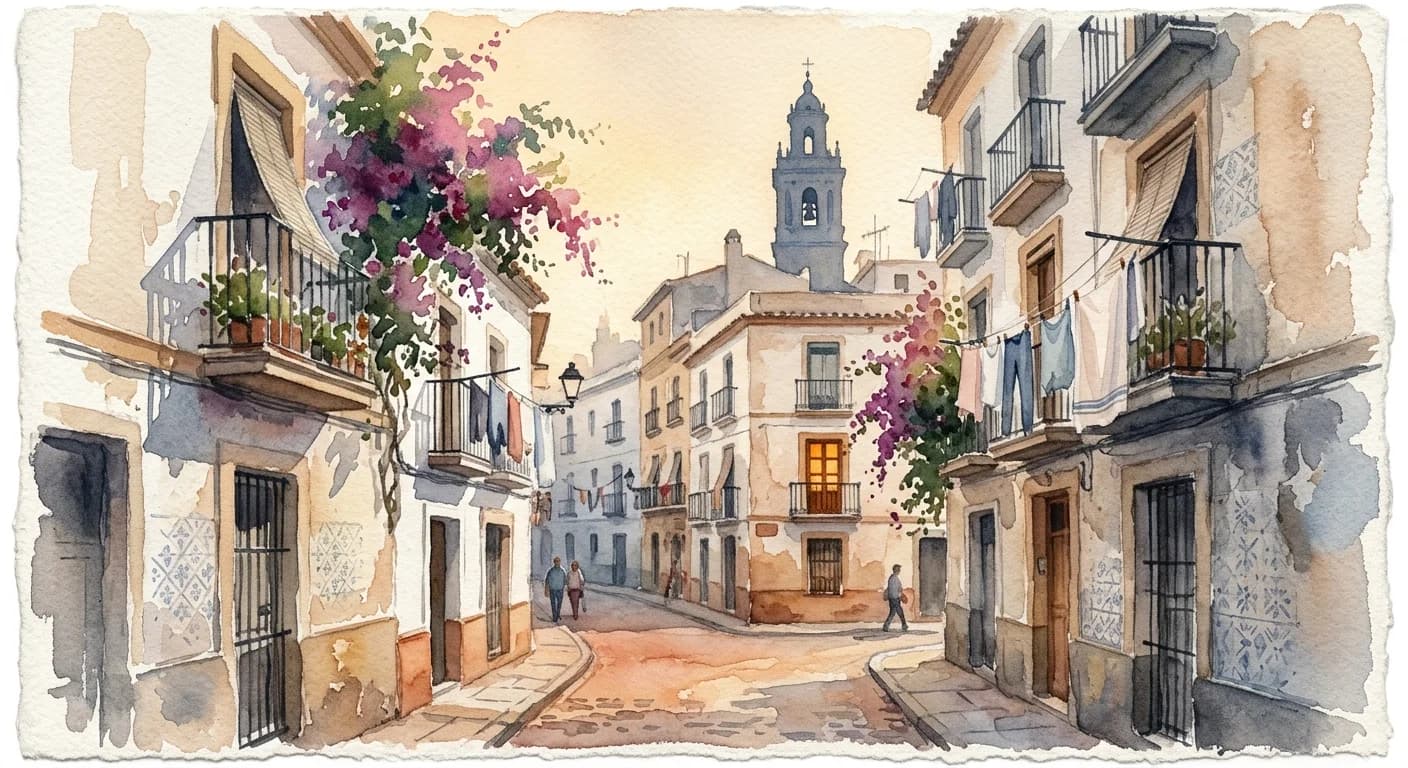
Cuadra
/KWAH-drah/
Meaning
Beyond a mere segment of urban infrastructure, a 'cuadra' in Spain represents a vibrant, self-contained micro-community. It's the familiar stretch where daily rituals unfold – the morning greetings with the baker, the afternoon chatter at the local bar, children’s laughter echoing between buildings. This defined space fosters a deep sense of local identity and belonging, embodying the collective memory and shared experiences of its inhabitants, making it a fundamental unit of urban life.
Literal Translation
Block (of a city)
The Story Behind the Word
The concept of 'cuadra' is deeply rooted in the historical development of Spanish cities, which often grew organically around central plazas and churches, fostering tight-knit communities. Unlike the grid-like, often impersonal urban planning of some other cultures, the Spanish 'cuadra' emphasizes human scale and interaction. It reflects a societal value placed on proximity, social connection, and the public square as a natural extension of home. This word exists because it accurately captures the lived experience of urban dwellers who identify strongly with their immediate surroundings and the network of relationships within them. It reveals a cultural preference for intimate, walkable neighborhoods where personal connections are paramount, contrasting with more car-centric, sprawling urban designs.
Experience It
Evening Stroll
After dinner, María and her husband take their customary 'paseo' down their 'cuadra'. They greet the fruit vendor, exchange pleasantries with their neighbor watering plants, and pause to admire the new mural on the corner, feeling perfectly at home in their familiar surroundings.
Community Celebration
For the neighborhood fiesta, the residents of the 'cuadra' organize a potluck. Tables are set up in the street, children play freely, and music fills the air, transforming the block into a lively communal space where everyone feels like family.
The Deeper Meaning
The 'cuadra' embodies a philosophy of urbanism centered on human connection and localized identity. It suggests that a city's true essence lies not just in its grand monuments or expansive avenues, but in the intimate, lived-in spaces where community thrives. It reveals a worldview where belonging is fostered through proximity and shared daily life, valuing the immediate social fabric over broader, more abstract urban definitions.
Did You Know?
In some Spanish cities, 'cuadra' can also refer to a stable or horse barn, reflecting its historical etymology from the Latin 'quadrus' (square), referring to a square enclosure.
How It's Used
Used to refer to a city block or neighborhood in urban areas, often in Latin America and Spain.