Gesellschaft
/geh-ZEL-shahft/
Meaning
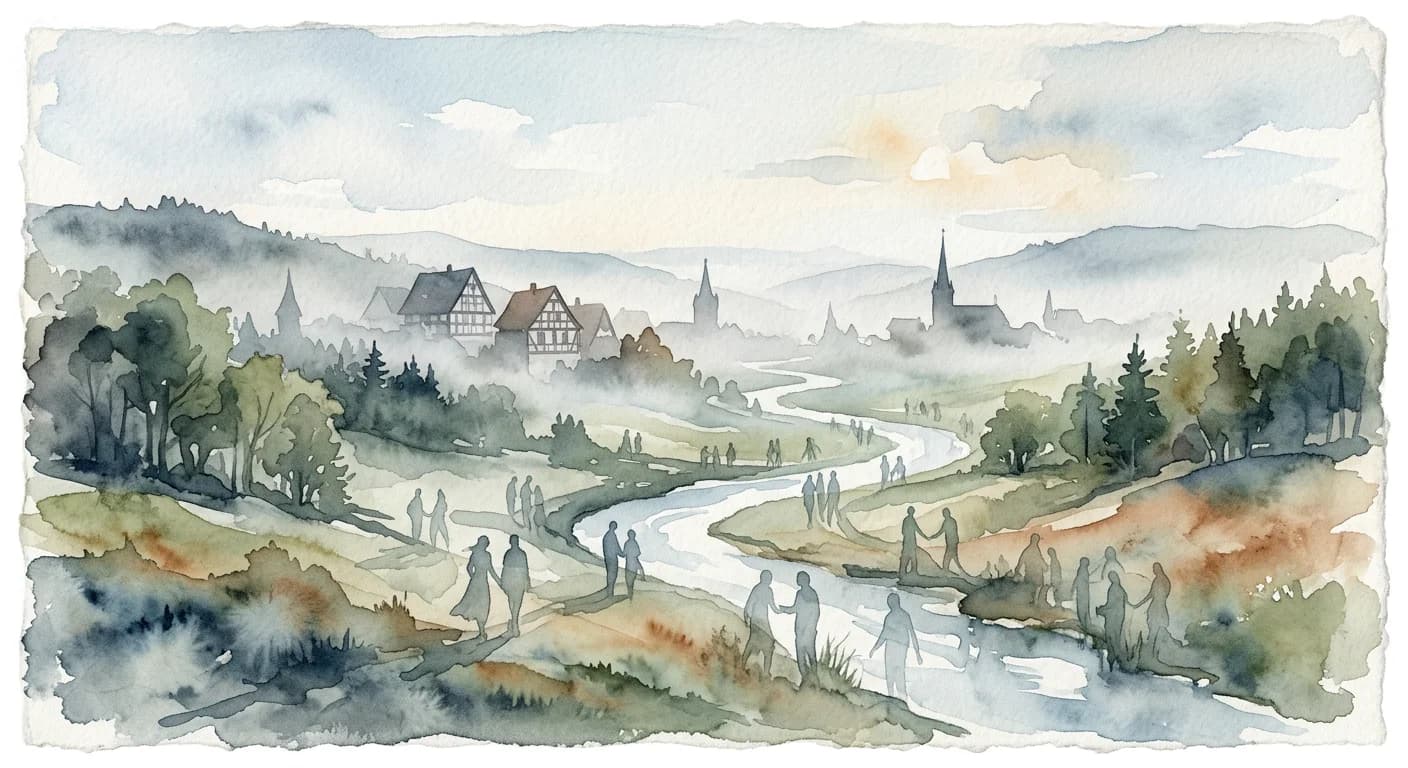
More than a mere collective, "Gesellschaft" embodies the intricate, often impersonal tapestry of modern social structures, institutions, and the rationalized interactions that bind individuals within a nation or state. It speaks to the organized, frequently contractual relationships that define our public lives, contrasting sharply with the intimate, emotionally driven bonds of 'Gemeinschaft.' This concept illuminates the societal framework we navigate, acknowledging that participation is often a matter of necessity and function rather than deep personal connection, reflecting the complexities of industrialized existence.
Literal Translation
Society / Company
The Story Behind the Word
The distinction between 'Gesellschaft' and 'Gemeinschaft' was famously articulated by German sociologist Ferdinand Tönnies in his 1887 work, "Gemeinschaft und Gesellschaft." This conceptual pairing became foundational to German sociology and philosophy, profoundly influencing thinkers like Max Weber and Georg Simmel. Tönnies observed the rapid urbanization and industrialization of 19th-century Germany, noting a shift from organic, village-like communities ('Gemeinschaft') to large-scale, rationalized societies ('Gesellschaft') characterized by individual self-interest, formal laws, and contractual obligations. This word exists because German thought has a strong tradition of analyzing social organization and the impact of modernity on human relations, offering a framework to understand the perceived loss of traditional community bonds in favor of a more functional, albeit alienating, social order. It reflects a deep-seated German introspection into the nature of collective life and the forces shaping it.
Experience It
Navigating Bureaucracy
A young immigrant struggles to understand the complex German bureaucratic processes for residency permits. The impersonal forms, strict appointments, and rigid rules exemplify the 'Gesellschaft' – a system designed for order and efficiency, where individual feelings are secondary to standardized procedures.
Corporate Workplace Dynamics
In a large German corporation, employees interact professionally, focused on tasks and company goals. While colleagues might be friendly, relationships remain largely functional and contractual, reflecting the 'Gesellschaft' where professional roles and organizational objectives supersede deep, personal intimacy.
The Deeper Meaning
The concept of 'Gesellschaft' reveals a worldview keenly aware of the double-edged sword of modernity: progress and efficiency at the cost of traditional communal warmth. It underscores a philosophical contemplation of individualism versus collective order, and the inherent tensions between personal freedom and societal demands. It posits that modern existence often necessitates navigating systems built on logic and utility, rather than pure human connection, prompting reflection on alienation and belonging in structured societies.
Did You Know?
The word 'Gesellschaft' is also commonly used in German company names, like 'Volkswagen AG' (Aktiengesellschaft), directly translating to 'stock corporation' or 'public limited company,' highlighting its connection to formal organizational structures.
How It's Used
Used in sociological and philosophical contexts to describe the nature of modern society, its structures, and the relationships within it. It contrasts with the more intimate concept of 'Gemeinschaft'.