U.
HomeRegionsLanguagesEmotionsCollections
Find Your Word

“The limits of my language mean the limits of my world.”

— Ludwig Wittgenstein, Philosopher

Untranslatable

A curated collection of the world's most beautiful expressions—words that remind us language is humanity's greatest invention.

  • Home
  • Collections
  • Regions
  • Countries
  • Emotions
  • Tags
  • Contexts
  • Finder
  • Europe
  • Asia
  • Americas
  • Africa
  • Middle East
  • About
  • Contact
  • Privacy Policy
  • Terms of Service

2026 © Untranslatable. All rights reserved.

    /
    /
    1. Home
    2. /
    3. Asia
    4. /
    5. Giri-choco
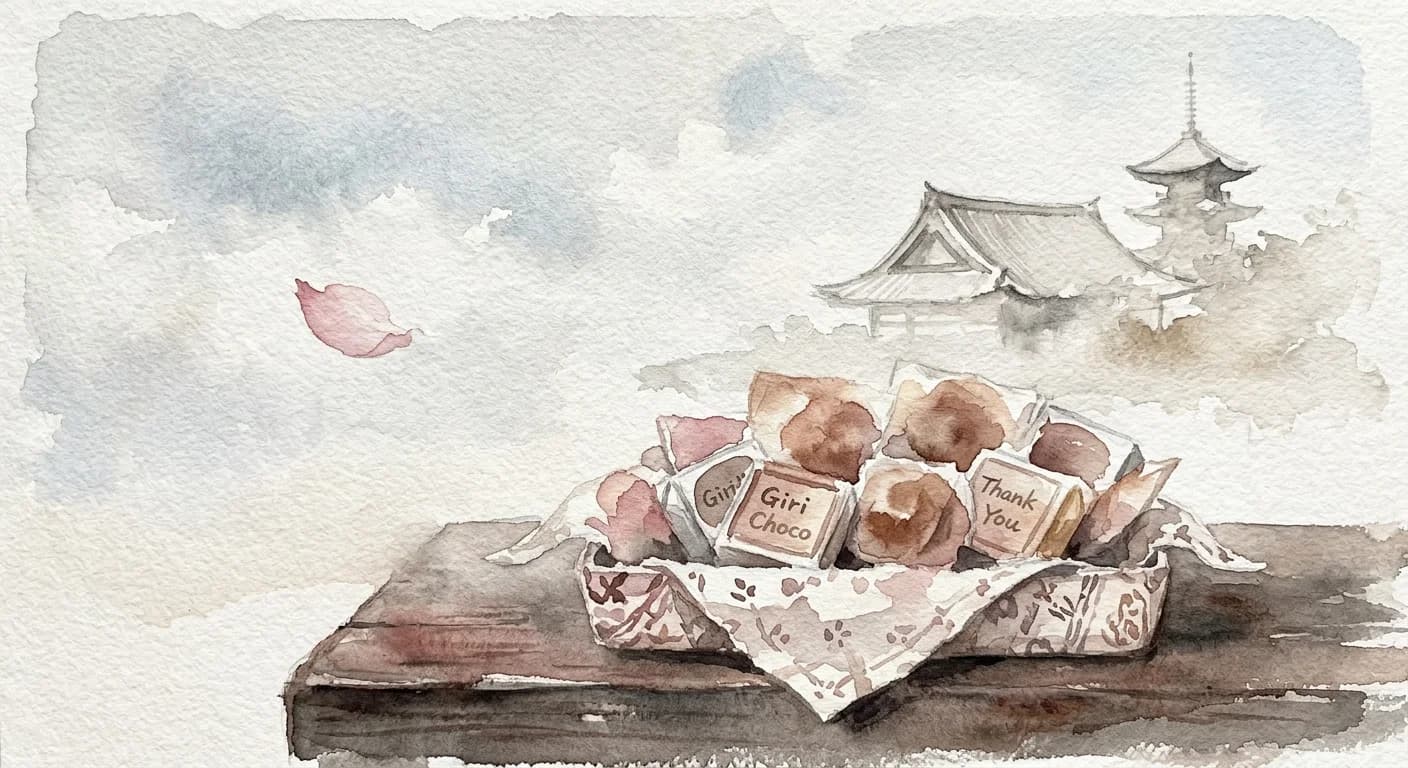
    Artistic representation of Giri-choco
    Japanese•
    🇯🇵Japan

    Giri-choco

    /GHEE-ree CHOH-koh/

    Meaning

    Giri-choco, or 'obligation chocolate,' is a uniquely Japanese Valentine's Day phenomenon where men distribute chocolates to female colleagues, bosses, and acquaintances not out of romantic affection, but as a social obligation. This ritual serves to maintain harmonious workplace relationships and social decorum, acting as a polite, often transactional, gesture. Unlike the deeply personal 'honmei-choco,' giri-choco is typically mass-produced and exchanged without any romantic undertones, underscoring its role in upholding societal expectations of reciprocal courtesy and maintaining group cohesion.

    Literal Translation

    Obligation Chocolate

    The Story Behind the Word

    The existence of giri-choco is deeply rooted in Japan's cultural emphasis on 'giri' (obligation or duty) and 'wa' (harmony). 'Giri' dictates that individuals must reciprocate favors and maintain social balance, while 'wa' prioritizes group cohesion and avoiding conflict. Valentine's Day, a Western import, was subtly reinterpreted through this lens. Initially, women gave chocolate to men. However, the expectation evolved, creating a reciprocal pressure for men to acknowledge female colleagues, leading to the creation of giri-choco. This practice reveals a society that values indirect communication, subtle social cues, and the meticulous maintenance of interpersonal relationships, even through seemingly trivial acts like gifting chocolate, to ensure a smooth social fabric.

    Experience It

    Office Valentine's Exchange

    Mr. Tanaka carefully places a small box of chocolates on the desks of his female colleagues on Valentine's Day. There are no grand gestures or personal notes, just a quiet acknowledgment of the social contract. He knows it's expected, a small investment in maintaining a pleasant working environment.

    Boss's Giri-choco

    Ms. Sato receives a generic box of chocolates from her male boss. She smiles politely and thanks him, understanding it's not a sign of favoritism or romantic interest, but simply his adherence to the annual office ritual. It's a gesture that reaffirms professional boundaries and mutual respect.

    The Deeper Meaning

    Giri-choco encapsulates the Japanese philosophy of 'uchi-soto' (inside-outside) and the intricate web of social obligations that define interactions. It highlights how even seemingly individualistic holidays are adapted to reinforce group harmony and duty over personal sentiment, revealing a profound collectivist worldview where maintaining social order is paramount.

    Did You Know?

    Some Japanese department stores now offer 'jiko-choco' (self-chocolate) for women to buy for themselves, and 'tomo-choco' (friend-chocolate) for women to exchange with female friends, reflecting a shift away from purely obligatory giving.

    How It's Used

    Used to describe the specific type of chocolate given out of obligation on Valentine's Day in Japan, primarily by men to women in professional or social contexts.

    Emotion
    gratitude
    Contexts
    celebration,friendship,seasons,work
    🇯🇵Japan

    by Anya Petrova·Written Mar 14, 2026·Updated Apr 3, 2026

    Related Words

    Explore more
    Wabi-sabiJapanese

    Wabi-sabi is the profound appreciation for the ephemeral, the imperfect, and the incomplete aspects of existence. It is about discovering beauty in the subtle textures of age, the unique character of flaws, and the gentle decay that marks the passage of time. This philosophy encourages a quiet acceptance of impermanence and a mindful connection to the natural world, finding elegance in simplicity and authenticity.

    IkigaiJapanese

    Ikigai is more than just a reason to get out of bed; it's a deeply personal and evolving sense of purpose that brings genuine fulfillment and joy to one's life. It represents the sweet spot where your passions, talents, needs of the world, and what you can be paid for beautifully converge. Discovering your ikigai often leads to a life lived with intentionality, resilience, and a profound connection to one's contributions. It's the intrinsic motivation that fuels a meaningful existence, regardless of external circumstances.

    NunchiKorean

    Nunchi is the sophisticated, almost telepathic, ability to instantly grasp the unspoken dynamics of any social situation, anticipating others' thoughts and feelings, and then responding with impeccable grace and timing. It's an acute form of social intuition, allowing one to navigate complex interpersonal landscapes by reading subtle cues like body language, tone, and context. Possessing good nunchi means effortlessly understanding the underlying emotional currents and adjusting one's behavior to maintain harmony and effectiveness, often without a single word exchanged.

    JugaadHindi

    Jugaad is more than just a quick fix; it embodies the spirit of resourceful, ingenious improvisation in the face of scarcity or systemic challenges. It's the art of bending rules, repurposing materials, and thinking outside the box to achieve a desired outcome, often with limited financial or technological resources. This approach celebrates clever workarounds and innovative adaptations, turning constraints into catalysts for creative problem-solving. It's about making do and making something work, brilliantly.