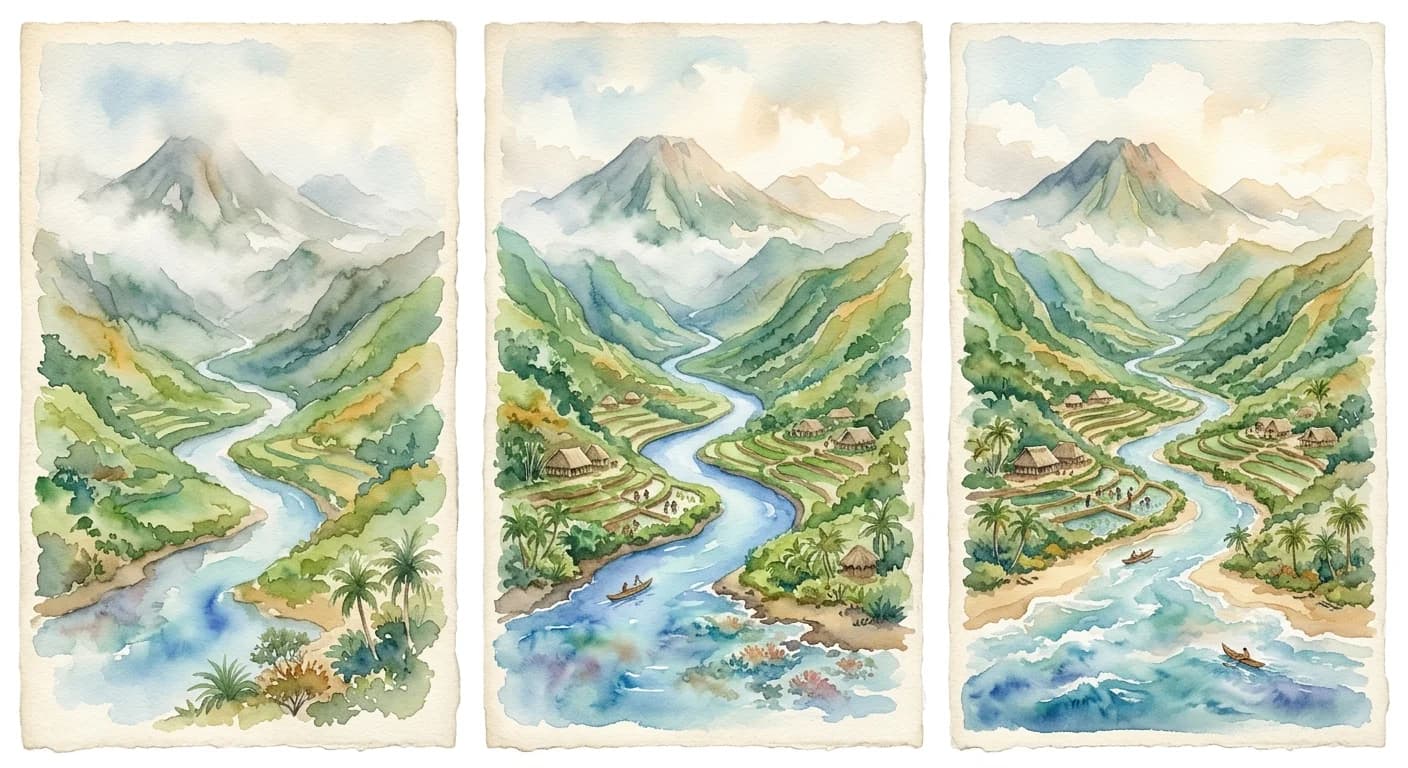
Ahupuaa
/ah-hoo-POO-ah/
Meaning
An ahupuaʻa is a meticulously organized traditional Hawaiian land division, stretching from the highest mountain ridges, through fertile valleys, and out to the fringing coral reefs. It encapsulates an entire watershed, designed as a self-sustaining ecological and social unit where every resource, from mountain rain to ocean fish, was managed holistically. This integrated system fostered a deep symbiosis between the land (ʻāina) and its people, ensuring perpetual abundance and community well-being through careful stewardship and reciprocal relationships.
Literal Translation
The literal meaning is debated, with some suggesting it refers to a boundary marker (puaa) shaped like a pig (puaa), or the ridge (ahu) of a pig.
The Story Behind the Word
The concept of ahupuaʻa is foundational to understanding pre-contact Hawaiian society, reflecting a profound respect for nature and an intricate knowledge of its cycles. It emerged from the practical necessity of survival on isolated islands, where resource management was paramount. This system was not merely a geographical division but a social and spiritual blueprint, asserting that land is not owned but stewarded. The aliʻi (chiefs) and konohiki (land managers) were responsible for the well-being of the ahupuaʻa and its inhabitants, ensuring equitable distribution and sustainable practices. It reveals a worldview where humans are an integral part of the ecosystem, not separate from it, and where the health of the land directly correlates with the health of the community. This deep interconnectedness fostered a sense of collective responsibility and interdependence, vital for island survival.
Experience It
Ahupuaʻa Harvest Day
The morning sun warmed the taro patches as families gathered, some having walked down from the upland forests, others up from the fishing villages. Today, resources from across the ahupuaʻa would be shared: freshwater shrimp from the stream, bundles of kalo (taro) from the loʻi, and fresh fish caught just beyond the reef. It was a communal effort, reinforcing the bonds that tied the mountain to the sea and the people to their shared land.
Managing the Water
During a dry spell, the konohiki of the ahupuaʻa carefully assessed the mountain springs and stream flow. Decisions about water allocation for the various kalo terraces and domestic use were made collectively, prioritizing the long-term health of the entire system. Understanding that water was the lifeblood of the ahupuaʻa, every drop was honored and managed with great care to sustain all life within its boundaries.
The Deeper Meaning
The ahupuaʻa embodies a profound philosophy of aloha ʻāina—love for the land—and mālama ʻāina—to care for the land. It asserts that human prosperity is inextricably linked to ecological health, advocating for a reciprocal relationship where humans are stewards, not masters, of natural resources. This worldview emphasizes balance, sustainability, and community well-being over individual accumulation, reflecting a deep spiritual connection to the natural world.
Did You Know?
The boundary markers of an ahupuaʻa were sometimes actual altars (ahu) topped with a carved pig (puaʻa), symbolizing the district's name and its connection to the land's bounty.
How It's Used
Used to describe traditional land divisions in Hawaii, often in discussions about Hawaiian history, culture, geography, and resource management.