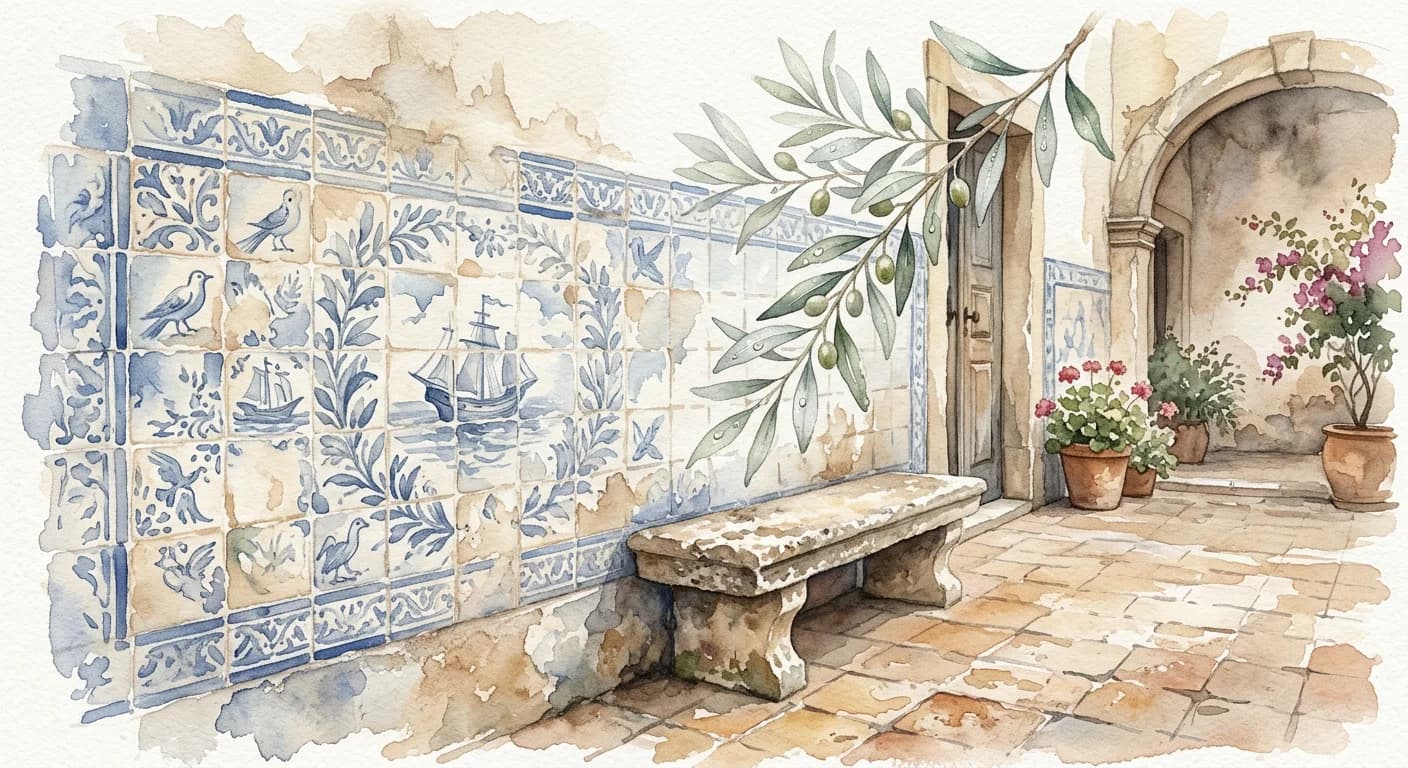
Azulejos
/ah-zoo-LAY-zhosh/
Meaning
Azulejos are the iconic tin-glazed ceramic tiles, predominantly blue and white, that dramatically embellish buildings throughout Portugal and parts of Spain. Far more than mere decoration, these intricate tiles serve as vibrant canvases, narrating historical events, religious parables, or simply captivating geometric patterns. They embody a profound sense of cultural identity and timeless beauty, transforming ordinary surfaces into living tapestries that reflect centuries of artistic tradition and deep Moorish influence, making every glance a journey through heritage.
Literal Translation
tiles
The Story Behind the Word
The word "azulejos" itself derives from the Arabic "az-zulayj," meaning "polished stone," reflecting their origins in the Islamic world. Introduced to the Iberian Peninsula by the Moors, these tiles were initially intricate geometric patterns. After the Christian Reconquista, Portugal developed its unique style, particularly during the 16th to 18th centuries. Azulejos became a national art form, not just for aesthetic appeal but also for practical reasons like insulation and protection against humidity. They covered churches, palaces, and even humble homes, serving as a visual chronicle of the nation's history, faith, and daily life. Their ubiquity reveals a culture that values beauty, storytelling, and an enduring connection to its past, literally embedding history into the very fabric of its architecture.
Experience It
Lisbon's Story Walls
An elderly woman walks through Alfama, her eyes tracing the intricate blue and white azulejos depicting the life of St. Vincent on a church facade. She murmurs, "My grandmother used to point out the details, telling me the stories these tiles hold."
A Coastal Home's Charm
A young couple renovates an old house in Porto. They carefully restore the original azulejos in the kitchen, featuring whimsical scenes of fishing boats and seagulls. "These tiles aren't just pretty," one says, "they feel like the soul of this place, connecting us to the sea."
What Gets Lost in Translation
English speakers often perceive azulejos merely as decorative tiles. However, their significance goes far beyond aesthetics. They are historical documents, spiritual expressions, and a practical architectural solution. To simply call them "tiles" overlooks their deep cultural function as a pervasive storytelling medium and a defining element of Portuguese identity, almost like an outdoor museum.
Across Cultures
While azulejos are uniquely Portuguese, similar traditions of decorative tiles exist across cultures. Islamic art features elaborate zellige and girih tiles in North Africa and the Middle East. Dutch Delftware tiles share the blue and white aesthetic and tin-glaze technique, though their usage and motifs differ significantly, often focusing on domestic scenes rather than large architectural narratives.
The Deeper Meaning
The omnipresence of azulejos in Portugal reveals a philosophy of integrating art into daily life and public spaces, blurring the lines between functional architecture and profound cultural expression. It suggests a worldview where beauty is not a luxury but an inherent part of the environment, and where history and narrative are continuously inscribed, making the past a living, breathing part of the present. They embody a collective memory made tangible.
Did You Know?
Did you know that during the 18th century, a massive earthquake in Lisbon (1755) indirectly led to a boom in azulejo production? The need to rebuild countless structures meant a huge demand for quick, durable, and decorative materials, cementing azulejos' place in Portuguese identity.
How It's Used
Used to refer to the ceramic tiles themselves, and by extension, the architectural style they represent.