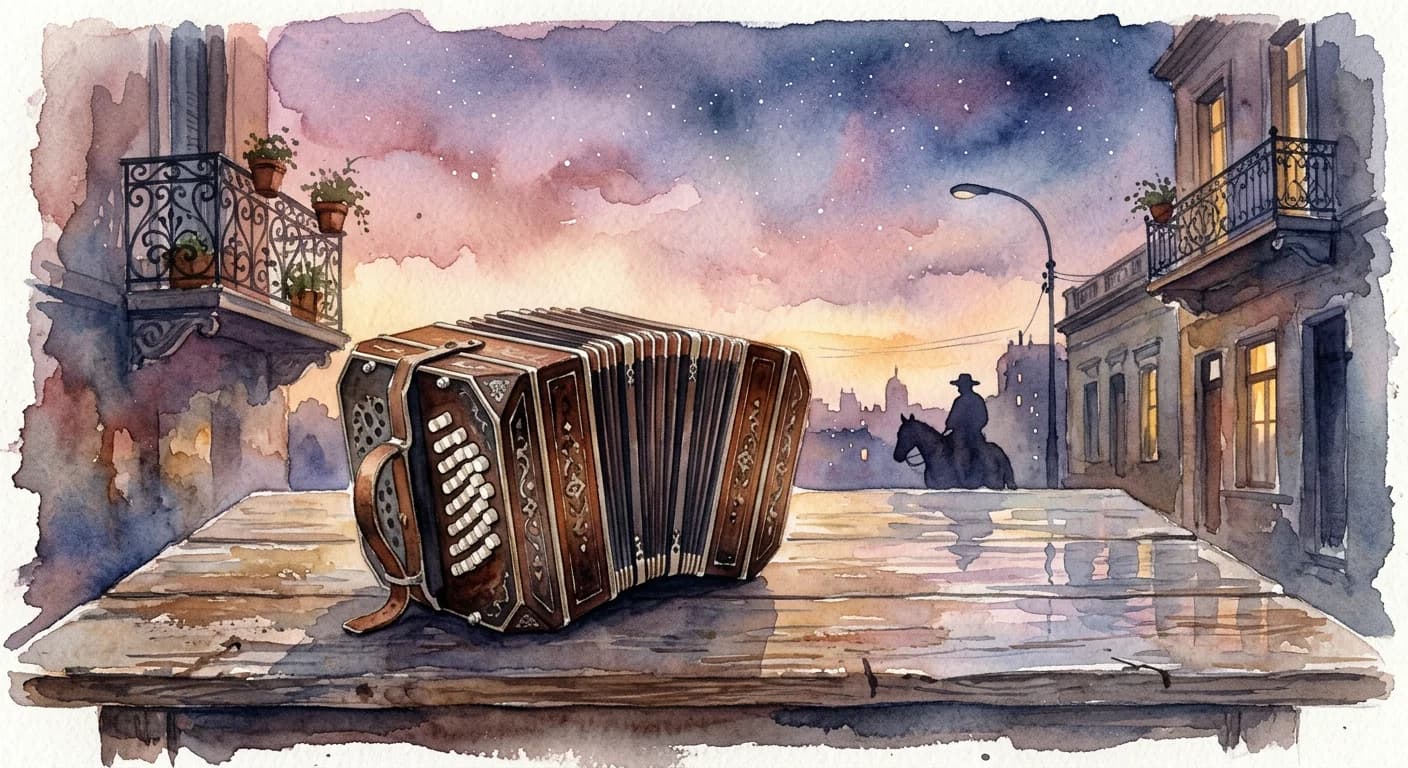
Bandoneón
/bahn-doh-neh-OHN/
Meaning
The bandoneón is far more than a mere musical instrument; it is the throbbing heart of tango, a melancholic and profoundly expressive concertina whose sound evokes the very soul of Argentina. Its bellows breathe life into complex emotions, painting sonic landscapes of longing, passion, and a deep-seated nostalgia for lost loves and bygone eras. The instrument's distinctive, often mournful yet intensely passionate voice is intrinsically woven into the fabric of Argentine and Uruguayan identity, a poignant symbol of their rich cultural heritage and emotional depth.
Literal Translation
bandoneón (instrument)
The Story Behind the Word
The bandoneón's cultural significance in Argentina and Uruguay stems from its pivotal role in the birth and evolution of tango. Originally imported from Germany in the late 19th century, it was adopted by the working-class immigrants and 'compadritos' of Buenos Aires and Montevideo, who found its soulful, often yearning sound perfectly articulated their experiences of displacement, unrequited love, and the struggles of urban life. The instrument's unique ability to produce both sharp, percussive accents and sustained, sorrowful melodies made it ideal for expressing the tango's complex emotional palette – a dance and music born from a fusion of European, African, and indigenous influences. It became the voice of the 'arrabal' (slum) and the 'milonga' (dance hall), embodying the 'porteño' (Buenos Aires native) spirit of resilience, passion, and a profound sense of 'saudade' or 'nostalgia' for a past that perhaps never truly existed. To hear a bandoneón is to feel the pulse of the Rio de la Plata.
Experience It
Milonga's Heartbeat
In a dimly lit milonga in San Telmo, the first notes of a bandoneón cut through the chatter. Its mournful yet powerful wail silences the room, drawing dancers onto the floor as if pulled by an invisible string, their movements mirroring the instrument's passionate lament.
Street Corner Serenade
A lone musician sits on a park bench in Palermo, his bandoneón resting on his lap. As he begins to play a classic tango, passersby pause, captivated by the instrument's soulful cry, a momentary connection to the city's melancholic heart.
The Deeper Meaning
The bandoneón embodies the 'duende' of tango – a raw, almost mystical quality of emotion and expression that emerges from a deep well of suffering and joy. It reflects a worldview where beauty is often found in melancholy, and where profound human experiences like love, loss, and longing are not merely felt, but are given an almost sacred, audible form, connecting the individual to a collective cultural soul.
Did You Know?
Despite its iconic status in Argentine tango, the bandoneón was originally designed in Germany as a cheaper, more portable alternative to the organ for church music, not for dance halls.
How It's Used
Used to refer to the musical instrument essential for playing tango music, particularly in Argentina and Uruguay.