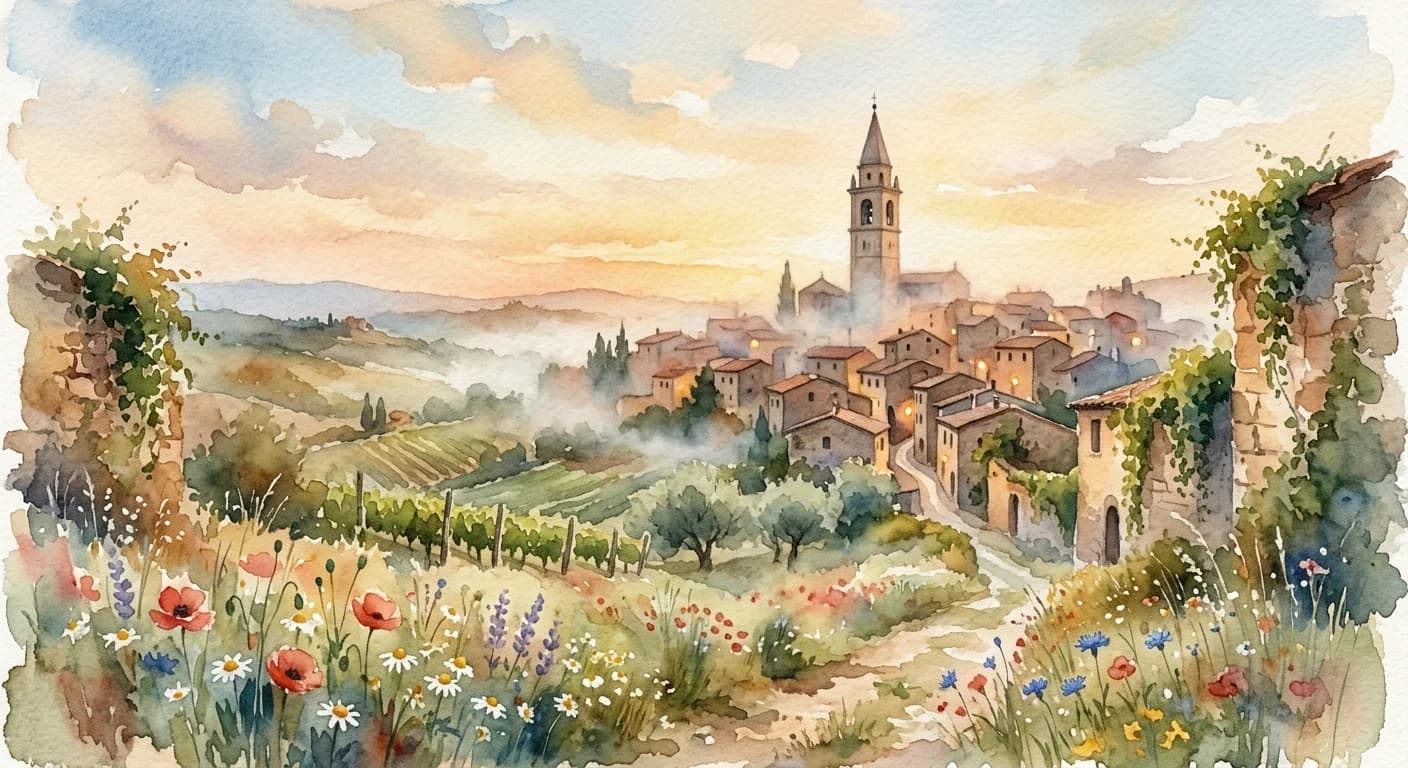
Campanilismo
/cam-pah-nee-LEE-zmoh/
Meaning
Campanilismo encapsulates a fervent devotion to one's hometown or village, a loyalty so profound it's anchored to the very bell tower (campanile) that marks its skyline and tolls its rhythms. It's an ingrained identification with a specific patch of earth, its unique traditions, local dialect, and the community forged within its boundaries. This deep-seated bond fosters an intense sense of belonging and solidarity among locals, often manifesting as a spirited rivalry or even suspicion towards neighboring towns, underscoring the vital role of local identity in the Italian cultural mosaic.
Literal Translation
Bell tower-ism
The Story Behind the Word
The existence of 'campanilismo' is deeply rooted in Italy's historical fragmentation. For centuries, the Italian peninsula was a patchwork of independent city-states, duchies, and kingdoms, each developing its distinct laws, customs, and even languages. The campanile, or bell tower, served as the literal and symbolic heart of these autonomous communities, calling citizens to assembly, warning of danger, and marking the hours of daily life. This history forged an intense localism, where one's primary allegiance was to their immediate community rather than a distant, often non-existent, national identity. It reveals a worldview where identity is intrinsically tied to place, where the familiar landscape and its people define who you are, fostering both fierce pride and a healthy skepticism of 'the other' from just over the next hill. Even after unification, these local identities persisted, shaping everything from cuisine to political allegiances.
Experience It
Town Festival Rivalry
During the annual 'Palio' horse race, the residents of Siena's various contrade (districts) exhibit intense campanilismo. Each contrada's supporters cheer with unbridled passion for their jockeys, often jeering at rivals, showcasing a fierce loyalty to their specific neighborhood that transcends the broader city identity.
Family Dinner Debate
At a Sunday family dinner, Nonna proudly declares that 'our town's olive oil is the best in all of Tuscany,' dismissing her cousin's suggestion that oil from a neighboring village could even compare. Her campanilismo means her local produce is inherently superior, a common and heartfelt belief.
The Deeper Meaning
Campanilismo illuminates a fundamental human need for belonging and a rooted identity. It suggests that our sense of self is not purely individual but is deeply intertwined with the physical and social landscape we inhabit. This philosophy prioritizes the tangible, immediate community over abstract national ideals, fostering a rich tapestry of local cultures and traditions, and highlighting the enduring power of place in shaping human experience.
Did You Know?
Many Italian towns still have distinct dialect variations, sometimes unintelligible just a few kilometers away, a direct legacy of centuries of campanilismo and isolated communities.
How It's Used
Used to describe the strong sense of local identity and pride associated with a particular town or village in Italy, often manifesting as rivalry with nearby towns.