U.
HomeRegionsLanguagesEmotionsCollections
Find Your Word

“The limits of my language mean the limits of my world.”

— Ludwig Wittgenstein, Philosopher

Untranslatable

A curated collection of the world's most beautiful expressions—words that remind us language is humanity's greatest invention.

  • Home
  • Collections
  • Regions
  • Countries
  • Emotions
  • Tags
  • Contexts
  • Finder
  • Europe
  • Asia
  • Americas
  • Africa
  • Middle East
  • About
  • Contact
  • Privacy Policy
  • Terms of Service

2026 © Untranslatable. All rights reserved.

    /
    /
    1. Home
    2. /
    3. Asia
    4. /
    5. Hanamichi
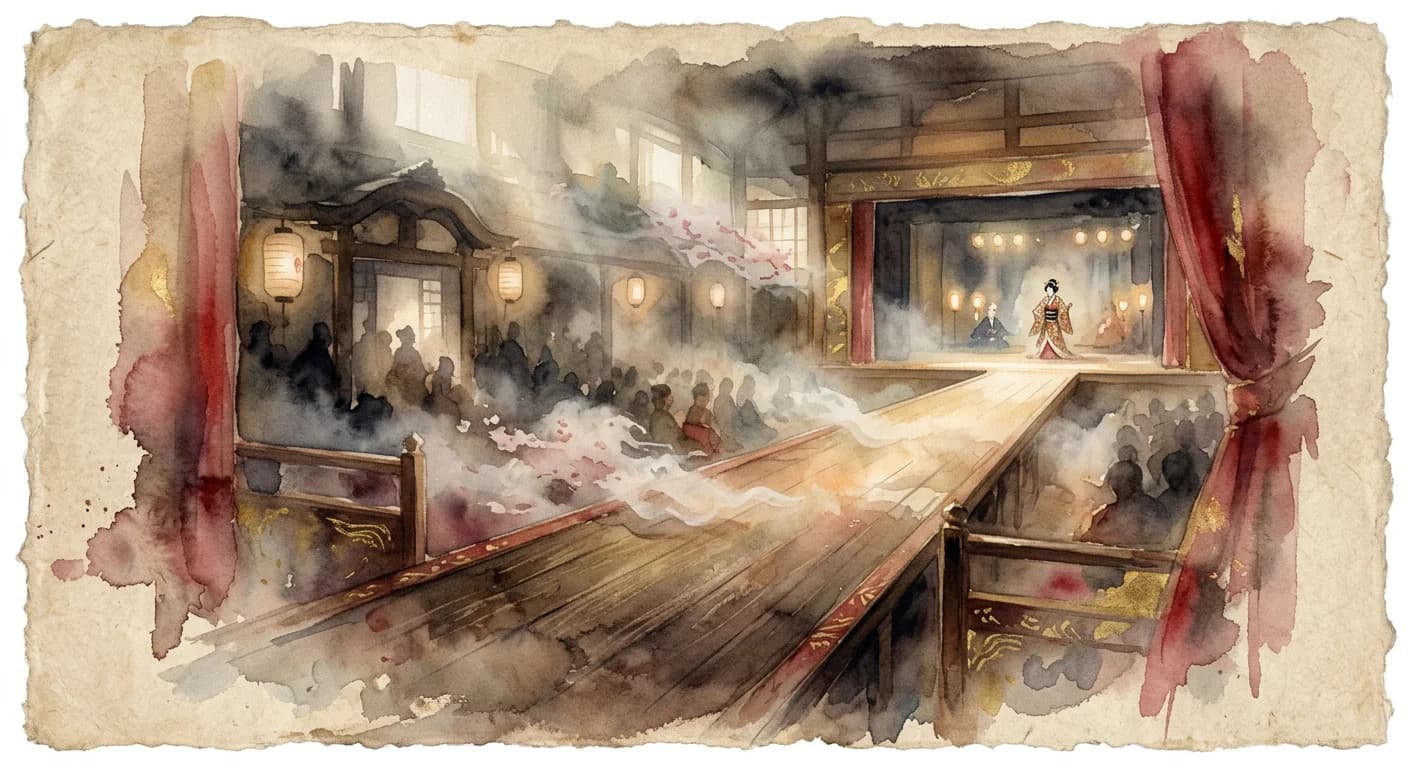
    Artistic representation of Hanamichi
    Japanese•
    🇯🇵Japan

    Hanamichi

    /HAH-nah-mee-chee/

    Meaning

    The Hanamichi is a vibrant, elevated runway cutting through the audience in traditional Japanese Kabuki theaters, extending from the rear of the auditorium to the main stage. More than a mere physical structure, this 'flower path' is a crucial element of dramatic storytelling, serving as a dynamic thoroughfare for actors' grand entrances and climactic exits. It allows performers to forge an intimate, visceral connection with the audience, intensifying emotional impact and building palpable anticipation, thereby transforming passive spectatorship into an immersive shared experience.

    Literal Translation

    flower path

    The Story Behind the Word

    The Hanamichi emerged in the late 17th century, reflecting Kabuki's roots as a popular, often raucous, entertainment for the common people. Unlike the more aristocratic Noh theater, Kabuki sought direct engagement, and the Hanamichi was a revolutionary innovation to bridge the gap between performer and spectator. It embodies the Japanese aesthetic principle of 'ma' (negative space or pause), as actors often perform significant moments on the Hanamichi, using its length to build tension and allow emotions to ripen. Its very presence showcases a cultural value placed on spectacle, direct interaction, and the deliberate crafting of dramatic flow, emphasizing that the journey to and from the stage is as vital as the performance on it. The Hanamichi is a testament to Kabuki's unique theatrical genius in creating an all-encompassing, living art form.

    Experience It

    Hero's Grand Entrance

    As the kuroko pull back the curtain, the hero strides onto the Hanamichi, his elaborate costume gleaming under the lights. He pauses halfway, striking a powerful mie pose, holding the audience spellbound as he locks eyes with them, building immense anticipation for his arrival on the main stage.

    Villain's Dramatic Exit

    Defeated but defiant, the villain slowly retreats down the Hanamichi, his shadow lengthening. He turns one last time to glare at the audience, a chilling smile on his face, leaving a lasting impression of his malevolence long after he disappears from view, his presence lingering in the air.

    The Deeper Meaning

    The Hanamichi embodies a worldview where the journey is as significant as the destination, and where art actively seeks to dissolve the boundaries between creation and reception. It suggests that true engagement requires not just observation, but a shared space and a deliberate pacing that allows emotions to unfold and resonate. This reflects a Japanese aesthetic that values process, anticipation, and the subtle interplay between presence and absence in dramatic expression.

    Did You Know?

    There are sometimes two Hanamichi in a Kabuki theater: the main Hon-Hanamichi and a secondary, narrower Kari-Hanamichi, used for less prominent entrances or to create dynamic crowd scenes.

    How It's Used

    Used to describe the specific elevated runway in Kabuki theaters.

    Emotions
    excitement,wonder
    Contexts
    cultural identity,performance
    🇯🇵Japan

    by Sofia Rossi·Written Mar 14, 2026·Updated Apr 3, 2026

    Related Words

    Explore more
    Wabi-sabiJapanese

    Wabi-sabi is the profound appreciation for the ephemeral, the imperfect, and the incomplete aspects of existence. It is about discovering beauty in the subtle textures of age, the unique character of flaws, and the gentle decay that marks the passage of time. This philosophy encourages a quiet acceptance of impermanence and a mindful connection to the natural world, finding elegance in simplicity and authenticity.

    IkigaiJapanese

    Ikigai is more than just a reason to get out of bed; it's a deeply personal and evolving sense of purpose that brings genuine fulfillment and joy to one's life. It represents the sweet spot where your passions, talents, needs of the world, and what you can be paid for beautifully converge. Discovering your ikigai often leads to a life lived with intentionality, resilience, and a profound connection to one's contributions. It's the intrinsic motivation that fuels a meaningful existence, regardless of external circumstances.

    NunchiKorean

    Nunchi is the sophisticated, almost telepathic, ability to instantly grasp the unspoken dynamics of any social situation, anticipating others' thoughts and feelings, and then responding with impeccable grace and timing. It's an acute form of social intuition, allowing one to navigate complex interpersonal landscapes by reading subtle cues like body language, tone, and context. Possessing good nunchi means effortlessly understanding the underlying emotional currents and adjusting one's behavior to maintain harmony and effectiveness, often without a single word exchanged.

    JugaadHindi

    Jugaad is more than just a quick fix; it embodies the spirit of resourceful, ingenious improvisation in the face of scarcity or systemic challenges. It's the art of bending rules, repurposing materials, and thinking outside the box to achieve a desired outcome, often with limited financial or technological resources. This approach celebrates clever workarounds and innovative adaptations, turning constraints into catalysts for creative problem-solving. It's about making do and making something work, brilliantly.