Colluvies
/koh-LOO-vee-ays/
Meaning
Colluvies describes a chaotic agglomeration, a jumble where distinct elements have lost their individual identity, merging into an undifferentiated mass. It evokes not just a simple collection, but a veritable mess, whether it's a physical pile of debris, a confused crowd, or even a tangled web of contradictory ideas. The term conveys a sense of disarray and a lack of clear order, implying that what once might have been separate has now become inextricably, often unpleasantly, intermingled.
Literal Translation
heap, collection, jumble
The Story Behind the Word
The existence of 'colluvies' in Latin reflects a Roman sensibility that valued order, structure, and clear boundaries. For a culture that prided itself on its engineering, legal codes, and societal hierarchy, a 'colluvies' represented the antithesis of their ideals. It speaks to a deep-seated apprehension of chaos and the dissolution of form, whether in the natural world (a landslide, a flood's detritus) or the social sphere (a mob, a corrupted argument). This word isn't merely descriptive; it carries a subtle judgment, highlighting a state that deviates from the preferred Roman ideal of clarity and organization. It reveals a worldview where distinguishing and categorizing are paramount, and anything that blurs those lines is inherently problematic.
Experience It
Archaeological Dig Site
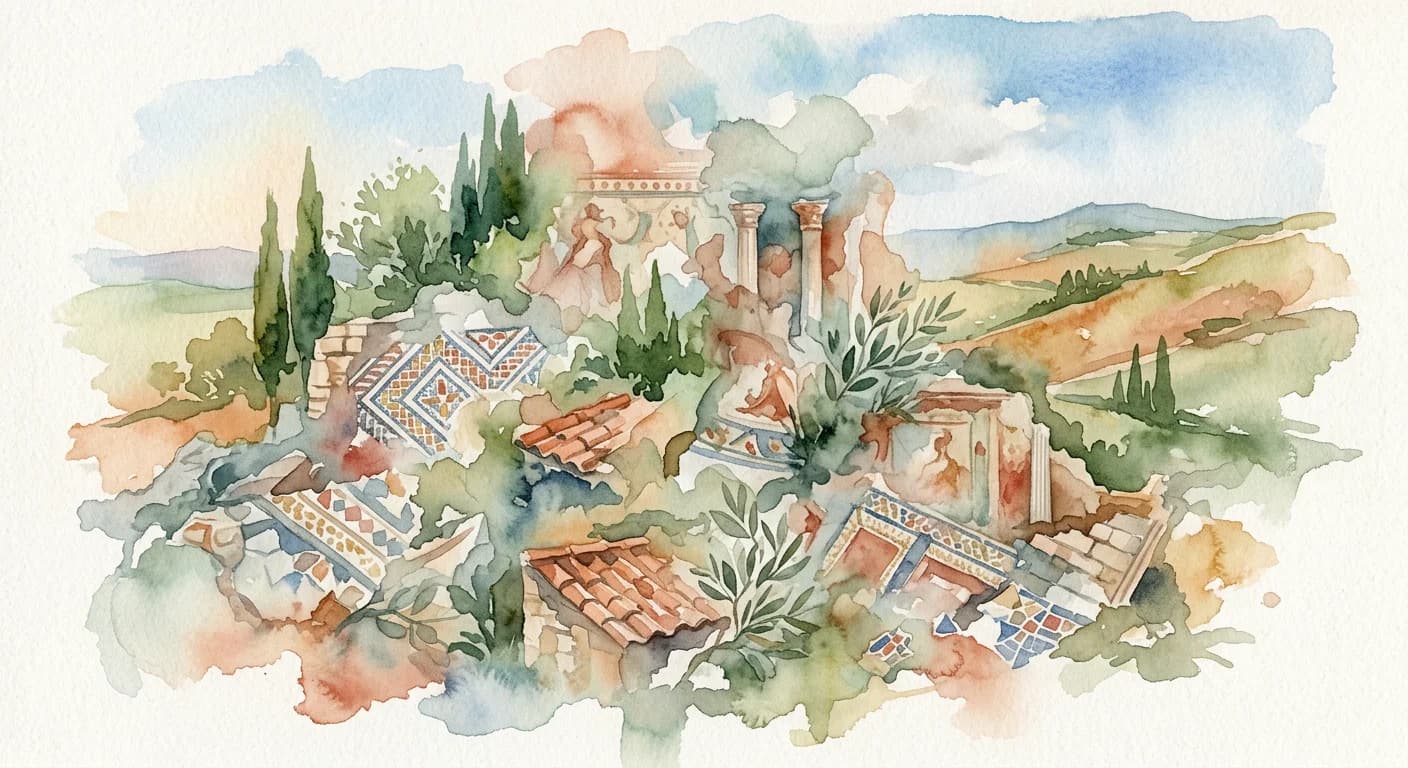
After centuries, the collapsed building left a colluvies of pottery shards, broken roof tiles, and scattered human remains, making it incredibly difficult for the archaeologists to discern the original structure or individual lives.
Rhetorical Confusion
The senator's speech was a colluvies of unrelated facts, emotional appeals, and half-baked theories, leaving the audience utterly confused about his actual policy stance.
The Deeper Meaning
The concept of 'colluvies' subtly underscores a classical emphasis on 'form' over 'formlessness.' It suggests that true understanding and beauty arise from distinct, well-defined components, and that a lack of such distinction leads to confusion and degradation. This reflects a philosophical inclination towards order, classification, and the inherent value of discernible structure in both the physical and intellectual realms.
Did You Know?
Did you know 'colluvies' is still used in geology to describe unconsolidated, heterogeneous sediments accumulated at the base of slopes, literally a 'heap' of eroded material?
How It's Used
Primarily used in academic or historical contexts when discussing ancient texts or concepts originating from Latin literature.