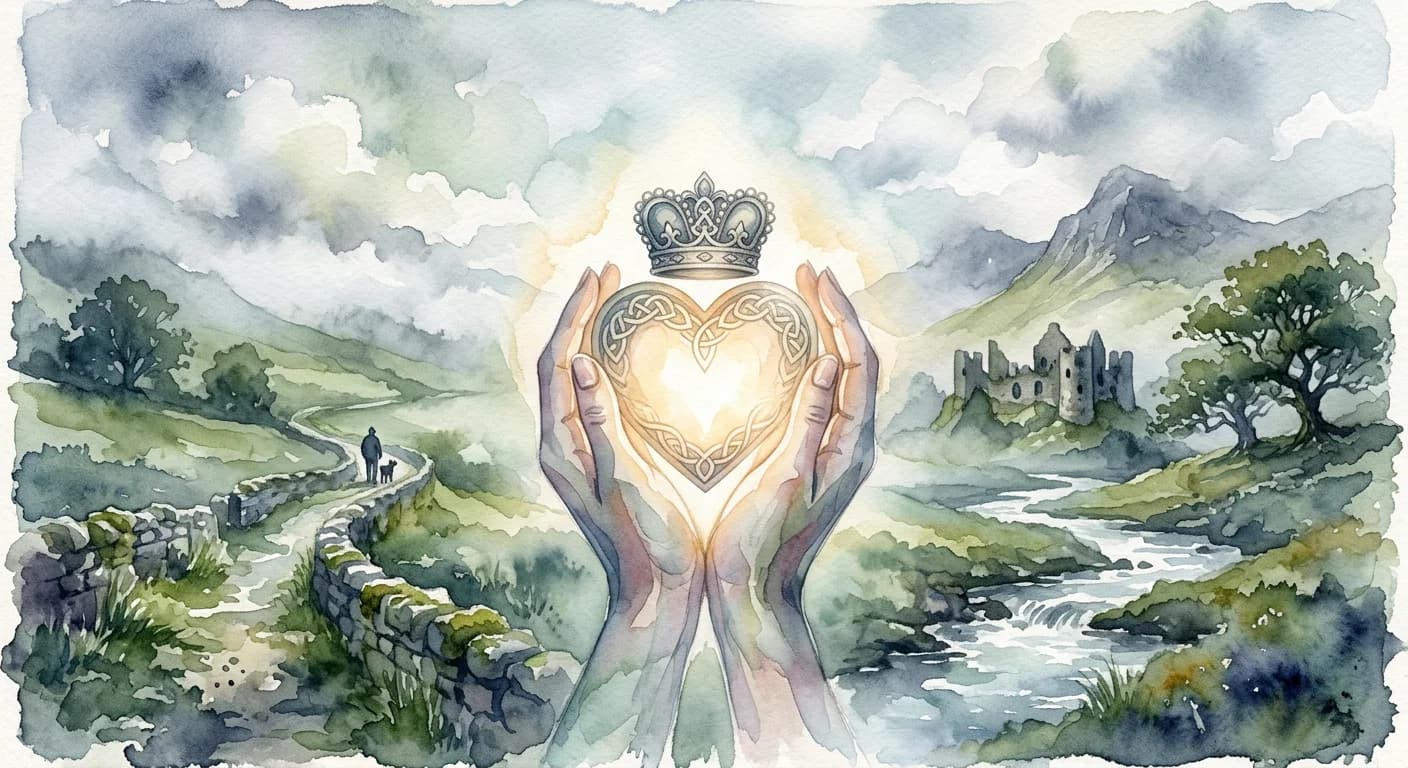
Claddagh
/CLAH-dag/
Meaning
The Claddagh is a potent Irish emblem, intricately weaving together the profound sentiments of love, unwavering loyalty, and steadfast friendship. Its iconic design, featuring two hands embracing a crowned heart, speaks volumes: the hands symbolize the bond of friendship, the heart represents love freely given, and the crown signifies enduring loyalty. More than mere adornment, it embodies a holistic philosophy of interconnected relationships, where affection, camaraderie, and steadfast commitment are inextricably linked, forming the very foundation of human connection.
Literal Translation
The name 'Claddagh' refers to the Claddagh district of Galway city in Ireland, where the ring originated. It doesn't have a direct literal translation in the sense of a descriptive phrase.
The Story Behind the Word
The Claddagh ring emerged from the fishing village of Claddagh in Galway, Ireland, during the 17th century, steeped in local legend, most famously the tale of Richard Joyce, a goldsmith abducted by pirates. Its enduring popularity stems from its embodiment of core Irish values: the importance of kinship, community, and deeply personal bonds. This symbol reflects a culture that cherishes loyalty and affection, often expressed through tangible tokens and generational traditions. It speaks to a worldview where relationships are not fleeting but are cultivated with devotion, passed down through families, and worn as proud declarations of one's relational state and emotional commitments. The Claddagh reveals a people who see relationships as sacred, requiring both tender love and staunch allegiance.
Experience It
A Mother's Legacy
On her wedding day, Aoife's grandmother presented her with a worn silver Claddagh ring. 'This was my mother's, and now it's yours,' she said, 'a reminder of the love, loyalty, and friendship that built our family and will build yours.' Aoife slipped it on her left hand, heart pointing inwards, feeling the weight of generations of devotion.
Seeking Connection
At a pub in Galway, Liam noticed a woman across the room wearing a Claddagh on her right hand, heart pointing outwards. He smiled, understanding her silent signal that she was open to meeting someone new. Emboldened, he approached her, a shared cultural understanding bridging the initial gap.
The Deeper Meaning
The Claddagh encapsulates a philosophy of relational integrity. It posits that true connection is not merely romantic love, but a robust combination of affection (heart), mutual support (hands), and unwavering fidelity (crown). This suggests a worldview where relationships are built on a tripod of virtues, each essential for stability and longevity, emphasizing the holistic nature of human bonds rather than isolating individual sentiments. It speaks to a deep-seated belief in the power and sanctity of committed interpersonal ties.
Did You Know?
Legend claims the Claddagh ring was designed by Richard Joyce, a Galway man captured by pirates and enslaved as a goldsmith, who crafted the ring during his captivity before returning to his beloved.
How It's Used
The Claddagh is most commonly seen in jewelry, particularly rings, which are often passed down through families. The way the ring is worn can signify a person's relationship status: on the right hand with the point of the heart facing inwards indicates a relationship is being sought, while on the left hand with the point facing inwards signifies commitment or marriage.