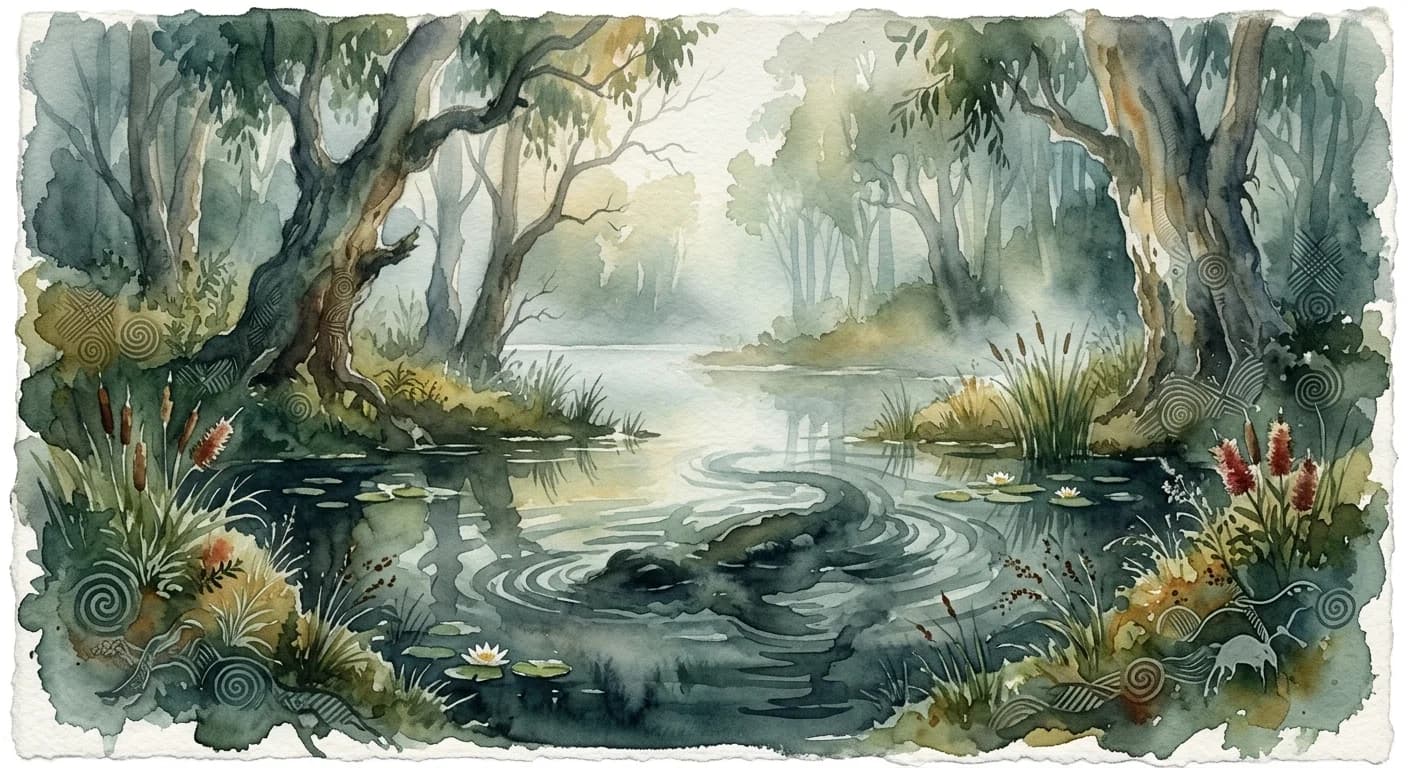
Bunyip
/BUN-yip/
Meaning
The Bunyip is a formidable mythical entity woven into the fabric of Australian Aboriginal folklore, manifesting as a fearsome beast inhabiting the deep, murky waters of swamps, billabongs, and riverbeds. Its diverse forms and names across different Indigenous language groups underscore the continent's rich tapestry of beliefs, often portraying it as a bringer of danger, its haunting cries serving as a dire warning. More than just a monster, the Bunyip embodies the untamed, mysterious, and sometimes perilous forces of the Australian landscape, reflecting the profound respect and understanding Indigenous cultures hold for their environment.
Literal Translation
The literal meaning varies greatly due to the multitude of Aboriginal languages, but often relates to 'evil spirit' or 'monster'.
The Story Behind the Word
The Bunyip's existence in Aboriginal culture is deeply rooted in the practical realities and spiritual interpretations of the Australian landscape. It serves as a potent pedagogical tool, teaching respect for dangerous waters and the unpredictable aspects of nature, especially to children. Philosophically, the Bunyip represents the liminal spaces and the unknown within the familiar, reinforcing the idea that the land is alive with powerful, often unseen, spirits and forces that demand reverence. Its varied descriptions across different language groups highlight the localized knowledge and unique relationship each community has with its specific environment, affirming that the land itself dictates the nature of its guardian spirits. The Bunyip thus reflects a worldview where humanity is intricately interwoven with, and accountable to, the natural world and its ancient, powerful inhabitants.
Experience It
Warning by the Billabong
As the sun dipped, painting the billabong in fiery hues, young Marlee heard a deep, mournful bellow emanating from the water's edge. Her grandmother, beside her, gripped her arm tightly and whispered, 'That's the Bunyip's cry, child. Remember, stay away from the water at dusk, for it guards its home fiercely.'
Ancient Storytelling
Around the crackling campfire, Old Man Jarrah recounted tales of the formidable Bunyip, its eyes glowing red in the moonless night. His voice, low and resonant, filled the air, imbuing the children with a healthy fear and respect for the deep, dark places in the rivers and swamps, ensuring they understood the land's ancient power.
The Deeper Meaning
The Bunyip embodies the Indigenous Australian philosophy of interconnectedness with country, where every element of the landscape, even its dangers, possesses a spiritual dimension. It underscores a worldview that values caution, respect for natural boundaries, and an understanding that the environment is not merely a resource but a living entity with its own powerful, sometimes fearsome, guardians and spirits. This entity teaches humility before nature's might.
Did You Know?
Some early European settlers, encountering Aboriginal stories of the Bunyip, actually believed it was a real, undiscovered megafauna, leading to sporadic and unsuccessful 'Bunyip hunts' in the 19th century.
How It's Used
The term 'Bunyip' is used in storytelling, folklore, and cultural references within Australia, particularly in relation to Indigenous Australian mythology and the natural environment.