Memsahib
/MEM-sah-hib/
Meaning
Memsahib transcends a mere title; it was a socio-cultural identifier during the British Raj, primarily for married European or Anglo-Indian women of elevated status. It encapsulated not just respect but also a clear acknowledgment of her position within the colonial hierarchy and domestic sphere. This term conveyed deference, recognizing her as the lady of the house, often with authority over household staff, and marked her distinct social standing from local women, embodying a complex interplay of power, politeness, and colonial-era stratification.
Literal Translation
Madam/Mistress
The Story Behind the Word
The term 'Memsahib' is deeply rooted in the power dynamics and social stratification of the British Raj in India. Its existence stems from the need of the Indian populace, particularly domestic staff and local traders, to address European women in a manner that acknowledged their perceived superiority and colonial authority. It wasn't just a translation of 'madam' but rather a linguistic marker of the vast cultural and social chasm between the colonizers and the colonized. The word reveals a society where deference was a survival mechanism and a form of social navigation, reflecting the British perception of their own racial and social supremacy, which was then mirrored in the language used by Indians. It highlights the formal, often transactional, nature of interactions between these groups, where respect was mandated by power rather than necessarily earned through personal relationship.
Experience It
Household Instructions
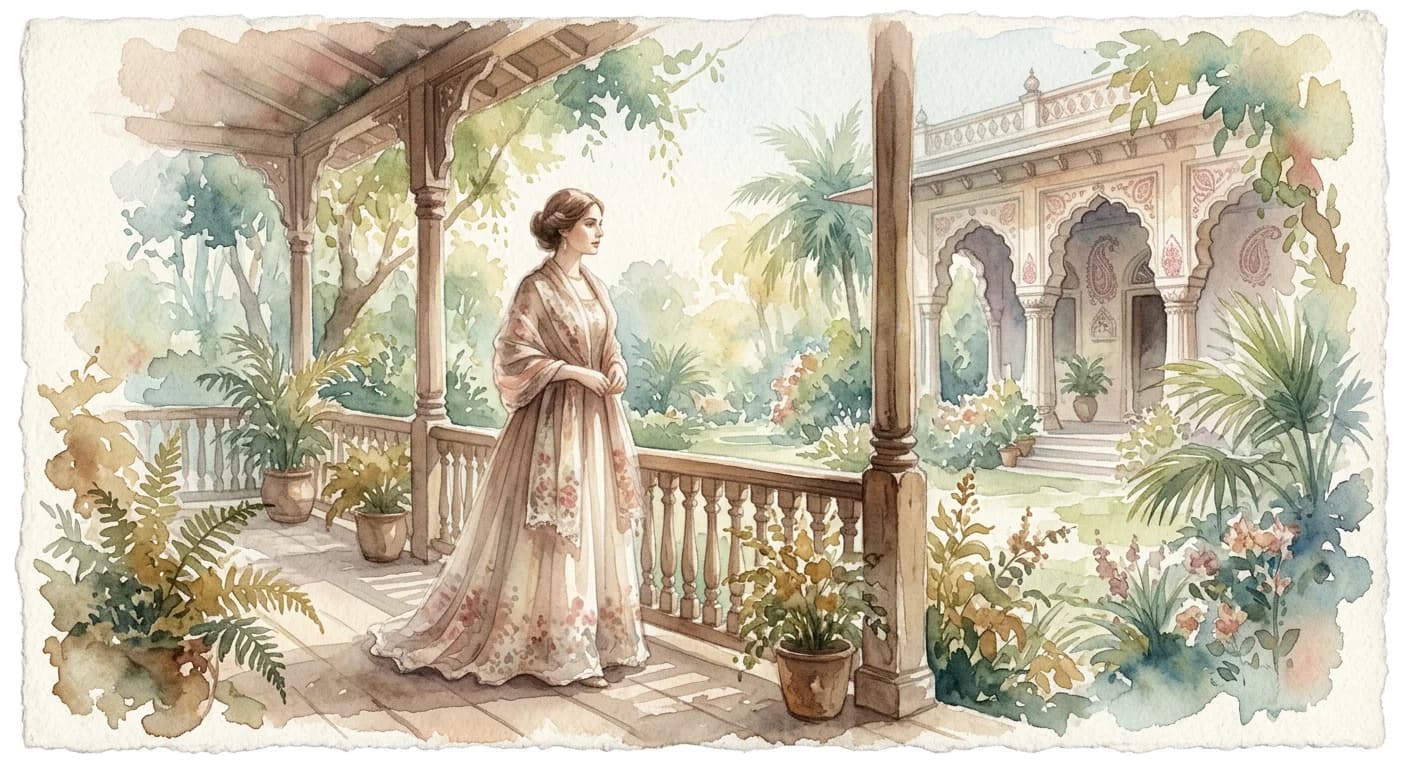
In a grand colonial bungalow, the head cook bows slightly, awaiting instructions. "Memsahib," he begins, "the bazaar has fresh fish today. Shall I prepare it for dinner?" The Memsahib, seated at her breakfast table, nods, appreciating the respectful address that acknowledges her authority over the household's culinary affairs.
Social Visit Deference
A local merchant, hoping to sell his silks, approaches the veranda. He addresses the woman tending to her garden with a polite, "Good afternoon, Memsahib. May I show you my latest collection?" The term immediately sets the tone, recognizing her status and the expected formality of their interaction, even in a casual setting.
The Deeper Meaning
The existence and widespread use of 'Memsahib' encapsulate a colonial-era philosophy of inherent social hierarchy based on race and origin. It reveals a worldview where power structures were explicitly embedded in language and daily interactions, defining who held authority and who was expected to defer. This linguistic marker underscores the psychological impact of colonialism, where even titles served to reinforce and perpetuate the subjugation of one group by another, shaping perceptions of self and 'other'.
Did You Know?
The term 'Memsahib' is derived from 'Mem,' a corruption of 'Madam,' and 'Sahib,' a respectful title meaning 'master' or 'lord,' literally translating to 'Madam-Master' or 'Lady Master,' underscoring the hybrid nature of colonial language.
How It's Used
Used as a respectful form of address or reference for a European or Anglo-Indian woman, especially a married one, during the colonial era and its lingering social influences. It was common in households and everyday interactions.