Ogham
/OH-um/
Meaning
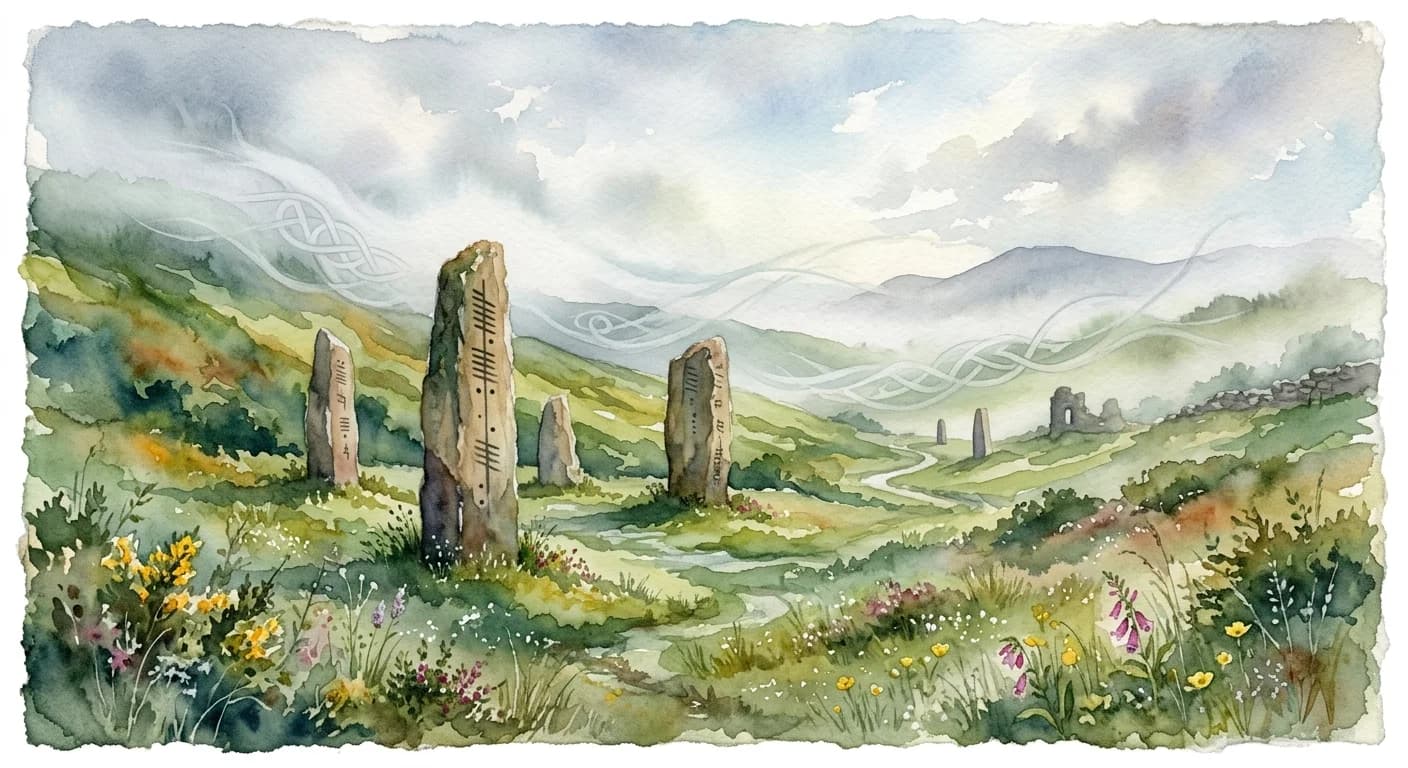
Ogham is more than just an ancient Irish alphabet; it is a profound visual language etched into the very landscape of Ireland, predominantly on stone monuments. Characterized by its distinctive series of strokes and notches along a central stem line, it served as a powerful declaration of identity and territorial claim. Beyond its literal function, Ogham embodies the mystical heart of Gaelic culture, linking the physical world to ancestral wisdom and the enduring spirit of a unique heritage.
Literal Translation
The origin and exact meaning of the word 'Ogham' are uncertain, though some theories link it to the Irish word 'ogham' meaning 'sharpness' or 'pointedness', possibly referring to the way the letters were carved.
The Story Behind the Word
Ogham emerged in early medieval Ireland, roughly between the 4th and 7th centuries AD, a period marked by the transition from pre-Christian Celtic traditions to the advent of Christianity. Its existence speaks volumes about a highly literate and organized society that valued both written communication and monumental commemoration. The practice of carving Ogham onto standing stones, often marking tribal boundaries or ancestral graves, reveals a deep connection to land, lineage, and the spiritual world. These stones were not merely markers but sacred objects, embodying the presence of the ancestors and the continuity of the clan. The secrecy and somewhat cryptic nature of Ogham, sometimes referred to as 'the alphabet of the trees' due to later associations, also hints at a society that understood the power of esoteric knowledge and symbolic language, often tied to druidic traditions and nature worship. It reflects a worldview where history, identity, and spirituality were inextricably intertwined with the physical environment.
Experience It
Unearthing Ancient Voices
A young archaeologist brushes away centuries of soil to reveal an ancient standing stone. Her fingers trace the familiar series of notches and lines – Ogham. A shiver runs down her spine, connecting her directly to the distant ancestors who carved their names and claims into the very rock of Ireland.
Modern Artistic Interpretation
In a contemporary Irish art gallery, a sculptor presents a striking piece: a modern interpretation of Ogham, its abstract lines representing a poem about Irish identity. Visitors gaze at the work, feeling the ancient script's enduring power to evoke heritage and connection to the land.
The Deeper Meaning
Ogham embodies a philosophy of permanence and ancestral connection. By carving words into stone, the ancient Irish sought to make their presence and lineage enduring, linking the fleeting human lifespan to the eternal landscape. It reflects a worldview where the past is not merely history but a living presence, constantly informing and shaping the present identity of a people and their land.
Did You Know?
Many Ogham inscriptions are read from bottom to top, sometimes even continuing over the top of the stone and down the other side, making them a truly unique reading experience!
How It's Used
Ogham is used to refer to the ancient Irish script itself, its inscriptions, and sometimes metaphorically to represent ancient Irish heritage and language.