U.
HomeRegionsLanguagesEmotionsCollections
Find Your Word

“The limits of my language mean the limits of my world.”

— Ludwig Wittgenstein, Philosopher

Untranslatable

A curated collection of the world's most beautiful expressions—words that remind us language is humanity's greatest invention.

  • Home
  • Collections
  • Regions
  • Countries
  • Emotions
  • Tags
  • Contexts
  • Finder
  • Europe
  • Asia
  • Americas
  • Africa
  • Middle East
  • About
  • Contact
  • Privacy Policy
  • Terms of Service

2026 © Untranslatable. All rights reserved.

    /
    /
    1. Home
    2. /
    3. Americas
    4. /
    5. Quipu
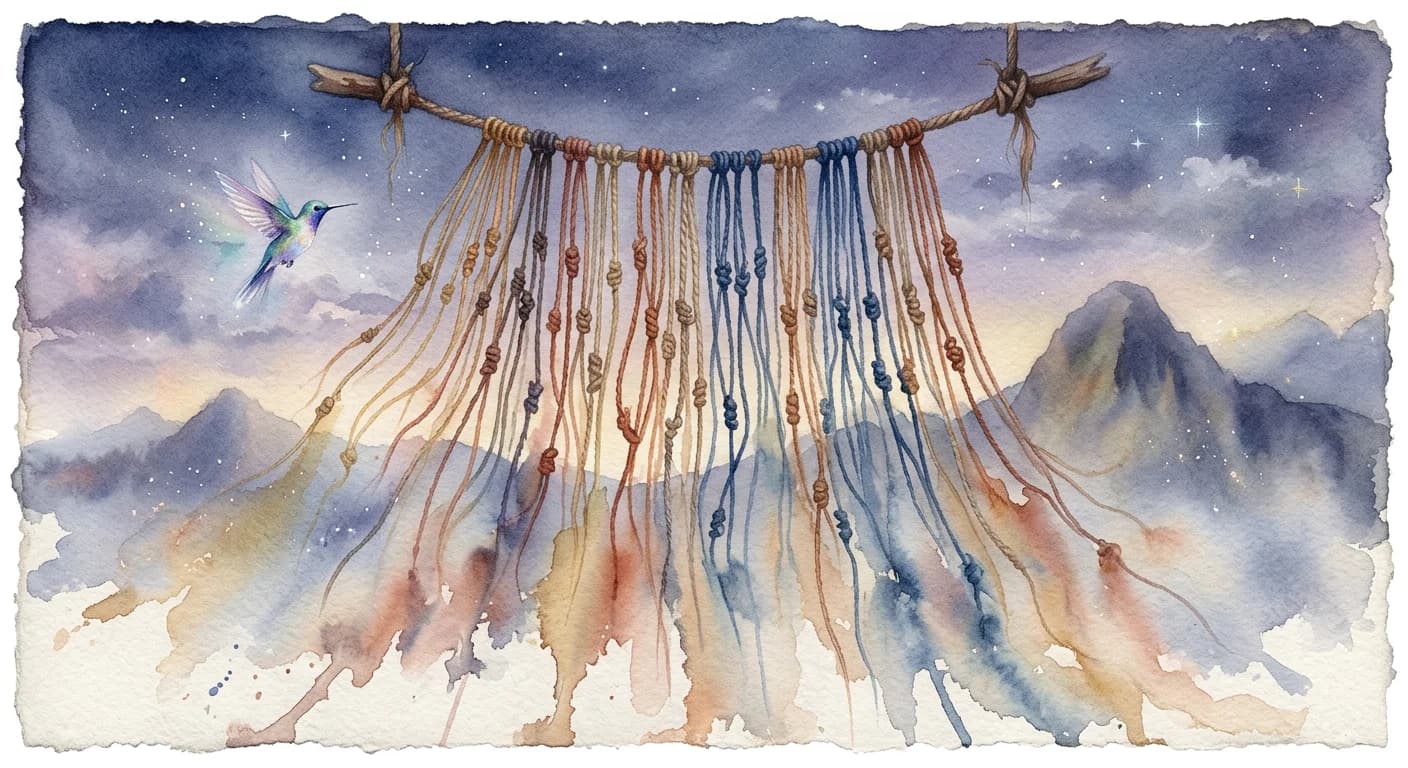
    Artistic representation of Quipu
    Quechua•
    🇧🇴Bolivia🇪🇨Ecuador🇵🇪Peru

    Quipu

    /KEE-poo/

    Meaning

    A Quipu is a remarkable system of knotted cords, intricately crafted by the Inca and pre-Inca Andean civilizations to record and transmit vast amounts of information. Far from simple tallies, the specific type of fiber, color, direction of ply, knot configurations, and their spatial relationships encoded complex data ranging from census figures and astronomical observations to historical narratives and legal codes. These tactile archives served as the backbone of administration and knowledge preservation across an immense empire, demonstrating a sophisticated non-verbal literacy.

    Literal Translation

    knot

    The Story Behind the Word

    The Quipu stands as a profound testament to Andean ingenuity and their unique approach to knowledge. In a civilization without a phonetic writing system, the Quipu became the repository of collective memory, allowing for precise record-keeping vital for managing a vast, complex empire that spanned diverse geographies. Its existence reveals a culture that valued tactile and spatial intelligence, where information was not just read but felt and interpreted through symbolic patterns. The Quipu wasn't merely a tool; it embodied the Inca's administrative prowess, their sophisticated understanding of mathematics and statistics, and their ability to govern and communicate across immense distances, linking disparate communities under a cohesive imperial structure.

    Experience It

    Census Data Collection

    An Inca official, a 'quipucamayoc,' meticulously adds new knots to a Quipu, recording the recent birth of twins in a remote Andean village. Each knot, its position and type, precisely tracks the population growth, agricultural output, and available labor for the regional governor, ensuring the empire's resources are accurately accounted for.

    Recalling History

    Before the Sapa Inca, a revered elder traces his fingers along a complex Quipu, reciting the lineage of past emperors and key historical events. The intricate patterns of knots and cords serve as mnemonic devices, guiding his oral narrative and preserving the collective history of the Inca people for generations.

    The Deeper Meaning

    The Quipu reflects an Andean worldview where knowledge is embodied and relational, not purely abstract. It suggests a philosophy where information is interconnected, with each knot's meaning derived from its relationship to others, mirroring the communal and interdependent nature of Inca society. This tactile form of record-keeping emphasizes memory, interpretation, and the active engagement of the 'reader' in unlocking its meaning, a stark contrast to linear, phonetic scripts.

    Did You Know?

    Despite centuries of study, many Quipus remain undeciphered, leading some modern researchers to believe they might also encode actual spoken language, making them potentially the world's only known three-dimensional writing system.

    How It's Used

    Historically used by the Inca Empire for record-keeping and communication. Modern usage refers to the historical artifact and its significance.

    Emotions
    gratitude,wonder
    Contexts
    celebration,history,work
    🇧🇴Bolivia🇪🇨Ecuador🇵🇪Peru

    by Anya Petrova·Written Mar 14, 2026·Updated Apr 3, 2026

    Related Words

    Explore more
    Pura vidaSpanish

    More than just 'pure life,' "Pura vida" encapsulates a profound philosophy of embracing the present moment with unwavering optimism and gratitude. It's a daily commitment to finding joy in simple pleasures, accepting life's challenges with a positive spirit, and prioritizing well-being over material possessions. This ubiquitous phrase reflects a national identity built on resilience, community, and an deep appreciation for nature's bounty.

    MamihlapinatapaiYaghan

    Mamihlapinatapai encapsulates that profound, unspoken moment when two individuals lock eyes, each silently acknowledging a mutual desire or intention, yet both hesitate to be the first to act upon it. It's a delicate dance of anticipation, a shared gaze brimming with common understanding and a quiet longing for the other to break the ice. This intricate look carries the weight of a shared, uninitiated potential, a silent conversation where both parties are perfectly aware of what could happen, but neither makes the first move.

    TingoPascuense

    Tingo describes the subtle, insidious process of progressively appropriating a neighbor's belongings by habitually requesting to borrow them, only to 'forget' their return. It's not outright theft, but a slow, deliberate erosion of another's possessions, often under the guise of neighborly exchange. This gradual accumulation, piece by piece, ultimately results in a significant transfer of goods without any direct confrontation or formal acknowledgment of the loss. It speaks to a passive-aggressive form of acquisition, where social niceties are weaponized.

    SamfundssindDanish

    Samfundssind is the profound, almost spiritual, commitment to the collective good that transcends individual desires. It's a deeply ingrained societal ethos where citizens instinctively understand their role in maintaining the health and harmony of the community, especially during challenges. This isn't just about following rules; it's an active, empathic engagement with society's needs, fostering a powerful sense of shared destiny and mutual care that underpins Danish social cohesion.