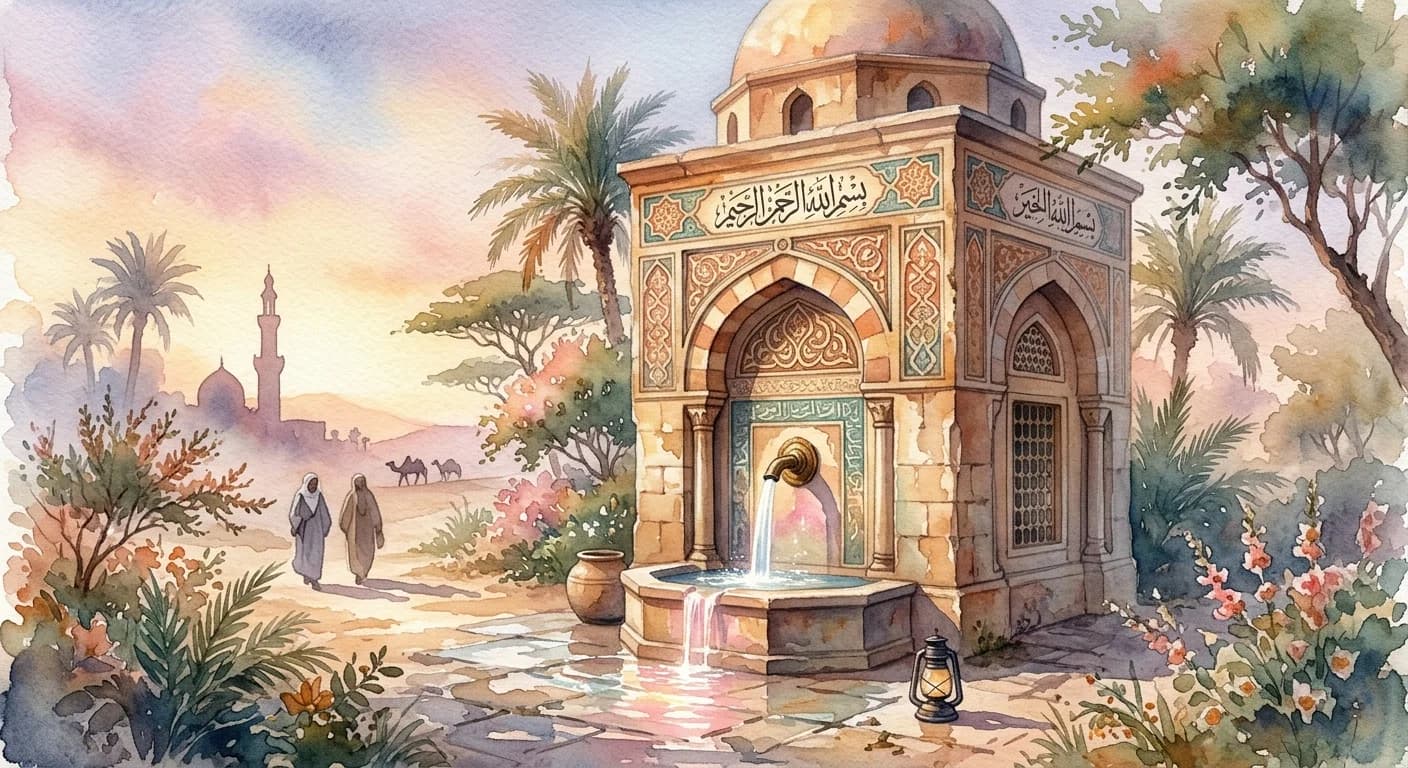
Sabil
/SAH-beel/
Meaning
Sabil, in the Egyptian context, refers to a public water fountain, often an exquisitely decorated architectural marvel, established through pious endowment (waqf). More than just a source of hydration, it embodies a profound act of selfless charity and devotion, reflecting the Islamic principle that providing water is among the most meritorious deeds. These structures historically served as vital lifelines for communities, offering succor to travelers and the thirsty, symbolizing generosity, community welfare, and the enduring spiritual legacy of benevolent patrons.
Literal Translation
Path or way (in classical Arabic); however, in common usage, it refers to a public fountain.
The Story Behind the Word
The existence of 'sabil' is deeply rooted in Islamic tradition, particularly the emphasis on charity (sadaqah) and the spiritual reward for providing water. The Quran and Hadith frequently highlight the sanctity of water and the virtue of sharing it. In arid regions like Egypt, access to clean water was historically a matter of survival, elevating the act of building a sabil from mere charity to a profound humanitarian and religious duty. These structures often became architectural masterpieces, reflecting the patron's piety, wealth, and desire for an enduring legacy. They reveal a worldview where earthly resources are seen as divine trusts, to be shared for the common good, and where acts of generosity are believed to secure blessings in the afterlife.
Experience It
Thirsty Traveler's Respite
Under the scorching Cairo sun, a weary traveler spots the ornate facade of a sabil. He approaches, gratefully cupping his hands to drink from the cool, flowing water, a silent prayer of thanks for the benevolent soul who endowed this life-giving source centuries ago.
Community Gathering Point
Children play near the historic sabil in their neighborhood, its stone basin providing a constant, refreshing presence. For generations, this sabil has not only quenched thirst but also served as a natural meeting point, a silent witness to countless daily lives and community interactions.
The Deeper Meaning
The concept of 'sabil' encapsulates a philosophy where human well-being is intrinsically linked to divine reward. It underscores the belief that true wealth lies in one's capacity for generosity and that providing fundamental necessities like water is a direct path to spiritual merit. It champions the idea of enduring legacy through selfless acts, demonstrating a societal value placed on communal welfare over individual accumulation.
Did You Know?
Many historic sabils in Cairo were built at busy intersections, often combined with a kuttab (Quranic school for children) on the upper floor, thus providing both physical and spiritual nourishment.
How It's Used
The term 'sabil' is used to refer to public water fountains or drinking fountains, particularly those that are historically significant or endowed as charitable acts. It can also metaphorically refer to any act of providing a public service or charity.