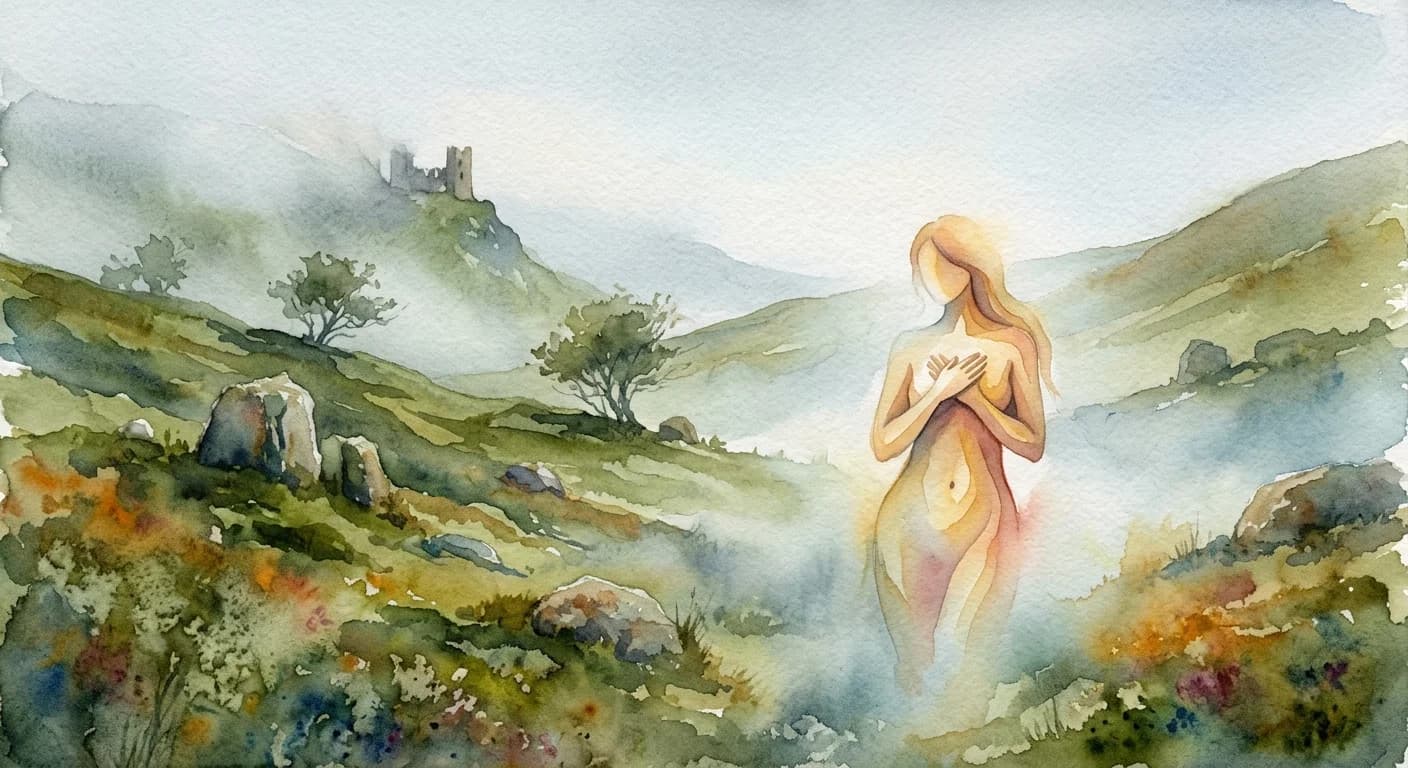
Sheela na gig
/SHEE-lah nah GIG/
Meaning
A Sheela na gig is a striking, often grotesque, stone carving predominantly found on medieval churches and castles in Ireland and Britain, depicting a naked woman explicitly displaying her vulva. These figures are not merely decorative, but potent symbols believed to embody fertility, raw sexuality, and the primal life-force, acting as powerful wards against evil. Their unapologetic explicitness and ancient origins evoke a deep connection to pre-Christian beliefs, representing an untamed feminine power that both challenges and predates dominant patriarchal religious narratives.
Literal Translation
Naked woman
The Story Behind the Word
The Sheela na gig exists within a fascinating intersection of pagan continuity and early Christian adaptation in Ireland. Far from being simple pornography, these figures likely represent a syncretic survival of ancient Celtic mother goddess or fertility cults, subtly integrated into Christian architecture. Their placement on churches suggests a perceived apotropaic (evil-averting) function, perhaps harnessing the powerful, life-giving, and death-dealing aspects of the feminine divine to protect sacred spaces. This reveals a worldview where the sacred was not always sanitized or desexualized; instead, the raw, generative power of female sexuality was acknowledged, even revered, as a fundamental force in the cosmos, capable of both creation and protection. It speaks to a culture that, for a time, found a way to incorporate primal, earthy energies into its spiritual landscape.
Experience It
Archaeological Discovery
Dr. O'Connell carefully brushed away the soil, revealing the unmistakable contorted face and spread legs of a Sheela na gig carved into the fallen stone. 'Another one,' she murmured, 'guarding the ruins, just as she guarded the living centuries ago. Still powerful, even in silence.'
Folklore Tour
The tour guide gestured towards the weathered carving above the church door. 'Legend says the Sheela na gig scares away the devil himself, her raw power too confronting for evil. She reminds us that life and creation are fierce, not always gentle.'
The Deeper Meaning
The Sheela na gig embodies a profound philosophical tension between purity and primal force, challenging conventional notions of sacredness. It suggests a worldview where the divine feminine, in its most unvarnished and fertile form, was seen not as a source of shame but as an essential, protective, and generative aspect of existence. This challenges linear progress narratives, highlighting how ancient, earthy spiritualities can persist and exert influence even within new religious frameworks.
Did You Know?
Despite their explicit nature, many Sheela na gigs are found on sacred Christian buildings, suggesting they were considered protective or sacred, not blasphemous, by early medieval communities.
How It's Used
The term 'Sheela na gig' refers to a specific type of figurative carving, often found as architectural decoration on historical buildings in Ireland and Britain. It is used in art history, archaeology, and cultural discussions related to ancient Celtic and medieval Irish art and symbolism.