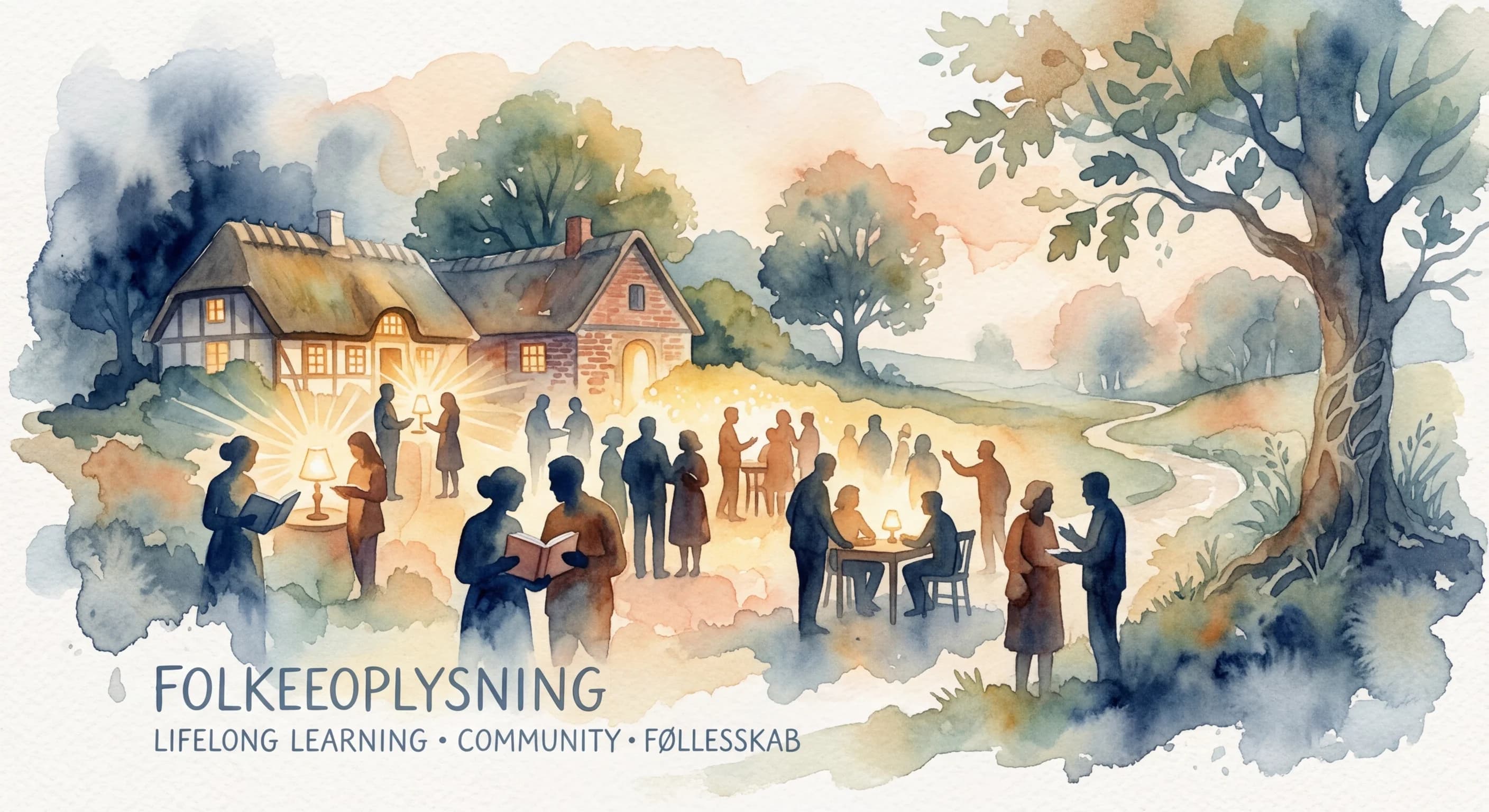
Folkeoplysning
/FOL-keh-UP-lees-ning/
Meaning
Folkeoplysning is the vibrant heartbeat of Danish civil society, a profound commitment to public enlightenment that transcends formal schooling. It embodies the lifelong journey of knowledge acquisition and cultural immersion for every citizen, fostering critical thinking and active democratic participation. Through accessible institutions like folk high schools, libraries, and community initiatives, it empowers individuals to understand their world, engage meaningfully, and contribute to a cohesive, informed society, viewing education not as a privilege but as a fundamental right and societal pillar.
Literal Translation
people-enlightenment
The Story Behind the Word
The concept of Folkeoplysning emerged powerfully in 19th-century Denmark, largely inspired by the theologian and philosopher N.F.S. Grundtvig. He envisioned an education system that would awaken the 'spirit of the people' (folkeånd), moving beyond rote learning to cultivate a deep understanding of life, history, and community through the 'living word' (det levende ord). This wasn't about vocational training, but about personal growth, democratic citizenship, and national identity, especially vital after Denmark's territorial losses. It reflects a deep-seated belief that an educated, critically engaged populace is essential for a thriving democracy and a resilient society. The persistent investment in institutions like folk high schools and public libraries underscores a collectivist ethos where individual flourishing is inextricably linked to the well-being and enlightenment of the entire community.
Experience It
Evening Folk High Course
A retired engineer, seeking new perspectives, enrolls in an evening course on modern philosophy at a local folk high school. He engages in lively discussions with people from all walks of life, broadening his worldview not for a degree, but purely for the joy of learning and intellectual exchange, a true manifestation of Folkeoplysning.
Community Debate Night
The local library hosts a public debate on urban development, attracting citizens of all ages. Facilitated discussions encourage critical thinking and diverse viewpoints, enabling residents to actively engage with local issues and understand complex societal challenges, embodying the democratic and educational spirit of Folkeoplysning.
The Deeper Meaning
Folkeoplysning reveals a profound societal philosophy that views education not as a means to an end (like a job or degree), but as an end in itself – a continuous process of personal and collective enrichment. It posits that an enlightened citizenry is the bedrock of a healthy democracy and a cohesive society, valuing shared understanding, critical dialogue, and active participation above individualistic achievement. It embodies a holistic approach to human development, intertwining knowledge with civic responsibility and cultural awareness.
Did You Know?
The world's first folk high school, Rødding Højskole, opened in Denmark in 1844, pioneering the non-formal, residential adult education model that spread across Scandinavia and beyond.
How It's Used
Used to describe the concept and practice of popular adult education and lifelong learning, often referring to institutions like folk high schools, libraries, and cultural initiatives aimed at public enlightenment.