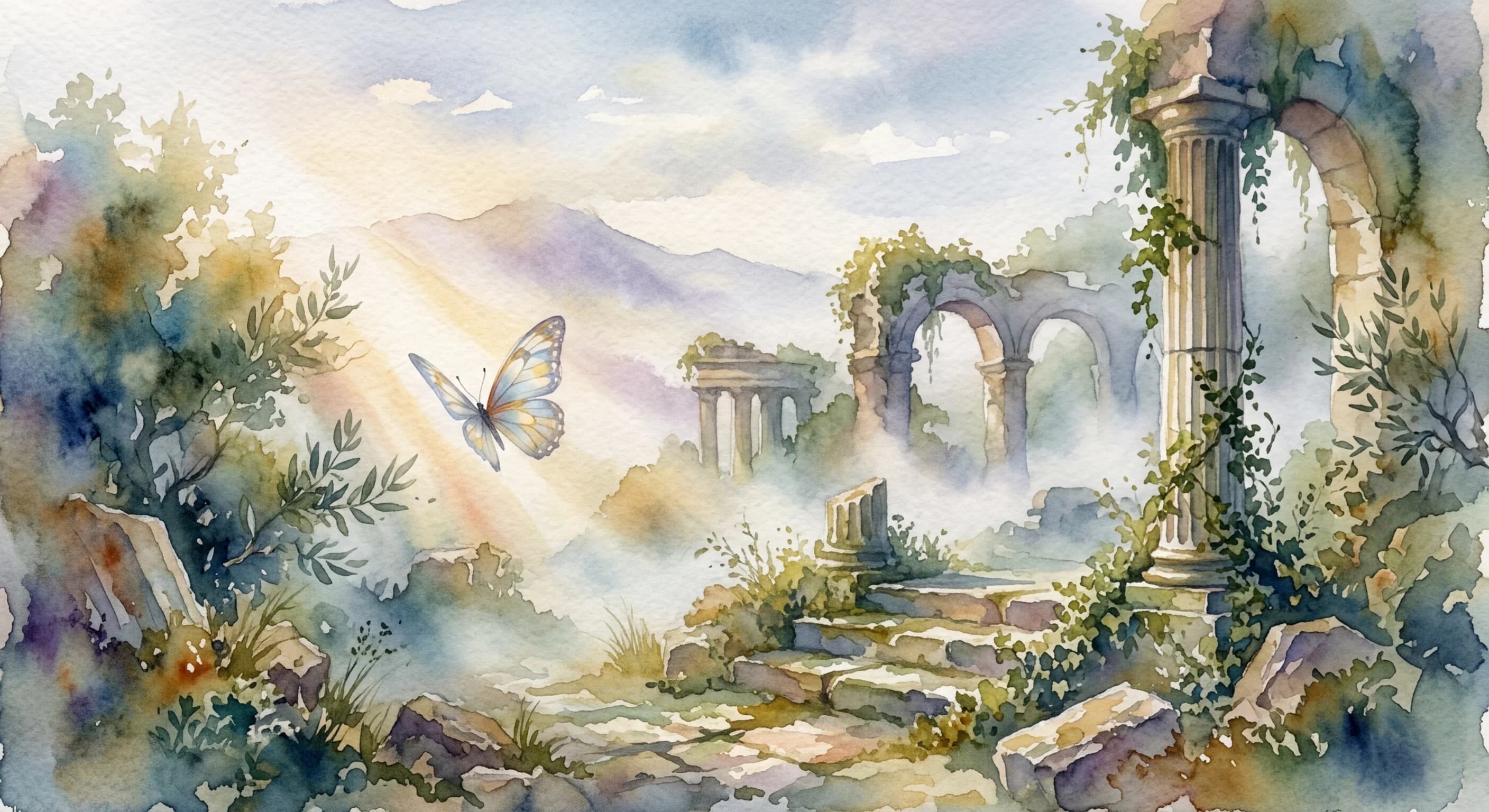
Aletheia
/ah-leh-THAY-ah/
Meaning
Aletheia transcends mere factual correctness, representing truth as an active process of 'unconcealment' or 'disclosure.' It's the moment when something previously hidden or obscured reveals its true essence, shedding layers of illusion or misunderstanding. This isn't about discovering a pre-existing fact, but rather experiencing the manifestation of reality as it genuinely presents itself, emerging from obscurity into clarity and presence. It signifies a profound, dynamic unveiling of what is authentic and real.
Literal Translation
unconcealment, disclosure, truth
The Story Behind the Word
Aletheia is a cornerstone of ancient Greek philosophical inquiry, deeply embedded in a culture that valued intellectual pursuit and the quest for understanding. Its etymology, from 'a-' (not) and 'lethe' (forgetfulness, oblivion), directly links truth to memory and the act of bringing something out of the darkness of forgetting. For thinkers like Plato, achieving Aletheia involved a rigorous journey of dialectic and contemplation, ascending from the shadowy illusions of the senses to the luminous forms of true knowledge. Later, Heidegger reinterpreted Aletheia as the fundamental openness of being itself, suggesting that truth isn't something we possess, but rather a condition for our existence, where reality unconceals itself to us. This concept reveals a Greek worldview that saw truth not as a static object, but as a living, dynamic process intrinsically tied to human experience and the nature of reality.
Experience It
The Philosopher's Insight
After years of wrestling with a complex ethical problem, a philosopher suddenly sees a pattern, a fundamental principle that unifies disparate ideas. This sudden flash of insight, where the true nature of justice 'unconcealed' itself to her, was a moment of Aletheia.
Artist's Creative Breakthrough
An artist struggles to capture the essence of a landscape, feeling that something is missing. Then, during an early morning fog, the interplay of light and shadow reveals the true spirit of the place, and the painting suddenly flows, achieving Aletheia in its expression.
The Deeper Meaning
Aletheia exposes a worldview where truth is not passively received but actively encountered. It suggests that reality holds a deeper, authentic layer that can only be accessed through a process of uncovering, moving beyond superficial appearances. This concept challenges the idea of truth as mere correspondence to facts, instead positing it as an event, a revelation that transforms perception and understanding, making the world manifest in its genuine form.
Did You Know?
The river Lethe in Greek mythology, whose waters caused forgetfulness, is the linguistic opposite of Aletheia, highlighting how truth is fundamentally about overcoming oblivion.
How It's Used
Primarily used in philosophical discourse and academic contexts when discussing the nature of truth, reality, and knowledge in ancient Greek philosophy and its modern interpretations.