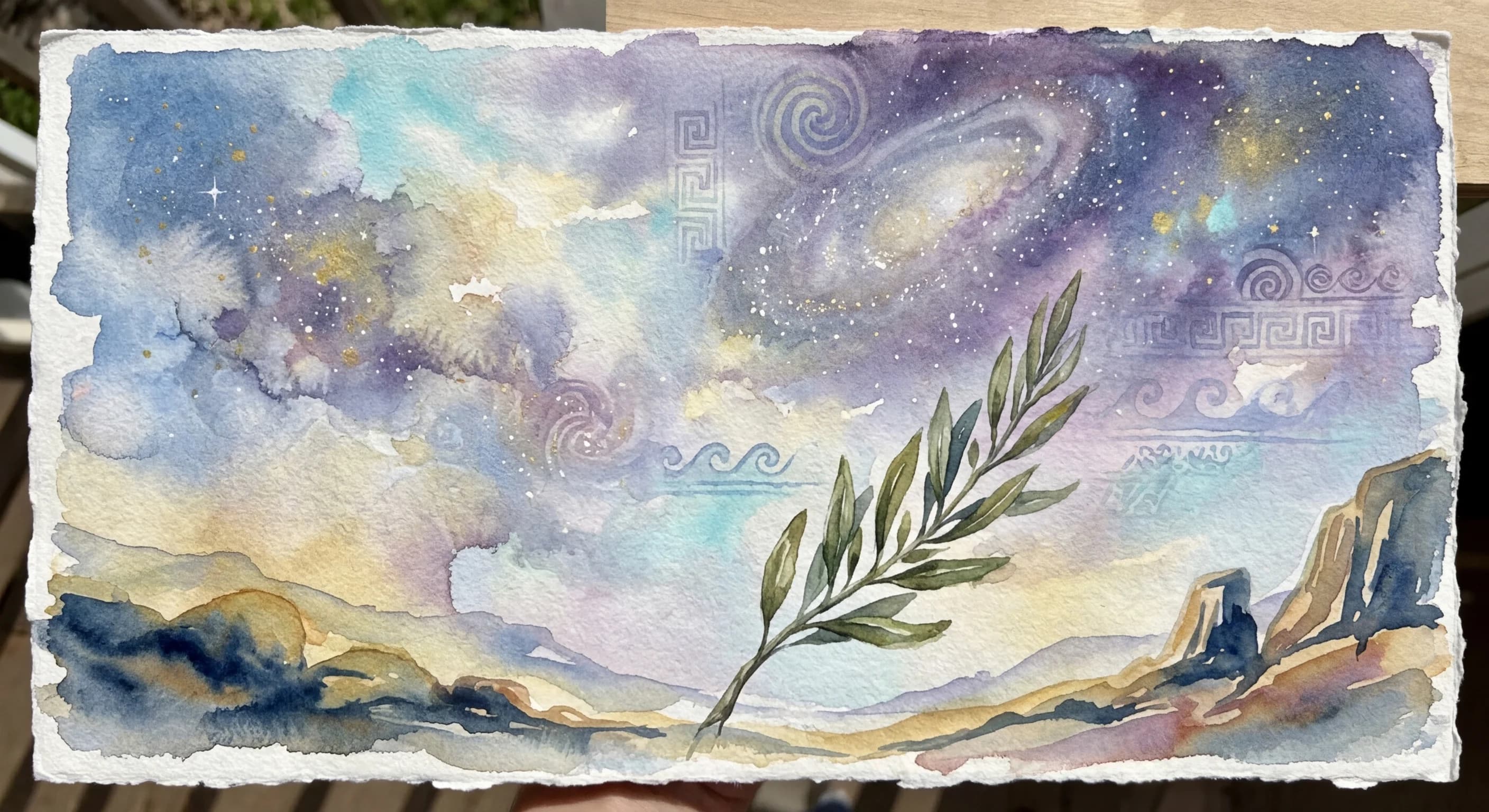
Nous
/NOOS/
Meaning
In Ancient Greek philosophy, 'Nous' transcends the simple English concept of 'mind,' embodying a cosmic, divine intelligence that orchestrates the universe. It is the very principle of order and reason, a luminous faculty through which one can apprehend eternal truths and the fundamental, unchanging nature of reality. More than mere intellect, Nous is an active, intuitive, and often divine spark, connecting the human spirit to the universal consciousness and enabling profound insight beyond sensory perception.
Literal Translation
mind, intellect, reason
The Story Behind the Word
The concept of Nous was central to Ancient Greek philosophical inquiry, reflecting a deep-seated belief in an ordered cosmos governed by rational principles. Philosophers like Anaxagoras first proposed Nous as the ultimate organizing force of the universe, setting matter into motion and establishing cosmic harmony. Later, Plato elevated it as the faculty capable of grasping the Forms, those perfect, eternal blueprints of reality. Aristotle saw Nous as the highest part of the human soul, capable of pure thought and contemplation of the divine. This pervasive idea reveals a culture that highly valued reason, order, and the pursuit of knowledge as a path to understanding both oneself and the divine structure of existence, suggesting that true wisdom came from aligning one's internal intellect with the universal one.
Experience It
Philosopher's Revelation
A philosopher, after years of rigorous study and contemplation, suddenly perceives the intricate mathematical harmony underlying the celestial movements. In that moment of profound clarity, he feels his individual mind, his Nous, resonate with the cosmic Nous, understanding the universe's inherent order.
Sculptor's Divine Form
A sculptor, gazing at a raw block of marble, doesn't just see stone but instinctively perceives the perfect form hidden within. It's as if his Nous, guided by an inner vision, connects with the ideal form of beauty, allowing him to chip away the superfluous and reveal the divine essence.
The Deeper Meaning
The concept of Nous reveals an ancient Greek worldview where the universe is not chaotic but inherently rational and intelligible. It posits a profound connection between the human mind and a divine, cosmic intelligence, suggesting that humanity's highest purpose is to cultivate this inner faculty to achieve wisdom, understand universal truths, and align with the divine order of existence. It underscores the belief that true knowledge is not just accumulated facts but an intuitive grasp of fundamental principles.
Did You Know?
Anaxagoras, the first philosopher to extensively use 'Nous,' believed it was infinite and self-ruled, responsible for separating the original mixture of all things into the distinct cosmos we perceive.
How It's Used
Used in philosophical discourse to describe the highest aspect of the human mind, capable of understanding universal truths, and also as a concept for the divine or cosmic intellect in ancient Greek philosophy.