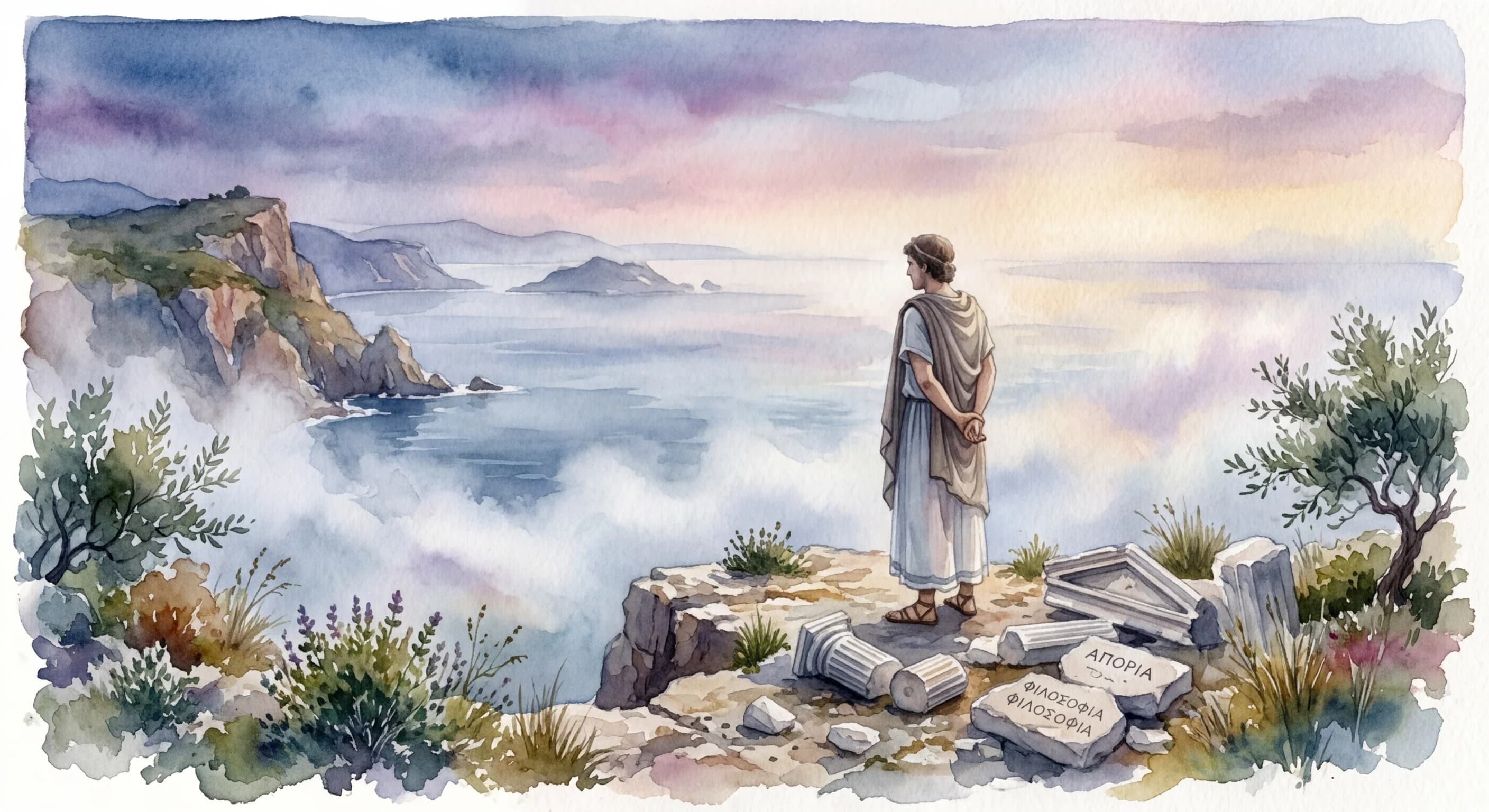
Aporia
/ah-POR-ee-ah/
Meaning
Aporia is a profound intellectual deadlock, a moment of unresolvable perplexity where logical reasoning falters, and all paths of inquiry seem to lead to contradiction. It's not mere ignorance but a recognition of the inherent limitations of understanding when confronting complex, often paradoxical, ideas. This intellectual paralysis compels deeper introspection, forcing a re-evaluation of fundamental assumptions and opening the mind to new perspectives beyond conventional thought.
Literal Translation
impasse, blockage, crossing
The Story Behind the Word
The concept of aporia is deeply embedded in ancient Greek philosophical tradition, particularly in the Socratic method. Socrates famously used it to expose the false wisdom of his interlocutors, leading them through a series of questions until they reached an impasse, realizing their own lack of true knowledge. This wasn't to humiliate but to prepare the ground for genuine inquiry, demonstrating that the recognition of 'not knowing' is the first step towards wisdom. Aporia thus reflects a culture that valued rigorous intellectual pursuit, critical self-examination, and the questioning of established beliefs as essential for philosophical growth. It reveals a worldview where truth is often elusive, and the journey of intellectual struggle is as important as the destination, fostering humility and a continuous quest for deeper understanding.
Experience It
Ethical Dilemma
A judge faces a case where applying the letter of the law would lead to an outcome widely perceived as unjust, yet bending the law would set a dangerous precedent. She finds herself in an aporia, unable to reconcile the demands of legal principle with those of moral equity, with no clear right answer.
Philosophical Paradox
A student grapples with Zeno's paradoxes, trying to rationally understand how Achilles can ever catch the tortoise if the tortoise always has a head start, however small. Despite understanding the mathematical solution, the intuitive intellectual block creates an aporia, a persistent feeling of logical impossibility.
The Deeper Meaning
Aporia underscores a fundamental philosophical tenet: that true wisdom often begins with the recognition of one's own ignorance. It challenges the human tendency to seek definitive answers, suggesting that some truths are inherently elusive or paradoxical. This concept reveals a worldview that embraces intellectual struggle and the discomfort of uncertainty as fertile ground for deeper thought and the evolution of understanding, rather than viewing them as failures of reason.
Did You Know?
The Socratic method, famous for leading students into intellectual dead ends, is essentially a systematic application of aporia to stimulate critical thinking and self-discovery.
How It's Used
Primarily used in philosophical contexts to describe a moment of intellectual doubt or confusion, especially when discussing complex ethical or logical dilemmas. It can also be used more broadly to describe any situation of inescapable difficulty or uncertainty.