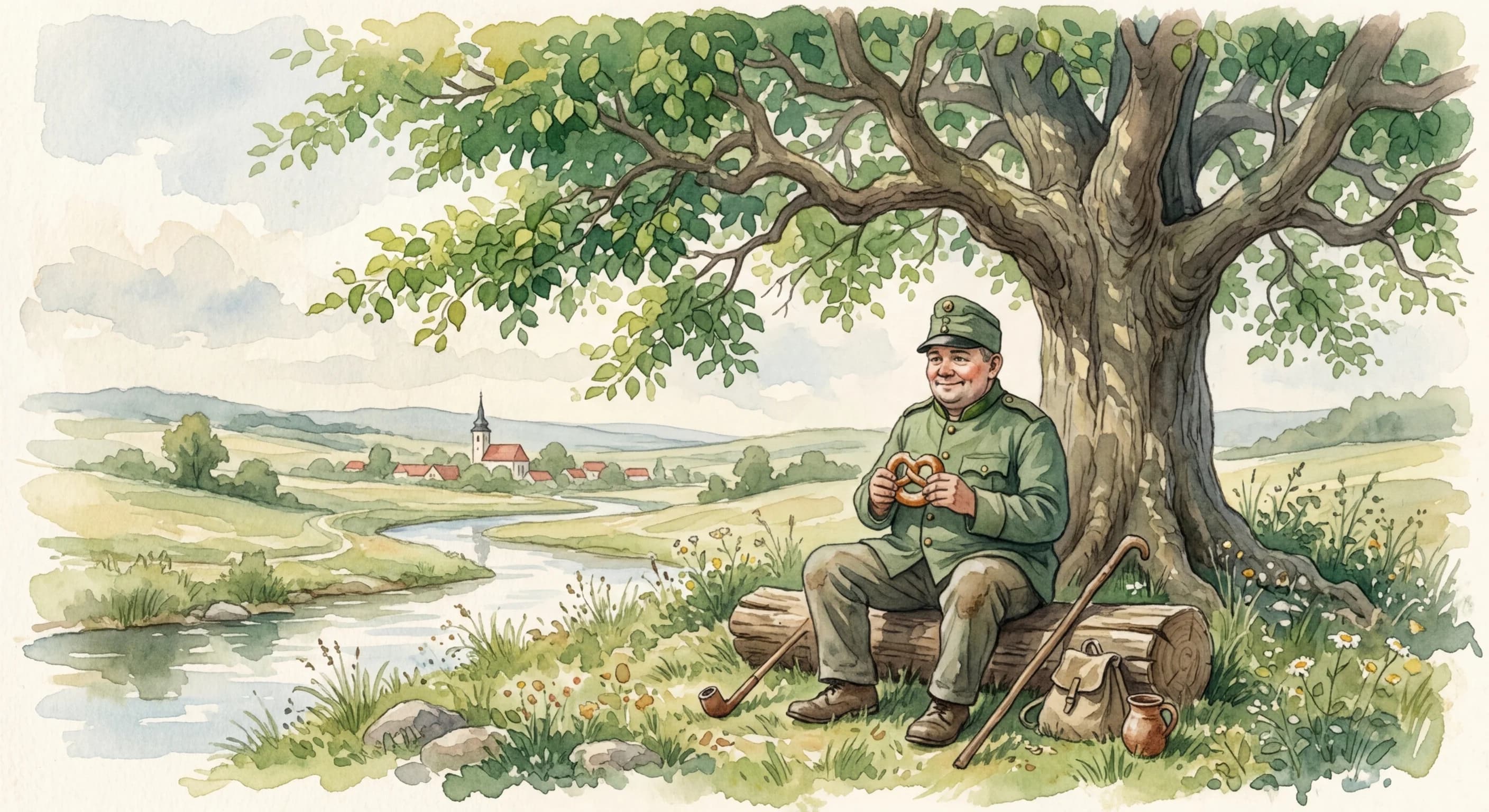
Švejk
/SHVAYK/
Meaning
Švejk embodies the spirit of a seemingly simple-minded, yet profoundly cunning individual who navigates oppressive systems through an artful blend of feigned idiocy and unwavering optimism. He's a master of passive resistance, his endless, often nonsensical anecdotes and literal interpretations of orders inadvertently exposing the inherent absurdity and cruelty of bureaucracy, militarism, and authoritarianism. To act like Švejk is to weaponize apparent foolishness, turning it into a subversive tool against those in power, proving that even the most rigid structures can be undermined by a persistent, good-natured 'idiot'.
Literal Translation
Švejk is a surname.
The Story Behind the Word
The character of Švejk emerged from the tumultuous backdrop of the Austro-Hungarian Empire's collapse and World War I, a period of immense suffering and disillusionment for Czechs. Jaroslav Hašek, a fervent anti-establishment figure, created Švejk as a satirical mirror reflecting the absurdity of imperial power and the futility of war. For Czechs, Švejk became more than just a literary character; he symbolized a deeply ingrained national coping mechanism – a way of enduring centuries of foreign domination (Habsburg, Nazi, Soviet) through subtle defiance, humor, and an uncanny ability to 'get by'. He represents the triumph of the common man's wit over oppressive might, revealing a cultural inclination to distrust authority and find liberation in the spaces between rules. Švejk's enduring popularity speaks to a collective memory of resilience and a unique brand of dark humor as a survival tool.
Experience It
Bureaucratic Švejkism
A citizen is asked for an obscure document at a government office. Instead of arguing, they return weekly with slightly incorrect versions, each time engaging the clerk in lengthy, tangential conversations about the document's historical lineage, effectively wearing down the system until their request is approved out of sheer exhaustion.
Workplace Švejk
Faced with an unreasonable deadline, an employee meticulously follows every single, often contradictory, instruction to the letter, resulting in a hilariously convoluted and delayed process that highlights the impracticality of the original demand, all while maintaining a cheerful, 'just following orders' demeanor.
The Deeper Meaning
Švejk embodies a profound philosophical insight into the nature of power and resistance: that absolute authority can be destabilized not just by direct confrontation, but by its own internal contradictions when faced with unwavering, literal compliance. He suggests that genuine freedom can be found in the refusal to take oppressive systems seriously, transforming passive acceptance into a form of active, psychological rebellion. It's a philosophy of 'wise foolishness' that questions the very definition of intelligence in the face of irrational power structures.
Did You Know?
Jaroslav Hašek never finished "The Good Soldier Švejk"; he died prematurely, leaving the novel famously incomplete, yet its impact on Czech culture is monumental.
How It's Used
The term 'Švejk' is used to refer to the character himself, his literary work, or to describe a person or behavior exhibiting characteristics of Švejkism – passive resistance, feigned stupidity, or an absurdly optimistic approach to adversity.