Andrzejki
/ahn-JSHAY-kee/
Meaning
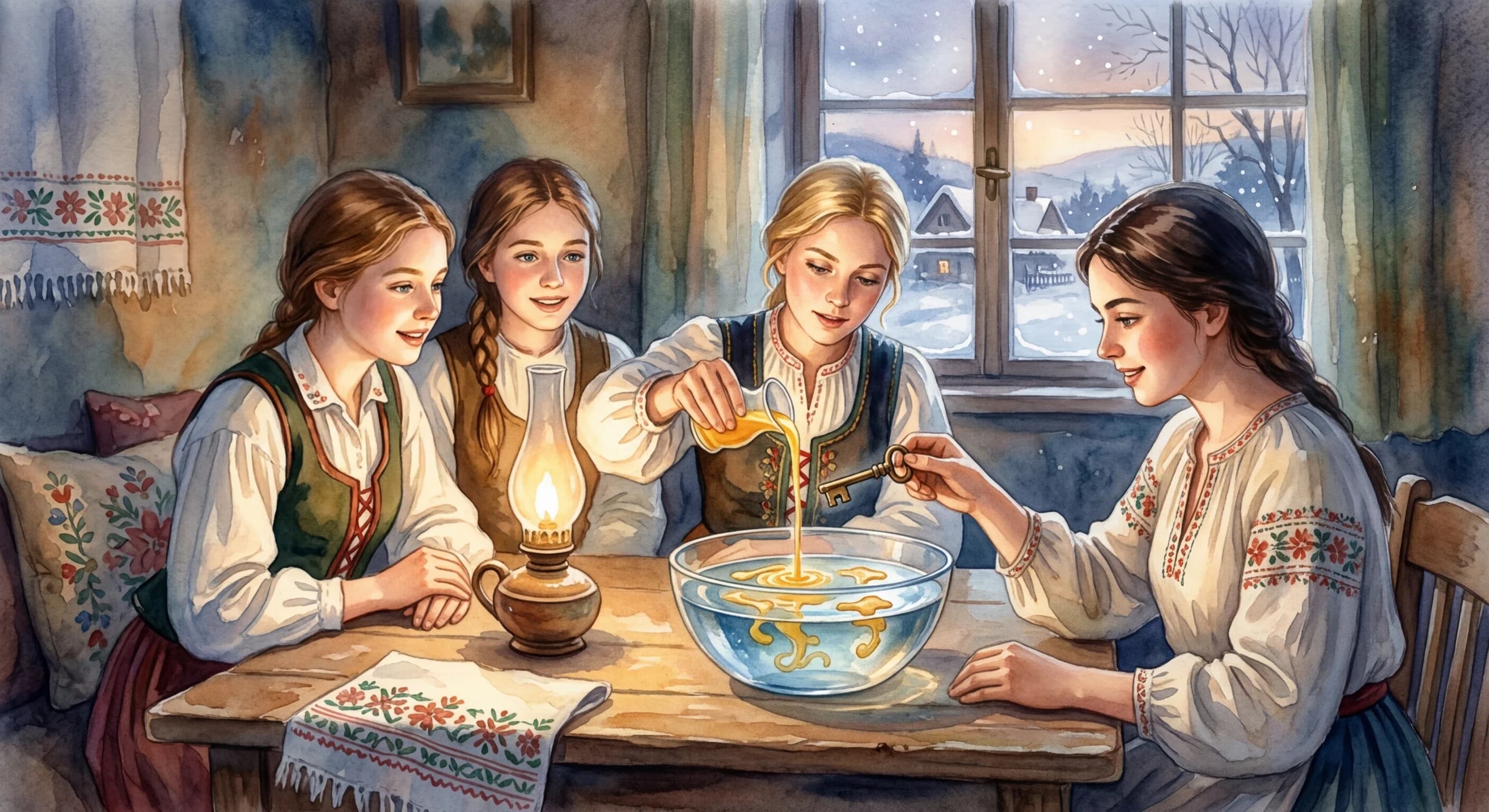
Andrzejki, or St. Andrew's Day Eve, is a cherished Polish tradition celebrated on November 29th, a night steeped in playful divination and youthful anticipation. Primarily observed by unmarried individuals, especially women, it's a magical time for fortune-telling rituals, most famously the pouring of molten wax through a keyhole into cold water. The ethereal shapes formed by the solidified wax are then interpreted, offering whimsical glimpses into one's future love life, from the initial of a future spouse to the timing of a wedding, all within a festive atmosphere of communal bonding before the solemnity of Advent.
Literal Translation
Andrew's (plural)
The Story Behind the Word
Andrzejki's roots intertwine pagan harvest festivals and Christian traditions, a common syncretism in Slavic cultures. Historically, it was a crucial pre-Advent ritual, a last hurrah of merriment and a final opportunity for young people to seek answers about their romantic destinies before a period of solemnity. The divination practices, like wax pouring (woskowanie), reflect a deep-seated human desire to peer into the unknown and exert some perceived control over an uncertain future, particularly regarding marriage, which was central to social and economic stability. It reveals a culture that values community, storytelling, and a playful engagement with superstition, viewing the future not as entirely fixed, but as something that can be playfully glimpsed and influenced through ritual, blending the sacred and the secular in a uniquely Polish way.
Experience It
Wax Fortune Telling
A group of teenage girls giggles as one carefully pours hot wax through an old keyhole into a basin of cold water. The wax hardens into an amorphous blob, which they then hold up to a lamp, casting an enormous shadow on the wall. 'Look! It’s a crown!' one exclaims, while another argues, 'No, it's definitely a bicycle! Your future husband will be a king or a cyclist!'
Andrzejki Party
The air hums with excitement at a student dormitory's common room, decorated with fairy lights. Laughter erupts as someone tries to identify their future partner's profession from a boot race, while others are busy with apple peelings, hoping to spell out an initial. It’s a lively evening of shared hopes and playful predictions, complete with traditional snacks and music.
The Deeper Meaning
Andrzejki reflects a cultural acceptance of liminal spaces and times – the eve before a saint's day, the transition from autumn to winter, the threshold between childhood and adulthood. It embodies a belief that during these moments, the veil between the ordinary and the mystical thins, allowing for glimpses into destiny. This highlights a worldview that embraces both the tangible and the intangible, finding comfort and entertainment in the mysterious aspects of life and love.
Did You Know?
While primarily for women, a similar, though less widely celebrated, day for men's fortune-telling exists in Poland: Katarzynki, or St. Catherine's Day Eve, on November 24th, just before Andrzejki.
How It's Used
Andrzejki is celebrated on the eve of Saint Andrew's Day (November 30th), specifically on the night of November 29th. It is primarily a folk tradition observed by young people, particularly unmarried women, as a form of fortune-telling.