Szlachta
/SHLAH-tah/
Meaning
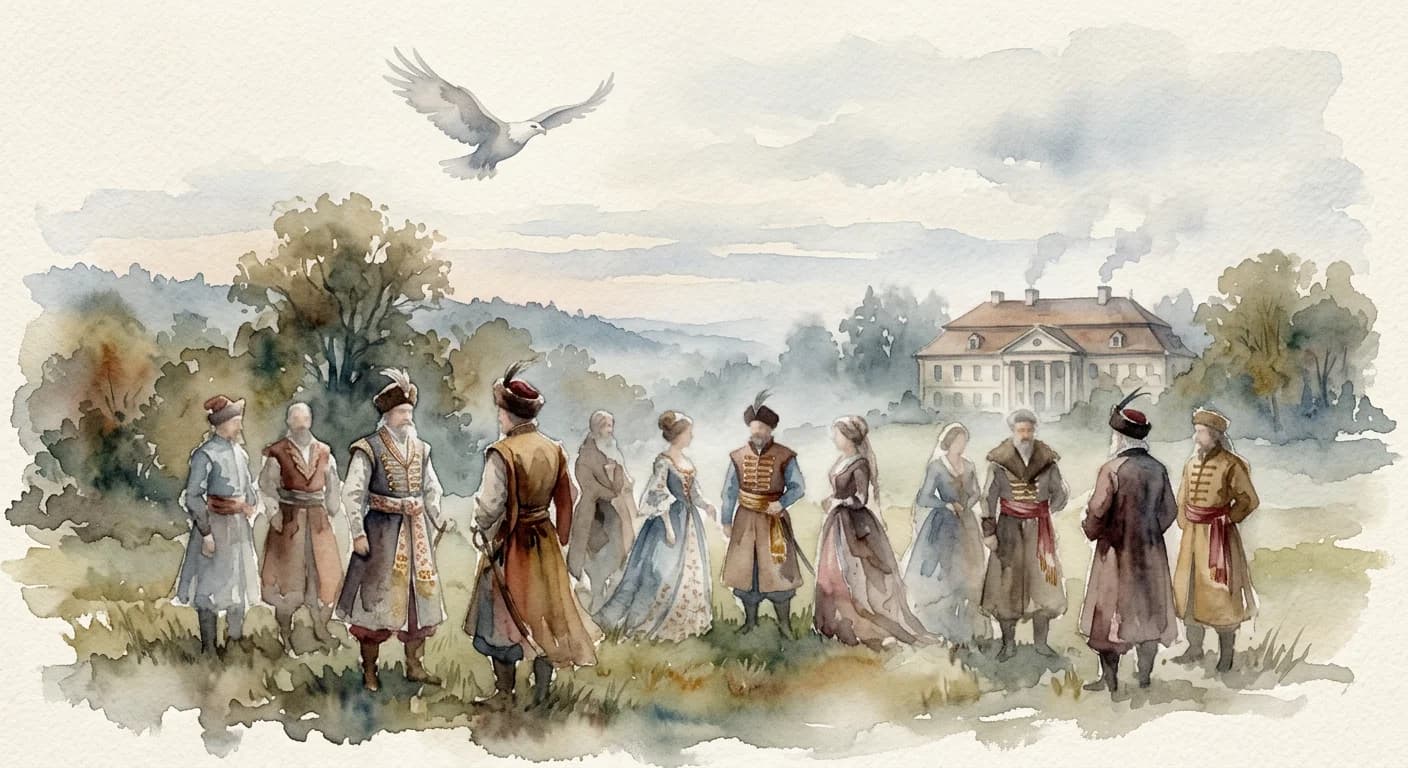
Szlachta refers to the historical Polish nobility, a powerful and unique social class that shaped centuries of Polish history. Far from a uniform aristocracy, it encompassed a vast spectrum from immensely wealthy magnates to landless gentry, all bound by a distinctive legal status, a complex code of honor, and a fierce commitment to 'Golden Liberty.' This collective identity and republican spirit, where every nobleman theoretically shared equal rights, profoundly distinguished the szlachta from Western European feudal systems and remains deeply intertwined with Polish national identity.
Literal Translation
nobility
The Story Behind the Word
The concept of 'szlachta' is central to understanding Polish identity, embodying a unique historical experiment in 'noble democracy.' Unlike hereditary monarchies, the szlachta collectively elected their kings and held significant legislative power through the Sejm (parliament), granting them unparalleled freedoms known as 'Golden Liberty.' This emphasis on collective rights, personal honor (szlachectwo), and the 'Neminem captivabimus' (no one shall be imprisoned without a court order) privilege fostered a strong sense of republicanism and a distinctive political culture. While it ultimately contributed to the partitions of Poland due to internal divisions and an inability to centralize power, the ideal of the szlachta as guardians of liberty and national sovereignty remains a powerful, albeit complex, symbol in Polish historical consciousness, revealing a deep-seated value for individual freedom within a collective framework.
Experience It
Debating in the Sejm
In the 17th century, a lesser szlachcic, Jan, stood before the Sejm, passionately arguing against a proposed tax increase. Though lacking vast lands, his voice carried the same legal weight as a powerful magnate, a testament to the szlachta's principle of 'equality among equals' in the deliberative assembly.
A Noble's Duty
Countess Zofia, a proud member of the szlachta, meticulously managed her estates, ensuring her peasants were cared for while upholding her family's honor. She understood her privileges came with responsibilities, often hosting local gatherings and contributing to the community, embodying the traditional role of a noble in Polish society.
The Deeper Meaning
The szlachta's existence reflects a profound philosophical tension between individual liberty and collective responsibility, and the potential pitfalls of unchecked freedom. Its 'Golden Liberty' championed individual rights and a republican ideal, yet its inherent decentralization and emphasis on consensus (liberum veto) often paralyzed governance. This historical experience underscores a deep-seated Polish appreciation for freedom, even if it sometimes came at the cost of national unity and efficient statecraft, revealing a cultural inclination towards safeguarding individual autonomy above all else.
Did You Know?
Despite being considered nobility, the Polish szlachta at its peak constituted up to 10-15% of the total population, a far higher proportion than in most other European countries, where nobility rarely exceeded 1-2%.
How It's Used
Used to refer to the historical Polish noble class, its members, or the system of nobility itself.