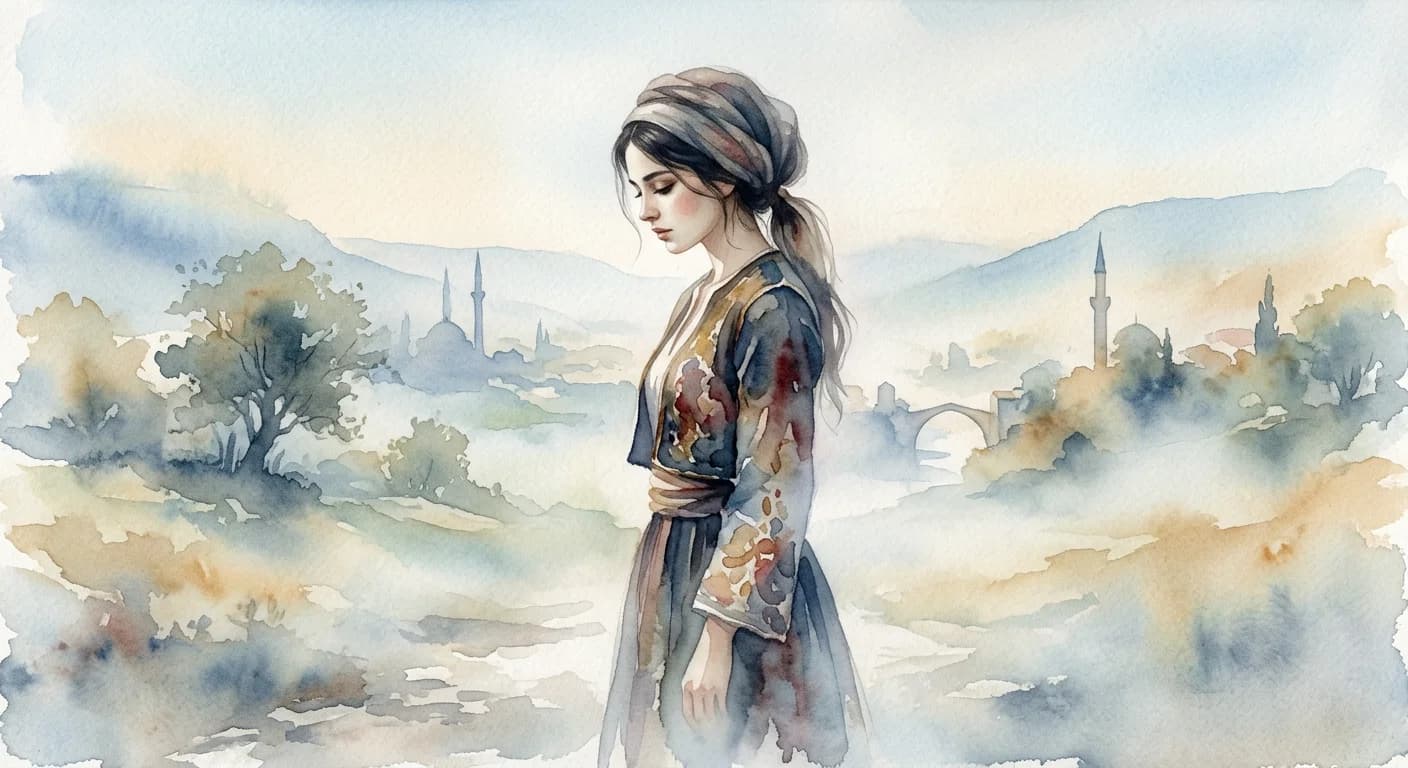
Sevdah
/SEV-dah/
Meaning
Sevdah embodies a profound, bittersweet longing, a soulful melancholy that intertwines deep sadness with a poignant appreciation for life's fleeting beauty. It's a complex emotional state, often evoked by memories of past loves, lost homelands, or a yearning for something beautiful yet unattainable. More than mere sorrow, sevdah is a deep, resonant ache that can feel both painful and exquisitely beautiful, frequently expressed through the haunting melodies of traditional Balkan music, sevdalinka. It captures a deep, almost spiritual connection to the transient nature of joy and the inherent sorrow of existence.
Literal Translation
While not a direct literal translation, 'sevdah' is derived from the Arabic word 'sawda', meaning black bile, which was once believed to be the source of melancholy.
The Story Behind the Word
The existence of 'sevdah' in Bosnian culture is deeply rooted in centuries of historical confluence and hardship. Bosnia, a crossroads of empires and religions, has experienced numerous periods of conflict, occupation, and displacement. This turbulent history fostered a collective psyche attuned to transience, loss, and resilience. Sevdah, therefore, isn't just a personal feeling; it's a cultural lament, a shared emotional landscape reflecting the melancholic beauty of a land and people who have known both profound joy and profound sorrow. It reveals a worldview that embraces the full spectrum of human emotion, finding beauty and meaning even in sadness, and cherishing memory as a vital link to identity.
Experience It
The Old Cafe
An elderly man sits alone in a dimly lit Sarajevo cafe, a cup of strong coffee growing cold before him. A distant sevdalinka plays softly from a radio, and his gaze drifts to the rain-streaked window. He's not crying, but a visible 'sevdah' settles over him, a quiet, profound yearning for a time and faces now long gone, etched into the city's very stones.
Moonlit Balcony
A young woman stands on her balcony late at night, gazing at the moon. She recently ended a passionate but ultimately unsustainable relationship. As a haunting melody drifts from a neighbor's window, she feels a familiar 'sevdah' — a beautiful ache in her chest, a longing for what was and what could never be, mingled with the tender memory of shared moments.
What Gets Lost in Translation
English speakers often conflate 'sevdah' purely with sadness or depression, missing its unique blend of beauty and longing. It's not a passive despair but an active, soulful ache that can be profoundly moving and even inspiring. It carries a sense of appreciation for what was, rather than just regret for what is lost. The musical tradition of sevdalinka perfectly illustrates this beautiful melancholy, making it an experience rather than just an emotion.
Across Cultures
Similar concepts of bittersweet longing exist across cultures. The Portuguese 'saudade' is perhaps the closest, describing a deep emotional state of nostalgic or melancholic longing for something or someone absent. German 'Weltschmerz' speaks to a world-weariness or sadness about the state of the world, while Japanese 'mono no aware' captures an empathetic sadness at the transience of things.
The Deeper Meaning
Sevdah reveals a philosophical embrace of life's inherent impermanence and the beauty found within sorrow. It suggests that true joy cannot exist without acknowledging sadness, and that longing itself can be a profound, enriching experience. This worldview encourages a deep, soulful connection to one's past, one's community, and the bittersweet unfolding of existence, valuing emotional depth over superficial happiness.
Did You Know?
The etymology of 'sevdah' traces back to the Arabic word 'sawda', literally meaning 'black bile'. This refers to the ancient Greek humoral theory, where an excess of black bile was thought to cause melancholy, highlighting a fascinating historical link between medical understanding and emotional expression.
How It's Used
Sevdah is often used to describe the mood evoked by traditional Balkan folk music (sevdalinka), poetry, or a general feeling of deep, soulful longing and melancholy.