Malanka
/mah-LAHN-kah/
Meaning
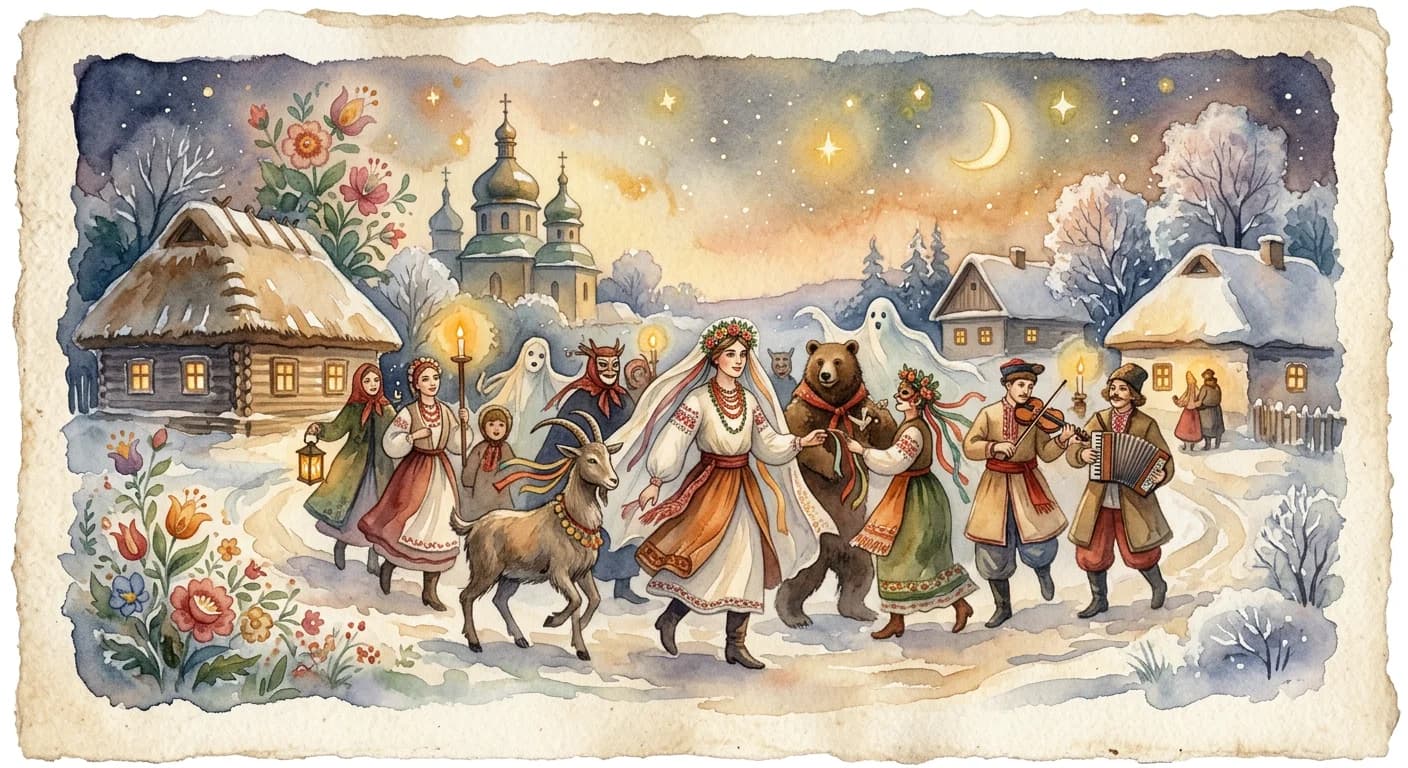
Malanka is a vibrant Ukrainian folk ritual celebrated on New Year's Eve (January 13th, per the Julian calendar), rooted in both ancient pagan customs and Christian traditions. It involves boisterous processions of costumed revelers, often young men cross-dressing or impersonating mythical beasts, who move from house to house. Their performances, songs, and skits are believed to cleanse the old year's misfortunes and usher in blessings, fertility, and prosperity for the coming harvest and year.
Literal Translation
Derived from the name Melania, referring to Saint Melanie the Younger, whose feast day is celebrated on January 13th, the eve of the New Year.
The Story Behind the Word
Malanka is a powerful expression of Ukrainian identity, intertwining pre-Christian agrarian rites with Orthodox Christian observances. Historically, it served as a vital community-building event, a moment for collective catharsis and the affirmation of social bonds. The chaotic energy, the inversion of roles (men as women, humans as animals), and the playful subversion of norms are not merely entertainment; they are a symbolic 'reset' of the social and natural order, designed to ensure fertility, ward off evil spirits, and guarantee a bountiful year. It reflects a worldview where the sacred and the profane, the old and the new, coexist and cyclically renew through ritualized performance, connecting generations to their ancestral heritage and the rhythms of the earth.
Experience It
Village Malanka Procession
The cold January night air vibrated with the sound of fiddles and tambourines as the Malankari, led by a towering 'Goat' and a dancing 'Malanka' (a man in women's attire), approached the first house. Their boisterous chants and mock battles spilled into the courtyard, bringing laughter and a shower of coins from the homeowner, eager for their blessings.
Preparing for the Feast
Grandma Oksana hummed as she set out the kutia and uzvar, anticipating the Malanka revelers. She knew their visit, though noisy and sometimes messy, was essential. It wasn't just fun; it was a promise of a good harvest, healthy livestock, and protection from harm for her family in the year ahead.
The Deeper Meaning
Malanka embodies a cyclical understanding of time and existence, where chaos and order are not opposing forces but necessary components of renewal. It reflects a deep-seated belief in the power of ritual, communal participation, and symbolic inversion to influence the natural world and ensure well-being, highlighting humanity's interconnectedness with both the spiritual and agrarian realms.
Did You Know?
In some regions, the Malanka celebration culminates in a symbolic 'plowing' of the first furrow in the snow, a direct ancient pagan ritual meant to bless the fields for the upcoming agricultural season.
How It's Used
Malanka is celebrated annually on the night of December 31st (Old Style, which corresponds to January 14th in the Gregorian calendar, also known as Saint Basil's Day). It is a vibrant folk custom involving music, dancing, theatrical performances, and the exchange of good wishes.