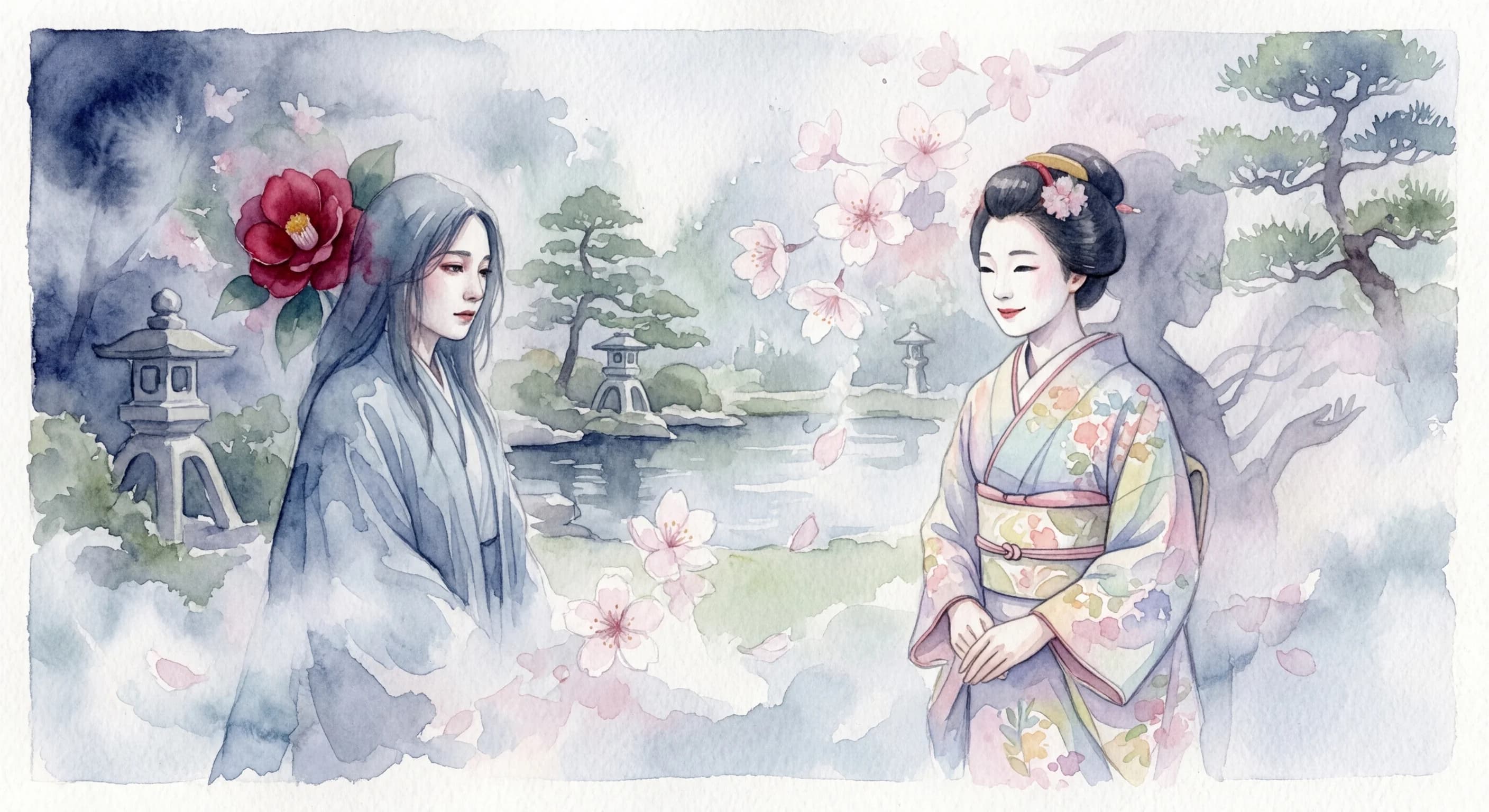
Honne to tatemae
/HON-neh toh tah-TEH-mah-eh/
Meaning
"Honne to tatemae" encapsulates the intricate dance between an individual's genuine thoughts and desires (honne) and the outward persona or behavior they project in society (tatemae). It illustrates the profound cultural imperative in Japan to maintain harmony and avoid discord, often requiring individuals to self-regulate their expressions. This duality is not about hypocrisy, but rather a sophisticated social mechanism for navigating complex human relationships, ensuring group cohesion, and facilitating polite interaction in a society that highly values collective well-being over individualistic expression.
Literal Translation
True sound/feeling and facade/public stance
The Story Behind the Word
The roots of honne and tatemae are deeply embedded in Japan's historical and philosophical landscape, particularly in Confucian ethics and the influence of Buddhism, which emphasize social order, hierarchy, and the suppression of ego for the greater good. Centuries of living in close-knit communities, coupled with the samurai code's emphasis on self-control and duty, fostered a society where overt displays of personal emotion could be seen as disruptive. Tatemae, therefore, became a crucial tool for lubricating social interactions, preventing open conflict, and preserving 'wa' (harmony). This concept reveals a worldview where individual identity is often understood in relation to the group, and where indirect communication and reading between the lines ('kuuki wo yomu' - reading the air) are paramount skills for social survival and success.
Experience It
The Diplomatic Decline
A junior employee, Kenji, strongly disagrees with his manager's new project strategy. Internally, his 'honne' screams that it's flawed and will fail. However, during the team meeting, Kenji nods, offers polite affirmations, and suggests minor, non-confrontational adjustments, presenting a 'tatemae' of agreement to avoid challenging his superior publicly and disrupting the meeting's flow.
The Gracious Host
Akiko's guest has just presented her with a gift she already owns and doesn't particularly like. Her 'honne' is a mix of mild disappointment and a desire to politely decline. Yet, with a warm smile and effusive thanks, Akiko expresses delight and gratitude (her 'tatemae'), ensuring her guest feels appreciated and avoiding any potential embarrassment or awkwardness.
The Deeper Meaning
Honne to tatemae reveals a profound philosophical understanding of the self as multi-layered and context-dependent, rather than a singular, fixed entity. It suggests that true authenticity is not always about raw, unfiltered expression, but often about the wisdom to discern when and how to reveal different facets of oneself. This perspective underscores a society that prioritizes collective well-being and relational harmony, viewing the individual's role as intricately woven into the social fabric, where self-restraint is a virtue for the greater good.
Did You Know?
This concept can even extend to architecture; traditional Japanese gardens often have a 'tatemae' (publicly visible) section and a 'honne' (private, secluded) section, reflecting the same duality in design.
How It's Used
This concept is used to explain social interactions, politeness, and the unspoken rules of Japanese society. It's often invoked when discussing why someone might act or speak in a way that seems contrary to their personal beliefs or feelings, particularly in professional or public settings.