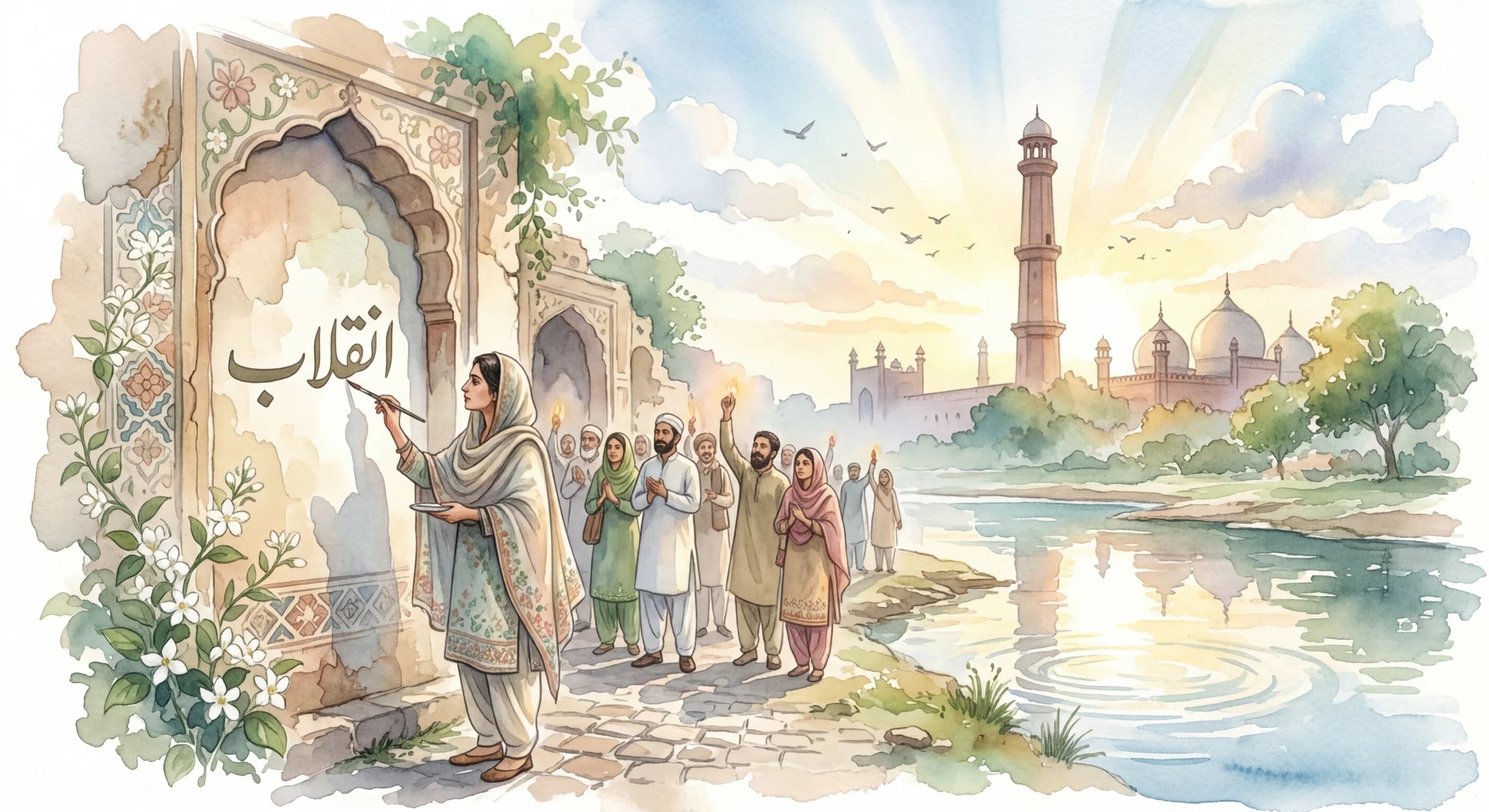
Inqilab
/in-ki-LAB/
Meaning
Inqilab transcends a mere 'revolution'; it embodies a seismic, often violent, transformation driven by a collective yearning for justice and a complete overhaul of an oppressive system. It signifies not just a change in power, but a fundamental reordering of society's moral, political, and economic fabric, carrying the weight of historical struggle and the fervent hope for a truly new dawn. This word resonates with the passionate conviction that fundamental change is not only possible but imperative, often implying a divine or historical mandate.
Literal Translation
Revolution, change
The Story Behind the Word
The word 'Inqilab' is deeply embedded in the political and social consciousness of the Indian subcontinent and the broader Islamic world, particularly since the 20th century. Its prominence surged during anti-colonial movements, notably the struggle for independence from British rule, where 'Inqilab Zindabad!' (Long Live the Revolution!) became a rallying cry for activists and revolutionaries like Bhagat Singh. This historical usage imbued 'Inqilab' with connotations of sacrifice, martyrdom, and the ultimate triumph of the oppressed. Philosophically, it reflects a worldview where societal stagnation or injustice is not merely an unfortunate state but an affront that demands radical, often revolutionary, action. It suggests a belief in humanity's capacity for collective agency to dramatically reshape destiny, often envisioning a utopian future free from exploitation. The word often carries an eschatological undertone, where the 'inqilab' is a necessary, almost divinely ordained, precursor to a just world.
Experience It
Student Uprising
Amidst widespread corruption and economic despair, university students took to the streets, chanting 'Inqilab! Inqilab!' Their banners called for a complete systemic overhaul, not just a change in leadership, believing only a true inqilab could cleanse the nation's ills.
Poetic Call to Action
The poet recited verses of 'inqilab,' his voice echoing the frustrations of generations. He spoke of breaking chains, of a new dawn forged in the fires of collective will, inspiring listeners to imagine a future where justice was not just a dream but a revolutionary reality.
The Deeper Meaning
Inqilab embodies a philosophy of transformative agency, asserting that humanity is not merely subject to fate but possesses the collective power to fundamentally alter its condition. It reflects a worldview that sees radical change as a moral imperative when faced with profound injustice, suggesting that true progress often requires a complete break from the past, rather than mere reform. This belief system prioritizes collective will over individual comfort in the pursuit of a more equitable societal order.
Did You Know?
The iconic slogan 'Inqilab Zindabad!' (Long Live the Revolution!) was popularized by Indian freedom fighter Bhagat Singh in the 1920s, making 'inqilab' a potent symbol of defiance against British colonial rule.
How It's Used
Used to describe political revolutions, societal upheavals, or any significant and transformative change, often with a historical and ideological connotation.