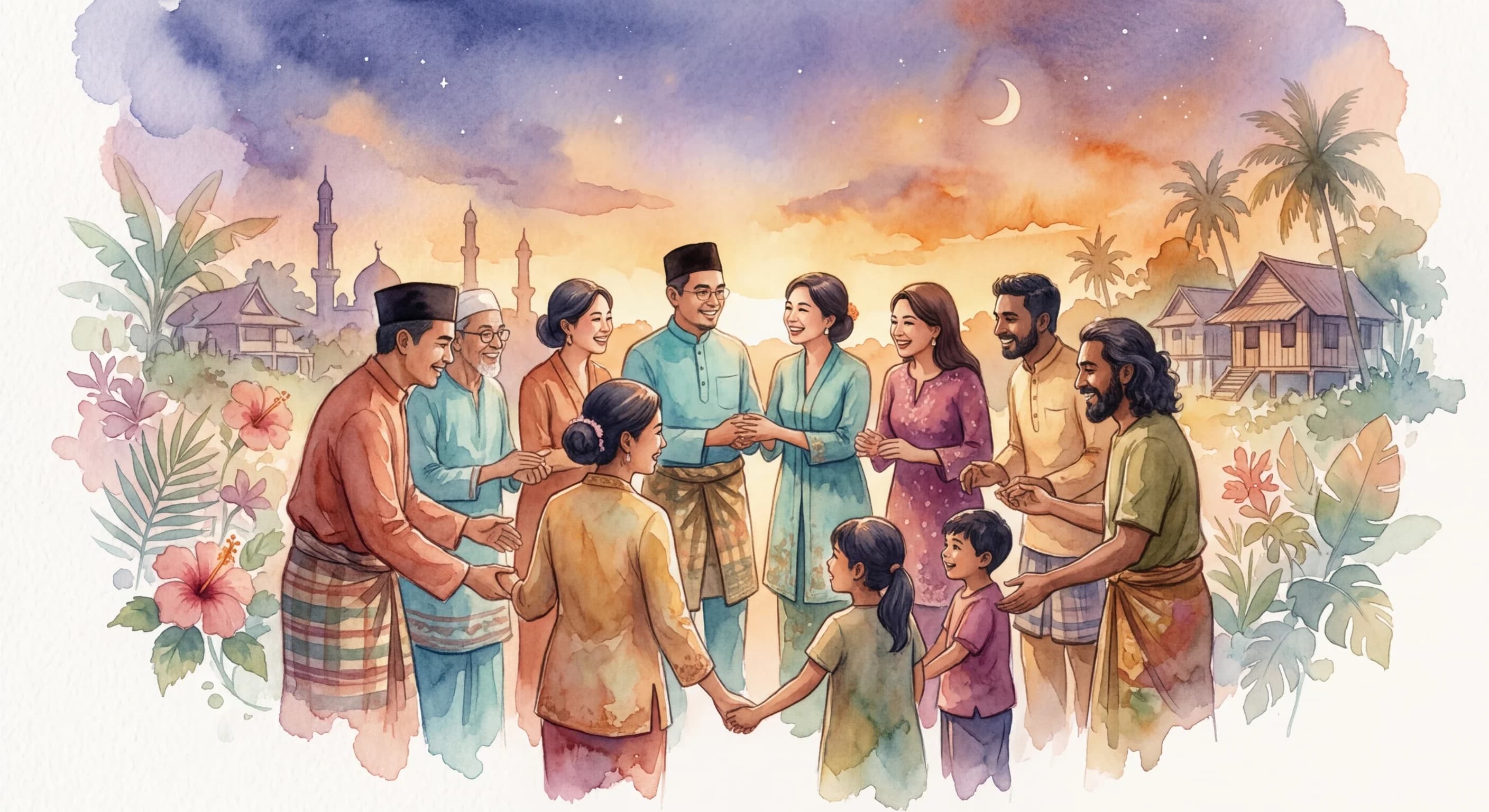
Muhibah
/MOO-hee-bah/
Meaning
Muhibah encapsulates a vibrant spirit of genuine goodwill, camaraderie, and mutual affection that joyfully transcends Malaysia's rich tapestry of ethnic, religious, and cultural differences. It's the active cultivation of harmonious coexistence and profound understanding, weaving a deep connection between people from all walks of life. Far beyond mere tolerance, muhibah envisions a shared national identity built on warmth, appreciation, and collective belonging, forming the very bedrock of Malaysian society, particularly celebrated during national holidays.
Literal Translation
Affection, love, friendship (derived from Arabic 'mawaddah')
The Story Behind the Word
The concept of muhibah is deeply rooted in Malaysia's post-independence nation-building efforts, particularly following the 1969 racial riots. It emerged as a crucial philosophical pillar to actively foster unity and prevent future communal strife in a profoundly multicultural society. The word, derived from Arabic 'mawaddah' (love/affection), was intentionally adopted to bridge the diverse communities, emphasizing shared humanity over ethnic or religious distinctions. It reflects a deliberate national ethos that acknowledges diversity as a strength, not a weakness, and actively promotes inter-ethnic understanding through shared experiences, festivals, and national identity. Muhibah reveals a societal worldview that believes in the power of conscious effort to forge a cohesive nation from diverse parts, underscoring the importance of social harmony for political stability and economic progress.
Experience It
Hari Raya Open House
During Hari Raya Aidilfitri, a Malay family hosts an 'open house.' Their Chinese and Indian neighbors, friends, and colleagues arrive, sharing food, laughter, and warm conversations, celebrating together as if they were one extended family. This embodies muhibah in action.
Community Gotong-Royong
Residents from various backgrounds in a suburban neighborhood gather for a 'gotong-royong' (communal work) to clean their local park. Malays, Chinese, Indians, and indigenous groups work side-by-side, sharing tools and refreshments, fostering bonds that strengthen their community spirit.
The Deeper Meaning
Muhibah reveals a foundational Malaysian philosophy that national unity is not a given but an ongoing, active pursuit. It posits that genuine connection and affection, rather than just tolerance, are essential for a diverse society to thrive. This worldview champions the idea that shared experiences and mutual appreciation can transcend inherent differences, building a collective identity that celebrates, rather than suppresses, individual cultural heritage.
Did You Know?
The 'Rukun Negara,' Malaysia's national ideology, explicitly promotes 'mutual respect and understanding' among its five principles, directly aligning with the spirit of muhibah.
How It's Used
Used to describe the spirit of unity and goodwill among people of different races and religions, particularly in Malaysia and Brunei. It is often invoked during national celebrations and inter-community events.