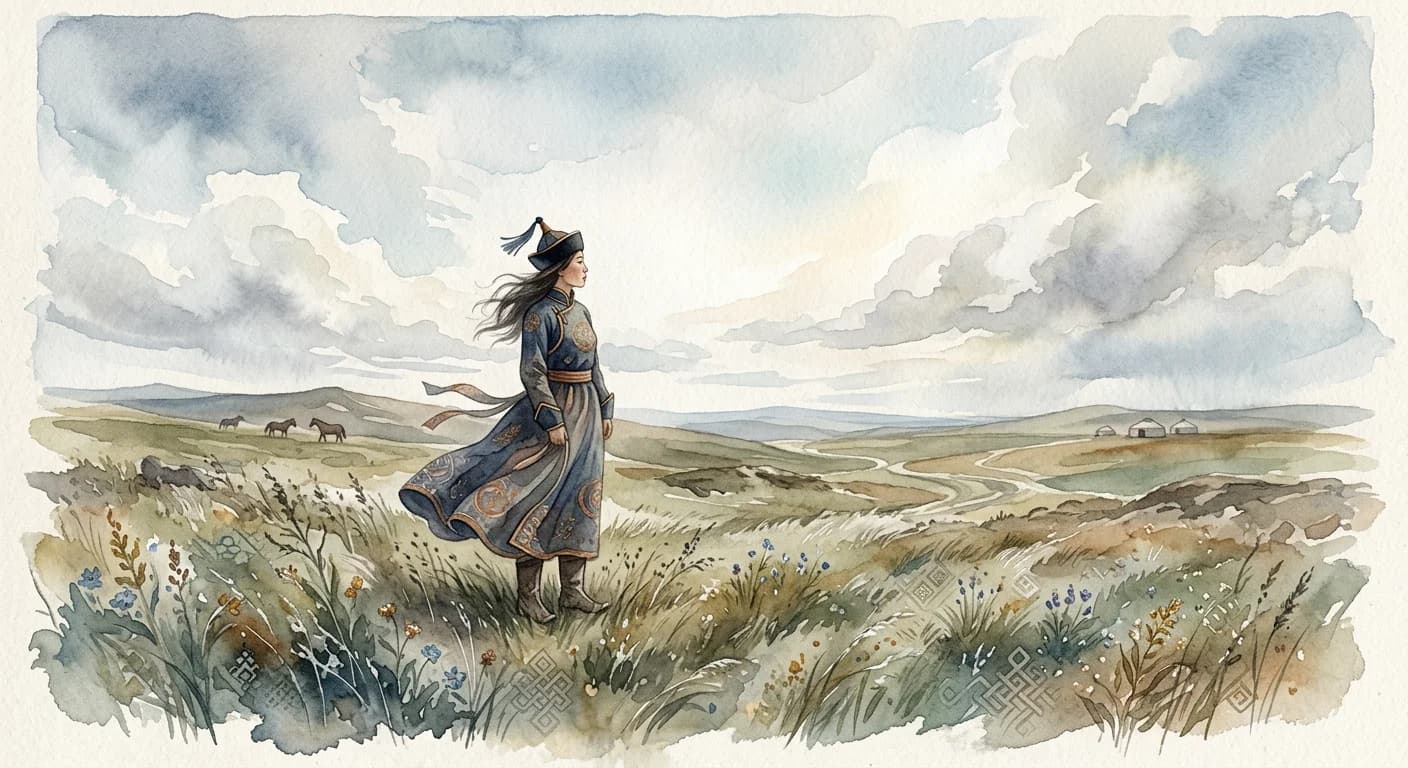
Хувь (Khuv')
/HOOV'/
Meaning
Khuv' embodies one's intrinsic share or predetermined portion in life, encompassing not only material wealth but also one's circumstances, luck, and even spiritual standing. It reflects an inherent destiny, a unique lot allocated to each individual by forces beyond their complete control. This concept permeates the Mongolian worldview, fostering an acceptance of life's ebb and flow, and a deeply rooted understanding of one's place within the vast, interconnected tapestry of existence. It signifies the balance of fortune and misfortune as an integral part of one's personal journey.
Literal Translation
Share, portion, lot, destiny
The Story Behind the Word
The concept of Khuv' is deeply rooted in Mongolia's nomadic heritage and its Buddhist spiritual traditions. For centuries, life on the vast steppes was inherently unpredictable, subject to harsh weather, livestock fortunes, and the whims of nature. This environment fostered a worldview where accepting one's 'lot' was not fatalistic surrender, but a pragmatic recognition of forces greater than individual will. Buddhism further reinforced this with the concept of karma and reincarnation, suggesting one's Khuv' in this life is a consequence of past actions. This word reveals a culture that values resilience, adaptability, and a profound respect for the natural order, where individuals understand their place within a larger cosmic and societal framework, balancing personal effort with recognition of destiny. It's a cornerstone of how Mongolians interpret success, hardship, and individual identity.
Experience It
Accepting Life's Path
After losing his herd to a harsh winter, Batbayar sighed, 'This is my Khuv'.' He didn't despair, but began planning how to rebuild, understanding that such misfortunes were part of his allotted journey, a challenge to be met with fortitude rather than bitterness.
A Fortunate Share
When nominating his daughter for a scholarship, Enkhjargal proudly declared, 'She has a good Khuv'.' He was acknowledging not just her intelligence and hard work, but also the favorable circumstances, opportunities, and inherent good fortune that seemed to bless her path.
The Deeper Meaning
Khuv' offers a profound philosophical insight into the Mongolian understanding of existence, blending elements of predestination with individual agency. It suggests that while external forces shape much of one's life, there is also an inherent 'portion' for each person. This fosters a stoic acceptance of unavoidable hardship, yet simultaneously encourages making the most of one's 'good Khuv'.' It reveals a worldview that finds peace in recognizing limitations while striving within them, emphasizing harmony with natural and cosmic forces rather than absolute control.
Did You Know?
The phrase 'Khuv' zaya' (хүвь заяа) is often used, intensifying the meaning to 'destiny' or 'fate,' highlighting the powerful, unchangeable aspect of one's allotted life path.
How It's Used
Used to discuss one's share in something, one's fate, or one's lot in life. It can be used in both positive and negative contexts. For example, 'This is my khuv' (meaning 'this is my share/destiny').