U.
HomeRegionsLanguagesEmotionsCollections
Find Your Word

“The limits of my language mean the limits of my world.”

— Ludwig Wittgenstein, Philosopher

Untranslatable

A curated collection of the world's most beautiful expressions—words that remind us language is humanity's greatest invention.

  • Home
  • Collections
  • Regions
  • Countries
  • Emotions
  • Tags
  • Contexts
  • Finder
  • Europe
  • Asia
  • Americas
  • Africa
  • Middle East
  • About
  • Contact
  • Privacy Policy
  • Terms of Service

2026 © Untranslatable. All rights reserved.

    /
    /
    1. Home
    2. /
    3. Asia
    4. /
    5. Sansara
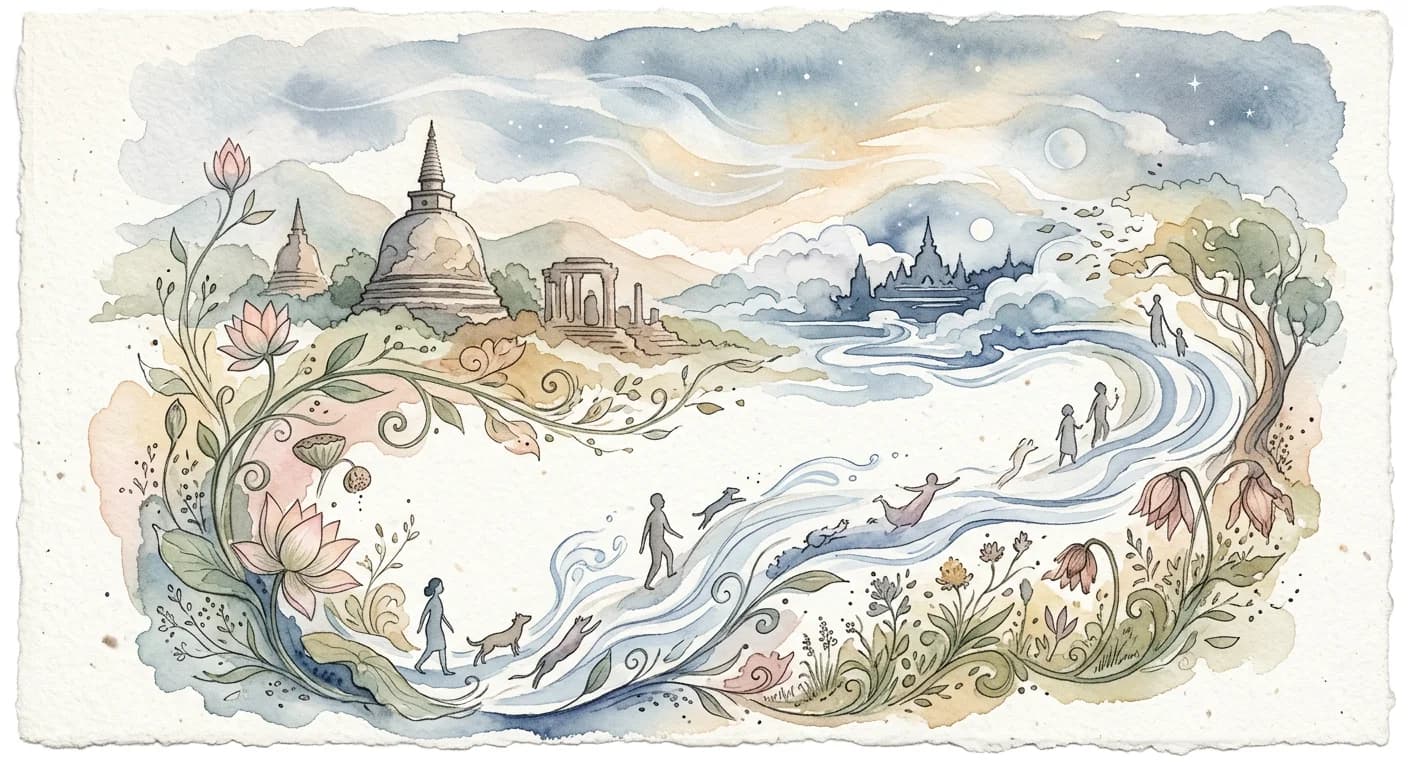
    Artistic representation of Sansara
    Sinhala•
    🇱🇰Sri Lanka

    Sansara

    /SAHN-sah-rah/

    Meaning

    Sansara, derived from the Sanskrit for 'wandering' or 'roaming,' encapsulates the profound Buddhist and Hindu concept of the continuous cycle of birth, death, and rebirth. It's not merely reincarnation, but an intricate, often wearisome journey through various forms of existence, driven by karma, craving, and ignorance. This ceaseless flux profoundly shapes the understanding of life's impermanence and the interconnectedness of all beings across cosmic time. The ultimate spiritual aspiration within these traditions is to transcend this cycle and achieve liberation.

    Literal Translation

    Wandering, roaming (Sanskrit)

    The Story Behind the Word

    The concept of Sansara is foundational to the cultural and spiritual landscape of Sri Lanka, deeply embedded in its predominantly Buddhist ethos. It provides a comprehensive framework for understanding existence, morality, and destiny, influencing everything from daily ethical conduct to grand philosophical inquiries. The belief that one's actions (karma) in this life determine their future rebirths fosters a strong sense of personal responsibility and compassion. This cyclical worldview contrasts sharply with linear Abrahamic traditions, offering a unique perspective on suffering, hope, and the ultimate purpose of life, which is to break free from this endless 'wandering' through spiritual purification and insight.

    Experience It

    A Monk's Reflection

    During a meditation retreat, a young monk pondered the fleeting nature of his current existence. He realized that this life, like countless others before and after, was just another turn on the wheel of Sansara, urging him to deepen his practice towards liberation.

    Grandmother's Wisdom

    Comforting her grieving granddaughter, an elderly Sri Lankan woman explained, 'Do not despair, little one. Your beloved pet has simply moved on in Sansara, perhaps to a happier realm. May its journey be peaceful, and ours continue with kindness.'

    The Deeper Meaning

    Sansara reveals a worldview centered on impermanence (anicca) and suffering (dukkha), where existence itself is seen as a continuous process of becoming and decaying. It underscores the profound interconnectedness of actions and consequences (karma) across lifetimes, advocating for ethical living not just for this life, but for the countless ones to come. This perspective emphasizes liberation from all forms of attachment as the ultimate path to true peace and understanding.

    Did You Know?

    While often associated with Buddhism and Hinduism, the concept of Sansara, or cyclical existence, predates both religions, with roots in ancient Indian philosophical traditions.

    How It's Used

    This term is used in philosophical and religious discussions, particularly within Buddhist and Hindu traditions, to describe the continuous cycle of life, death, and rebirth.

    Emotions
    hope,melancholy,serenity,wonder
    Contexts
    meditation,philosophy,religion,solitude
    🇱🇰Sri Lanka

    by Anya Petrova·Written Mar 10, 2026·Updated Apr 3, 2026

    Related Words

    Explore more
    SaudadePortuguese

    Saudade encapsulates a profound, melancholic longing for something or someone cherished that is absent, often with the bittersweet knowledge that it may never return. It's a deep emotional state tinged with nostalgia, evoking a sense of loss for past experiences, places, or people, yet also holding a tender appreciation for the beauty of what once was. This yearning is not merely sadness, but a complex tapestry of desire, memory, and a poignant acceptance of absence, holding the beloved in a warm, persistent embrace within the heart.

    Wabi-sabiJapanese

    Wabi-sabi is the profound appreciation for the ephemeral, the imperfect, and the incomplete aspects of existence. It is about discovering beauty in the subtle textures of age, the unique character of flaws, and the gentle decay that marks the passage of time. This philosophy encourages a quiet acceptance of impermanence and a mindful connection to the natural world, finding elegance in simplicity and authenticity.

    IkigaiJapanese

    Ikigai is more than just a reason to get out of bed; it's a deeply personal and evolving sense of purpose that brings genuine fulfillment and joy to one's life. It represents the sweet spot where your passions, talents, needs of the world, and what you can be paid for beautifully converge. Discovering your ikigai often leads to a life lived with intentionality, resilience, and a profound connection to one's contributions. It's the intrinsic motivation that fuels a meaningful existence, regardless of external circumstances.

    NunchiKorean

    Nunchi is the sophisticated, almost telepathic, ability to instantly grasp the unspoken dynamics of any social situation, anticipating others' thoughts and feelings, and then responding with impeccable grace and timing. It's an acute form of social intuition, allowing one to navigate complex interpersonal landscapes by reading subtle cues like body language, tone, and context. Possessing good nunchi means effortlessly understanding the underlying emotional currents and adjusting one's behavior to maintain harmony and effectiveness, often without a single word exchanged.

    Featured in 2 collections

    🎌Japanese Philosophy✨Fate & Serendipity