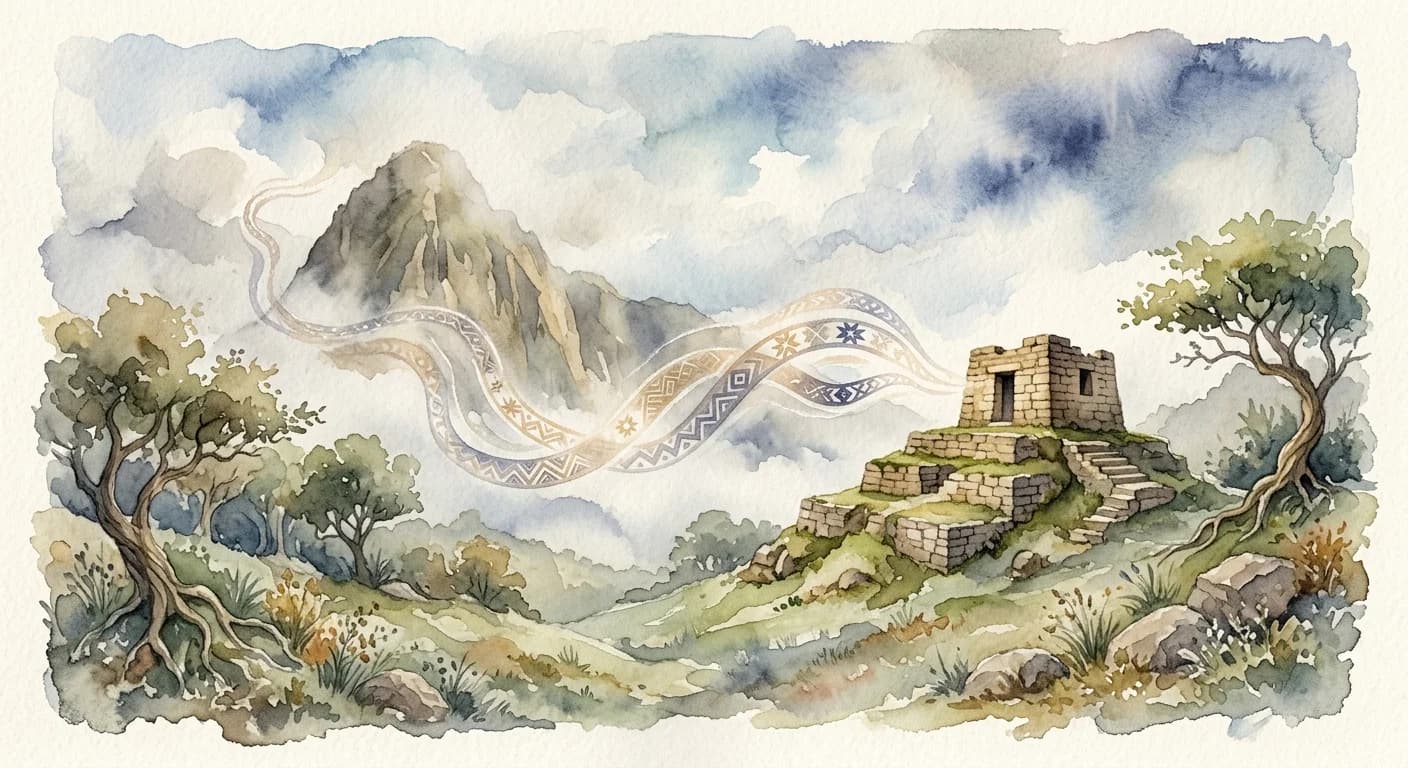
Qhipa
/KEE-pah/
Meaning
Qhipa transcends the simple notion of 'back' or 'rear' to embody the profound concept of the past, ancestral legacy, and the very foundations upon which the present stands. It's not merely a temporal marker but a spiritual repository of collective memory, wisdom, and the enduring influence of those who came before. This word articulates a deep connection to heritage, signifying that the past is not gone but actively shapes and informs current realities, particularly within cultures steeped in oral traditions and profound reverence for ancestors.
Literal Translation
back, rear, past
The Story Behind the Word
The existence of 'qhipa' in Quechua reveals a fundamental difference in how time and lineage are perceived in Andean cultures compared to many Western perspectives. For the Quechua, the past ('qhipa') is not something left behind, but rather something that literally lies *ahead* of you, guiding your path, while the future ('ñawpaq' - front) is unseen, behind you. This inversion signifies that one walks backward into the future, constantly facing and drawing wisdom from the ancestral past. This worldview fosters a deep sense of responsibility to uphold traditions, honor ancestors, and ensure the continuity of the community's collective memory, viewing history as a living, guiding force rather than a static record.
Experience It
Honoring the Ancestors
During the Inti Raymi ceremony, an elder speaks, saying, 'We stand here today because of our qhipa, the strength and wisdom of our ancestors.' He gestures to the ancient ruins, emphasizing the unbroken chain of heritage that connects them to their cosmic origins and guiding principles.
A Child's Legacy
A mother gently tells her child, 'Always remember your qhipa, the stories of your grandparents and their grandparents. Their spirit and courage flow through you, guiding your steps.' She points to a family heirloom, a symbol of the enduring connection across generations.
The Deeper Meaning
Qhipa encapsulates an Andean philosophical principle where time is cyclical and relational, not linear. It emphasizes that the past is not merely historical but an active, living force that permeates the present and informs the future. This worldview fosters a profound respect for tradition, ancestral knowledge, and the understanding that individual and collective identity is inextricably linked to the continuous unfolding of heritage.
Did You Know?
In Andean cosmology, the 'qhipa' (past) is often conceptualized as being 'in front' of a person, while the 'ñawpaq' (future) is 'behind.' This portrays time as a path where one walks backward, facing and learning from the past as they move into the unknown future.
How It's Used
Used in Quechua-speaking communities to refer to the past, ancestry, or something that comes after or behind, often in a context that implies a connection to heritage or tradition.