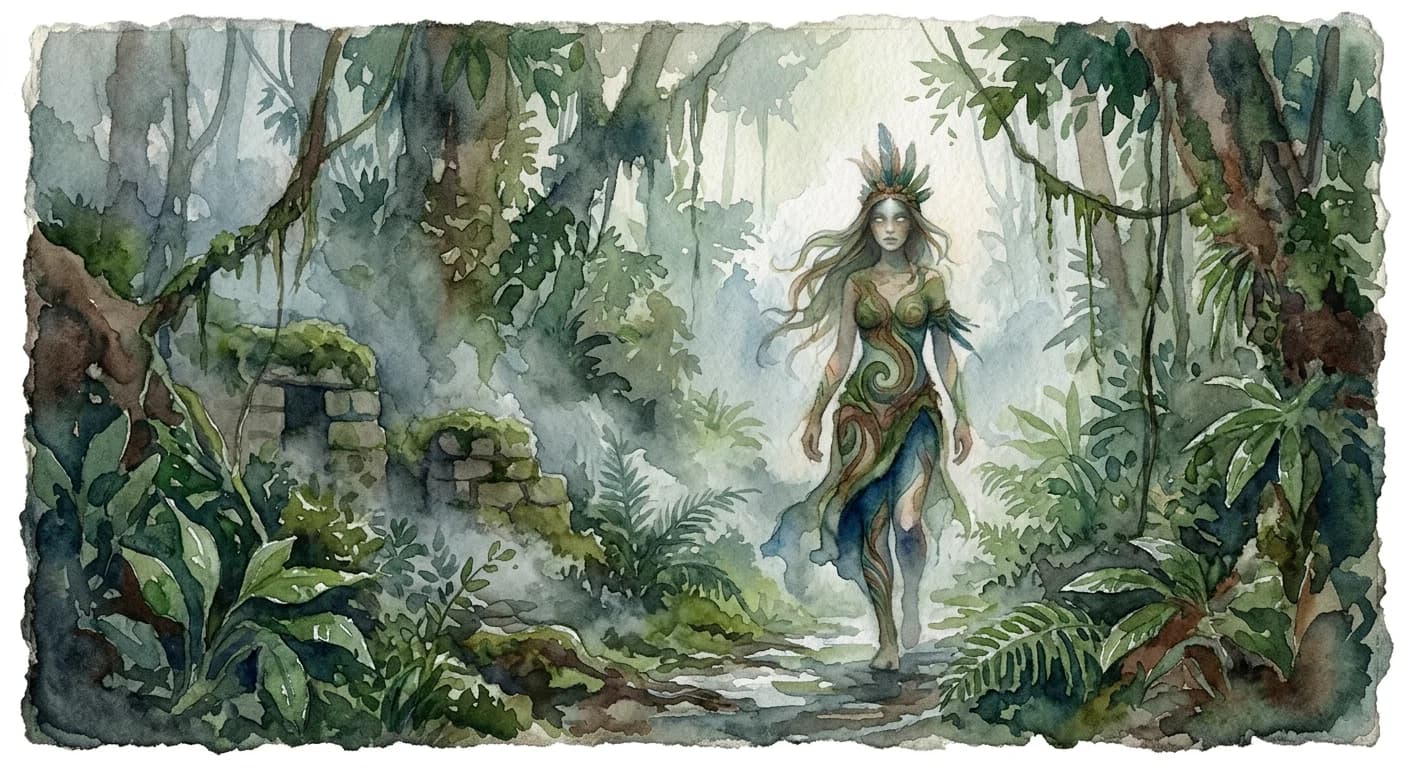
Ch'unchu
/CHUN-choo/
Meaning
Ch'unchu evokes the enigmatic forest dweller or spirit from Andean cosmology, a wild, untamed being intrinsically linked to the Amazon rainforest. Often revered as a fierce guardian of the jungle's profound mysteries and ancient powers, the Ch'unchu embodies the raw, uncontrollable essence of nature that lies just beyond human civilization. This concept reflects a deep cultural awe and respectful fear towards the vast, verdant territories that buttress the Andean highlands, acknowledging the jungle's potent secrets and untamed vitality.
Literal Translation
The exact literal meaning beyond 'forest dweller' or 'wild man' is debated, but it strongly implies a connection to the jungle and a non-human or semi-divine status.
The Story Behind the Word
The concept of the Ch'unchu is deeply rooted in the historical interaction between Andean highland cultures and the vast, often impenetrable Amazonian lowlands. For centuries, the jungle represented both a source of exotic resources and an unknown, sometimes dangerous frontier. The Ch'unchu emerged as a mythological personification of this wildness, a way for Andean peoples to conceptualize and relate to a world fundamentally different from their ordered agricultural societies. It highlights a worldview where nature is not merely a resource but an active, conscious entity with its own spirits and guardians. The Ch'unchu's existence underscores the Andean recognition of ecological interconnectedness and the profound respect, tinged with apprehension, for the powerful forces of the natural world, particularly the untamed jungle. This word reveals a cultural understanding that certain aspects of nature are beyond human domination, demanding reverence and careful interaction rather than conquest.
Experience It
The Festival Dance
During the annual Paucartambo festival, a dancer, adorned with a feathered headdress and painted face, leaps with primal energy. He embodies the Ch'unchu, swaying to the rhythmic drums, reminding everyone of the jungle's wild spirit that still resonates at the edges of their mountain world.
Whispers of the Forest
A Quechua elder recounts tales by the fire, warning young children not to stray too deep into the cloud forest. 'The Ch'unchu watches,' he murmurs, 'he knows the paths only the ancient trees remember, and he guards the forest's heart from those who disrespect it.'
The Deeper Meaning
Ch'unchu encapsulates a profound Andean philosophical stance regarding humanity's place within the natural order. It signifies that there exist realms of being and power that are inherently wild, autonomous, and beyond human dominion. This concept challenges anthropocentric views, advocating for a respectful co-existence with, rather than control over, the powerful, mysterious forces of the natural world, particularly the untamed wilderness of the jungle.
Did You Know?
In some Andean festivals, the Ch'unchu dancers are seen as representing the 'wild' people of the Amazon, who historically traded with and sometimes clashed with highland communities, blending myth with historical encounters.
How It's Used
The term 'Ch'unchu' is used in storytelling, mythology, and traditional festivals, particularly in regions bordering the Amazon. It often appears in dances and rituals that reenact encounters with these forest spirits.