Ollin
/OH-leen/
Meaning
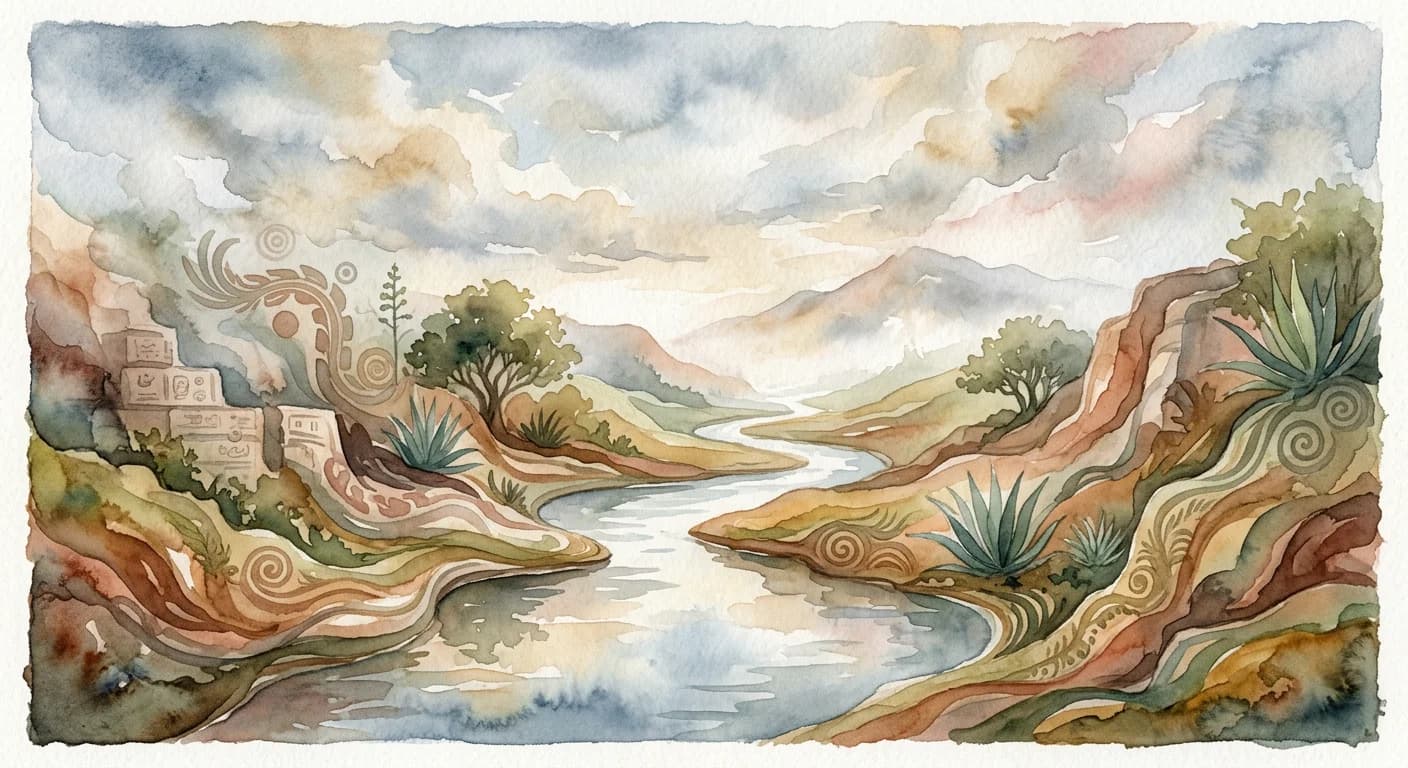
Ollin is the pulsating heart of the Nahuatl cosmos, embodying the ceaseless dance of creation and destruction, life and death, motion and transformation. It's not just physical movement, but the very essence of dynamic change that animates the universe, from the turning of celestial spheres to the growth of a seed and the spiritual journey of the soul. This profound concept illuminates the interconnectedness of all existence, where every ending seeds a new beginning, inviting a deep awareness of reality's constant, vibrant flux.
Literal Translation
movement, earthquake, motion
The Story Behind the Word
The concept of Ollin is absolutely central to the Nahuatl worldview, particularly for the Mexica (Aztec) people. It reflects a cosmos that is inherently unstable and dynamic, not static. This instability was not a flaw but the very engine of existence, driving the cycles of creation and destruction, particularly the succession of "Suns" or cosmic ages. The famous Aztec calendar stone, with its central face representing the current Fifth Sun, is ringed by glyphs for Ollin (often depicted as four arms radiating from a central eye), symbolizing the continuous, transformative movement of the cosmos and the earth-shaking events that mark its transitions. This belief system fostered a culture deeply attuned to natural cycles, celestial observations, and the necessity of ritual (like human sacrifice) to maintain the delicate balance and energy flow (tonalli) within this dynamic universe. Ollin reveals a people who saw life as a constant state of becoming, where even destruction was a necessary part of a larger, ongoing cosmic rhythm.
Experience It
Observing the Cosmos
A priest-astronomer gazes at the night sky, tracking the planets. He sees not just dots of light, but the visible manifestation of Ollin, the grand cosmic dance dictating seasons, eclipses, and the very fate of the world below.
Facing the Earthquake
As the earth trembles violently, a farmer feels the deep rumble. He understands this not merely as a destructive force, but as the raw power of Ollin, a reminder of the planet's living, shifting nature, and the impermanence of all things.
The Deeper Meaning
Ollin underpins a worldview that embraces impermanence and cyclicality as fundamental truths, rather than anomalies. It posits that creation and destruction are two sides of the same coin, constantly interweaving to fuel existence. This perspective encourages adaptability, respect for natural forces, and an understanding that personal and cosmic destinies are inextricably linked through continuous transformation.
Did You Know?
The glyph for Ollin often depicts four points (representing the four cardinal directions or previous cosmic eras) radiating from a central eye or mouth, symbolizing concentrated, transformative energy.
How It's Used
Ollin is often used in philosophical, spiritual, and cosmological contexts within Nahuatl culture. It can refer to the movement of celestial bodies, the changing seasons, or the internal spiritual journey of an individual. It is a core concept in understanding the Aztec worldview, particularly in relation to time and destiny.